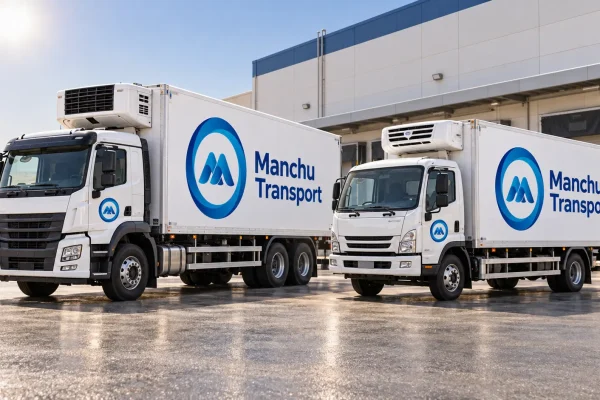
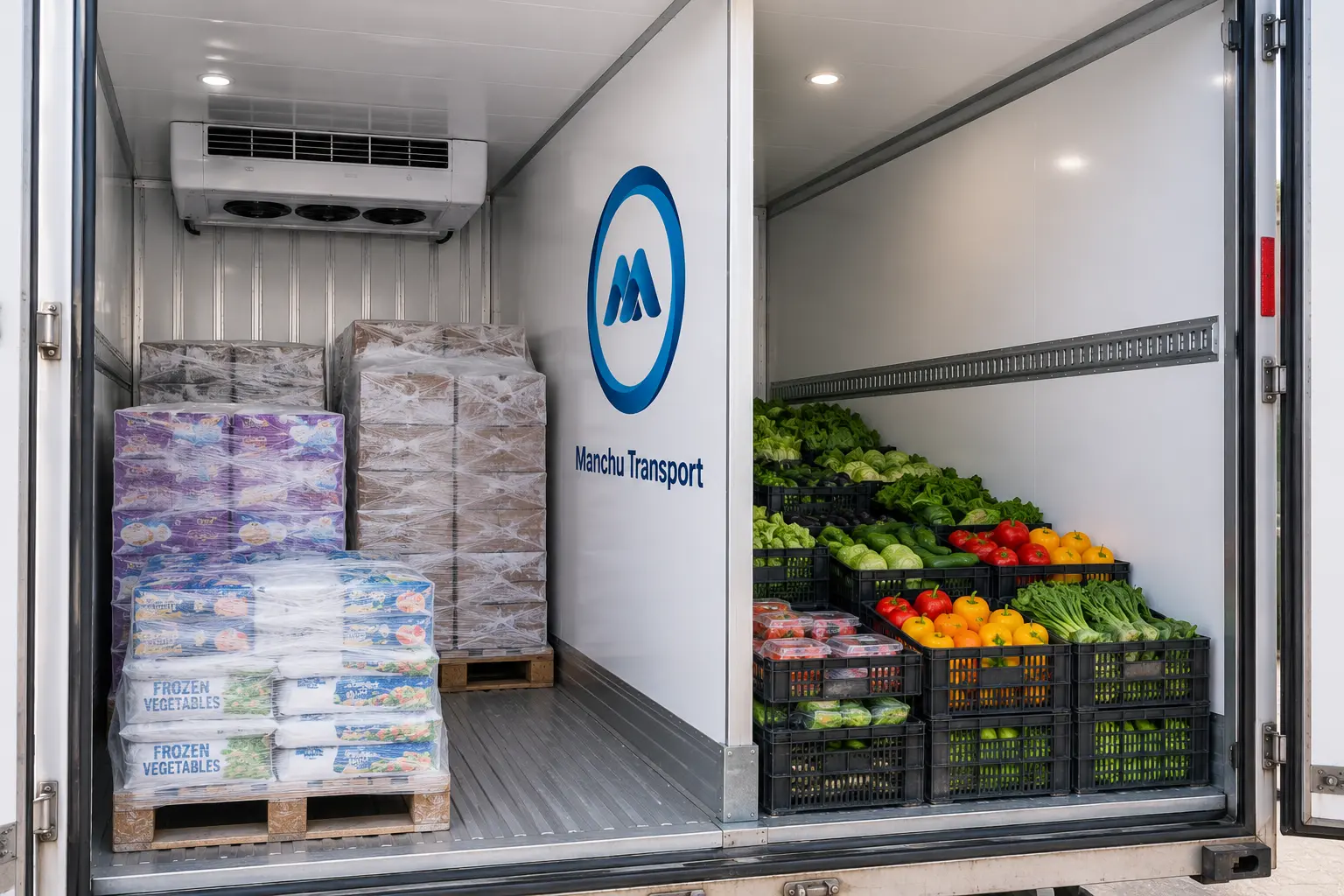
If your business regularly sends two vehicles on the same route — one chiller truck for dairy and produce, one freezer truck for meat and seafood — you are paying for a problem that a single vehicle can solve. A multi-temperature refrigerated truck uses an insulated internal partition and independent cooling zones to carry chilled cargo at +2°C to +8°C in one compartment and frozen cargo at -18°C or below in another, on the same chassis, in the same trip.
This is not the same conversation as choosing between a 3-ton and a 7-ton truck, and it is not about chiller-versus-freezer terminology. It is a distinct vehicle configuration, and it solves a specific operational problem: running two drivers, two fuel bills, and two sets of tolls to deliver what could realistically move on one truck.
How Dual-Zone Trucks Actually Work
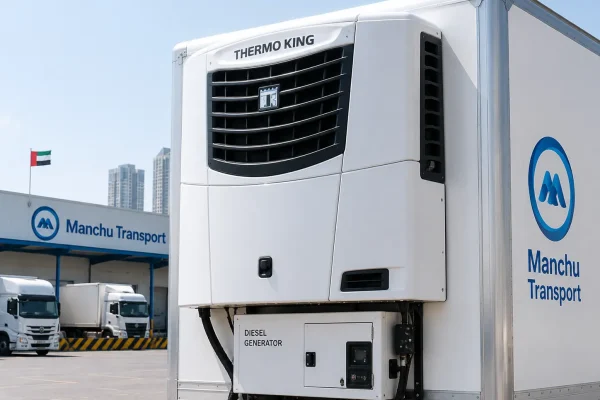
A multi-temperature truck is a genuinely engineered vehicle, not a standard box with a wall bolted inside. The refrigeration architecture typically pairs a primary host unit — mounted externally at the front of the box, housing the main compressor — with one or more remote evaporators: slimline, ceiling-mounted cooling units fed by refrigerant lines running back to the host unit. The primary evaporator handles the forward compartment, usually set up for deep-frozen cargo. The remote evaporator independently cools the rear compartment to a separate, warmer set point. Each zone runs its own thermostat and can be adjusted without affecting the other.
Movable vs fixed bulkheads
The wall dividing the two zones — the bulkhead — comes in two forms. A fixed bulkhead is permanently mounted and gives you a set ratio of frozen-to-chilled space, whatever that ratio happens to be. A movable bulkhead runs on a ceiling track and can be repositioned to match the day’s actual cargo mix — more frozen space on a day heavy with seafood, more chilled space on a day heavy with dairy and produce. For a rental fleet serving varied routes, movable bulkheads are the more practical option, but they only work if the seal against the walls, floor, and ceiling stays airtight. A gap at the bulkhead edge lets warm air leak between zones, and the frozen side ends up fighting a losing battle against heat coming through the “wall” that is supposed to isolate it.
Why door placement matters
A well-designed multi-temp truck avoids opening the rear doors to reach a forward compartment. If your frozen cargo sits at the front and the only access is through the rear chilled zone, every delivery stop floods the chilled compartment with hot ambient air on the way to the frozen goods. Vehicles built for this configuration properly use dedicated side-access doors for the forward zone so drivers can service frozen cargo without disturbing the chilled zone’s temperature at every stop — a detail worth asking about before you book, not after your first multi-stop route.
Real UAE Use Cases
This configuration earns its rental premium on routes that genuinely mix cargo temperatures, not on every route.
- Supermarket and FMCG distribution — a distributor delivering frozen poultry and fresh dairy to the same retail loading dock consolidates two deliveries into one, which also reduces dock scheduling conflicts at busy receiving points.
- Event catering and HORECA — mixed menus with raw frozen proteins and ready-to-eat chilled items can travel on one vehicle, provided the physical separation between the two is genuine and not just two thermostats in an open box.
- Pharmaceutical and medical logistics — moving standard +2°C to +8°C medicines alongside deep-frozen biologics or plasma products to the same facility in one GDP-compliant trip.
If your route only ever carries one temperature class, a multi-temp truck is the wrong tool — see our guide to 3-ton vs 7-ton vs 10-ton chiller trucks for standard single-temperature sizing instead.
The Cost Case: One Truck vs Two
The honest version of this argument matters more than the sales version. Running two single-temperature vehicles on the same route means two driver salaries, two visa sponsorships, two fuel bills, and two sets of Salik or Darb toll charges — on top of two separate rental agreements. A multi-temperature truck carries a rental premium over a single-temperature equivalent of roughly 10% to 20%, reflecting the additional bulkhead hardware and remote evaporator. Even at that premium, consolidating onto one 7-ton or 10-ton multi-temp vehicle typically costs meaningfully less than running two separate 3-ton trucks with two drivers, because the duplicated driver and overhead costs are the larger line item, not the vehicle rental rate itself.
The trade-offs are real and worth planning around rather than glossing over. A multi-temp configuration reduces total usable cargo volume compared to a single-temperature truck of the same tonnage, because the bulkhead and second evaporator take up space that would otherwise be cargo. And an extreme load imbalance — say, 90% frozen and 10% chilled on a given day — can make the fixed or movable partition inefficient regardless of which type you have. This is a consolidation tool for routes with a genuine, recurring mix of chilled and frozen cargo, not a default upgrade.
Compliance: Mixed-Temperature Loads Under UAE Food Safety Rules
Carrying chilled and frozen cargo in the same vehicle is fully compliant under both Dubai Municipality and ADAFSA rules, provided the separation is structurally real. Our own reference table on food holding temperatures already notes this directly: mixed-temperature loads require a genuine physical thermal partition, not an open compartment with two thermostats — see the comparison table in our food holding temperatures guide for the full Dubai-versus-Abu-Dhabi breakdown. Because the two zones are legally and thermally distinct, a properly documented multi-temp truck needs independent, continuous temperature logging for each zone — one log proving the frozen side held -18°C, a separate log proving the chilled side held its own required range — rather than a single reading that only tells an inspector about one compartment. For Abu Dhabi and Al Ain routes, this sits alongside the same ADAFSA Mobile Food Establishment Permit and ASATEEL GPS registration requirements that apply to any commercial food vehicle.
What to Ask Before You Rent a Multi-Temp Truck
Not every vehicle marketed as “dual zone” is built to the same standard. Before booking, ask the provider:
- Is the bulkhead movable or fixed? A fixed ratio that does not match your typical cargo split will cost you usable space every single trip.
- Does the frozen zone have side access? If not, every stop on a multi-drop route exposes the chilled zone to ambient heat through the rear doors.
- Are there independent data loggers in each zone? One thermostat reading for a two-zone truck is not sufficient documentation if either zone is challenged at delivery.
- What is the cleaning protocol between rentals? Cross-contamination risk at the bulkhead seam is a real question worth asking, not a formality.
- Does the remote evaporator housing reduce usable pallet height in the zone it serves? It sometimes does, and it affects how you plan your load.
Which Vehicle Class Actually Makes Sense
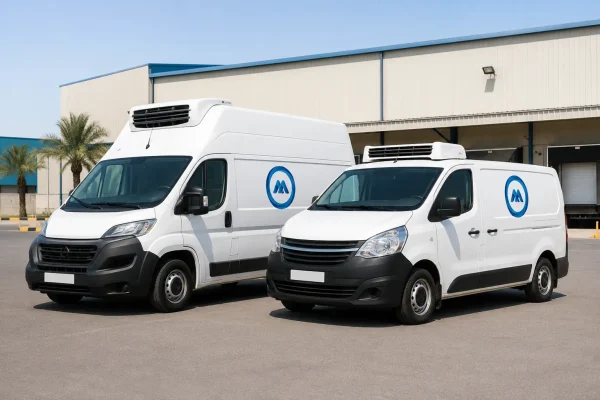
True dual-zone configurations are rare in 1-ton or 1.5-ton vans — there simply is not enough internal volume to fit a bulkhead, a second evaporator, and a commercially useful payload in each zone. The practical range starts around 3-ton for lighter urban routes, but 7-ton and 10-ton trucks are where multi-temp configurations are most common in the UAE market, because the larger chassis has enough volume to absorb the space the partition and hardware take up while still carrying a meaningful load in both zones. See our full breakdown of 3-ton, 7-ton, and 10-ton chiller trucks for the payload and pallet-count context behind each size class.
Consolidate Your Mixed-Temperature Routes
Manchu Transport’s 7-ton and 10-ton fleet is available with dual-zone multi-temperature configuration for routes across Dubai, Abu Dhabi, and Al Ain, on daily, weekly, or monthly terms, with or without a certified driver. If you are currently running two vehicles to serve one delivery route, request a quote with your typical chilled-to-frozen cargo ratio and stop count, and we will tell you honestly whether consolidating onto one truck actually saves you money on your specific route. Explore our chiller truck rental Dubai, chiller truck rental Abu Dhabi, and chiller truck rental Al Ain pages for current fleet availability.
Frequently Asked Questions
What is a multi-temperature refrigerated truck?
A single commercial vehicle divided into separate compartments by an insulated bulkhead, with independent refrigeration zones — typically a primary unit for a deep-frozen compartment and a remote evaporator for a separately controlled chilled compartment.
Is it legal to transport chilled and frozen food in the same truck in the UAE?
Yes, provided the vehicle has a genuine physical thermal partition and independently controlled, documented temperature zones. An open compartment with two thermostats and no real separation does not meet this standard.
How much more does a multi-temp truck cost to rent than a standard chiller truck?
Typically around 10% to 20% more than a single-temperature equivalent, reflecting the bulkhead and additional evaporator hardware. Whether that premium saves you money depends on whether it lets you retire a second vehicle and driver entirely.
Do multi-temp trucks need separate temperature logs for each zone?
Yes. Because the two compartments are thermally and legally distinct, compliant documentation requires an independent data log for each zone rather than a single reading for the whole vehicle.
What size truck is best for a dual-zone configuration?
7-ton and 10-ton trucks are the most common and practical choice in the UAE market. Smaller vans and light trucks generally lack the internal volume to fit a bulkhead and second evaporator without sacrificing too much usable cargo space.
Is a multi-temp truck the right choice for every mixed-cargo route?
No. It makes sense for routes with a genuine, recurring split between chilled and frozen cargo. If your load is overwhelmingly one temperature class with only occasional mixed cargo, a single-temperature truck plus an occasional second vehicle may still be cheaper.
Vehicle configurations and specifications vary by provider and by unit. Confirm bulkhead type, zone access, and data-logging setup directly with your rental provider before booking a route-critical delivery.
Need Reliable Refrigerated Transport?
Get a free quote for chiller van, truck, or trailer rental in Dubai and across the UAE.
Get a Free QuoteRecommended Services
Our Refrigerated Transport Services
Choose the vehicle that matches your route, payload, and temperature requirements.
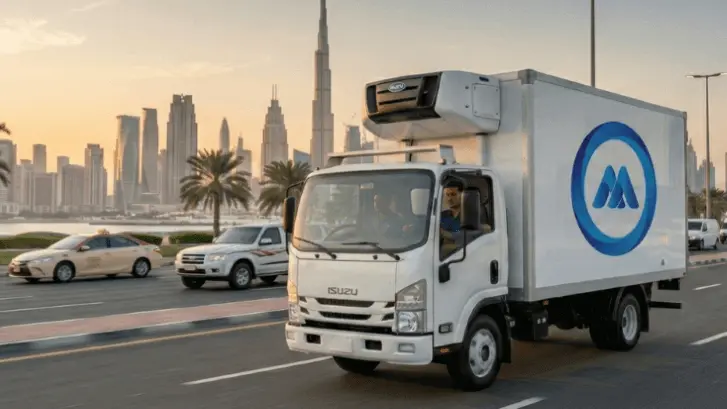 Dubai
Dubai
Chiller Truck Rental Dubai
3-Ton to 10-Ton refrigerated trucks for supermarket, pharma, and wholesale distribution.
View Service
Abu Dhabi
Chiller Truck Rental Abu Dhabi
ADAFSA and ASATEEL-compliant truck rentals for Mussafah, KIZAD, Khalifa City, and Al Ain.
View Service Last-Mile
Chiller Van Rental Dubai
1-Ton and 1.5-Ton chiller vans for last-mile cold chain, catering, and pharmacy routes.
View Service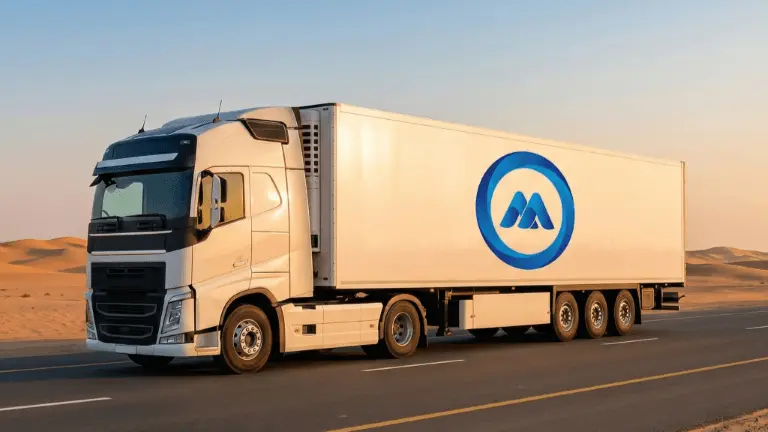 Cross-Border
Chiller Trailer Rental Dubai
20-Ton and 25-Ton reefer trailers for port clearances, warehouse transfers, and GCC routes.
View Service