If you searched for “Dubai Food Code 2026,” here is the direct answer: there is no separate 2026 edition. The regulation currently in force is the Dubai Food Code 2.0, issued by Dubai Municipality’s Food Safety Department, and it remains the active legal baseline for every food business and food transport operator in the emirate this year. What has changed is not a new numbered edition so much as how aggressively the existing Code is enforced — through the FoodWatch digital platform, DMChecked inspection reports, and tighter integration between food safety regulators and transport authorities than existed a few years ago.
This guide is written for F&B operations managers, procurement officers, and fleet coordinators — not kitchen designers. If you need chopping-board colour codes or dishwasher sink specifications, this is not that guide. If you need to know exactly what the Food Code requires from the vehicle carrying your stock, and who is legally responsible when that vehicle fails an inspection, keep reading.
The Food Code, the DM Permit, and FoodWatch Are Three Different Things
A lot of confusion in this space comes from treating “Dubai Food Code,” “DM Card,” and “FoodWatch” as interchangeable terms. They are not — they are three connected but distinct pieces of the same compliance stack, and understanding the difference matters if you are hiring transport rather than operating your own fleet.
- The Food Code is the legislative rulebook. It sets the actual standards: how food must be stored, transported, and handled, what temperatures are legally required, and what construction standards a food-contact vehicle must meet.
- The DM Food Transport Vehicle Permit is the physical credential. It is the annual certification proving that a specific vehicle — not a company in general — has been inspected and meets the Food Code’s engineering and hygiene standards. We cover the full application process in our guide to the Dubai Municipality Food Transport Vehicle Permit.
- FoodWatch is the digital enforcement layer. It is the platform where a Person in Charge (PIC) verifies supplier and vehicle permit status, logs temperature data, and creates the audit trail inspectors pull during a review. See our full FoodWatch registration guide for the registration steps.
In practice: the Food Code tells you what “compliant” means, the DM Permit is your proof that a given vehicle meets that bar, and FoodWatch is where you demonstrate — continuously, not just once a year — that you are still meeting it.
What the Food Code Actually Requires From a Transport Vehicle
The provisions that matter most to a refrigerated transport operator sit in the sections of the Code governing storage, transportation, and distribution. Stripped of the language written for restaurant kitchens, the operational requirements for a chiller van or truck come down to four areas.
Cargo hold construction
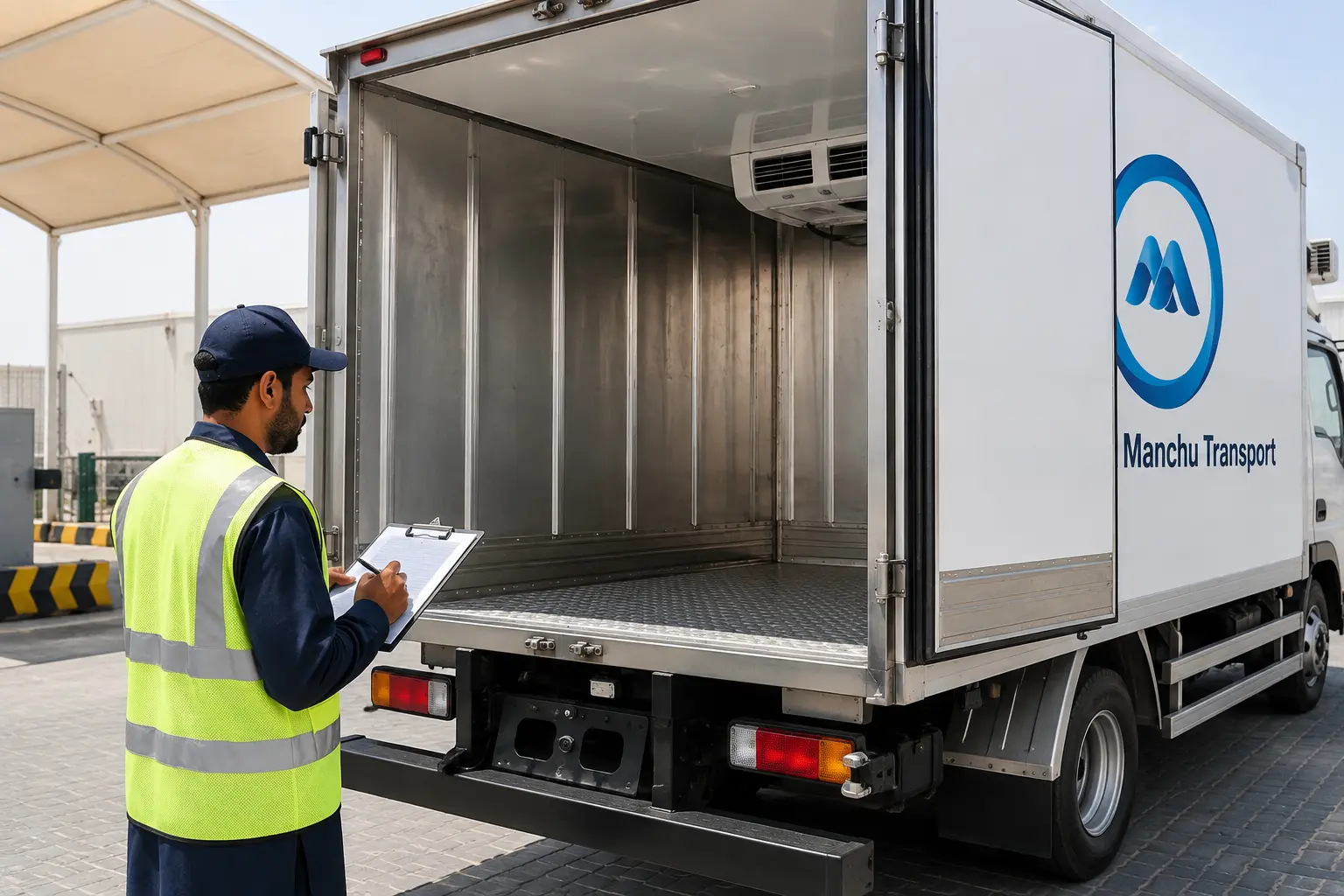
Surfaces that contact food must be non-toxic, smooth, and easily cleanable — stainless steel and food-grade plastic are the standard. Damaged flooring, cracked interior panels, rust, or exposed insulation are treated as a direct violation, because these defects create places for bacteria to establish and persist. A vehicle in this condition will not pass a DM inspection regardless of what its refrigeration unit reads.
Airflow and loading discipline
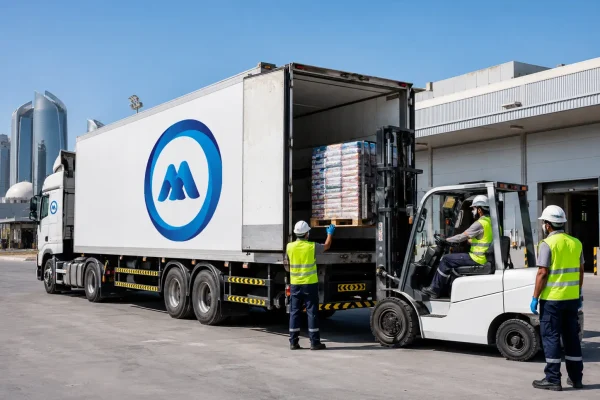
Cargo must be stored off the floor and away from the walls to allow air to circulate. Pallets or boxes stacked directly against the interior walls block airflow, which creates localised hot spots even when the unit’s own thermostat shows a compliant reading. This is one of the most common ways a vehicle “fails” a spot check without the driver realising anything was wrong.
No mixing food and non-food cargo
A vehicle registered as a food transport vehicle is restricted to food cargo. In the rare cases where a delivery vehicle legitimately carries both food and non-food items, the food must sit in a fully sealed, separately identified compartment. This is also the underlying principle behind why a mixed chilled-and-frozen load needs a genuine physical thermal partition rather than an open compartment with two thermostats — a distinction we cover in more depth in our guide to multi-temperature refrigerated trucks.
Sanitisation between loads
When ready-to-eat food is transported, the Code’s standard is that the cargo unit is cleaned and disinfected after every single use with an approved, food-safe sanitising agent — not on a weekly schedule, and not “when it looks dirty.”
Continuous Temperature Control
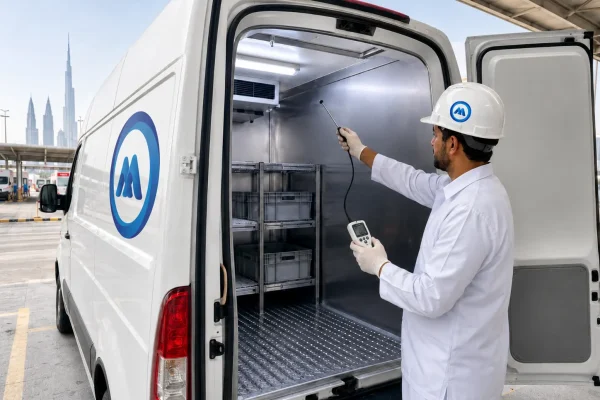
Temperature is where inspection findings get expensive fastest, and it deserves its own detailed reference — we cover the exact holding bands, the Danger Zone rules, and the 2-hour/4-hour tolerance windows in full in our guide to hot and cold food holding temperatures under Dubai Municipality and ADAFSA rules. The point worth emphasising here is the inspection method: Dubai Municipality inspectors do not simply read the vehicle’s ambient thermostat. They use a calibrated probe to check the core temperature of the product itself at the point of delivery. A chilled product reading above the Code’s ceiling on the probe is treated as a Danger Zone breach regardless of what the dashboard display says the cargo bay air temperature is set to. This is also why the industry has moved from manual spot-check logs toward continuous digital temperature monitoring — a paper log filled in once at pickup does not survive this kind of scrutiny.
Who Is Liable When You Hire Third-Party Transport
This is the part of the Food Code that most directly affects any business that hires a chiller van or truck instead of running its own fleet, and it is worth being precise about rather than overstating it. Dubai’s food safety framework places the operational responsibility for compliant handling on the food business itself, not solely on whoever happens to be driving the vehicle. In practice, that means if you contract a transport provider whose vehicle is uninsulated, poorly maintained, or lacking a valid DM Permit, the exposure does not stay with the transport company. Your own goods can be rejected or confiscated at delivery, your Person in Charge can be penalised, and repeated incidents build a compliance history against your own trade licence — not just the driver’s.
This is the reason procurement teams increasingly ask transport providers for permit numbers and inspection sticker colours before signing a rental agreement, rather than assuming “refrigerated” on a listing is enough. It is a legitimate question to ask, and any properly compliant provider will answer it without hesitation.
What Happens If You Get This Wrong
Enforcement escalates from a warning through financial penalties to vehicle impoundment and, in the most severe cases involving spoiled or adulterated food, criminal proceedings under Federal Law No. 10 of 2015 with fines that can reach into the hundreds of thousands of dirhams. We have published the full, itemised fine schedule — covering Dubai Municipality, ADAFSA, and ASATEEL penalties by violation type — in our guide to chiller van fines and cold chain penalties in the UAE. If you have an inspection coming up or want to understand your exact exposure, that guide has the AED figures broken down by violation.
A Practical Pre-Dispatch Checklist
Before a vehicle leaves the depot, these are the checks that actually prevent a Food Code violation rather than just documenting one after the fact:
- Pre-cool the cargo bay to target temperature before loading — not while loading.
- Check the interior for damage — cracked panels, rust, or standing moisture fail inspection even with a working compressor.
- Confirm the DM Permit sticker is current and visible inside the cargo bay, not just filed in an office somewhere.
- Load away from the walls to preserve airflow, and never stack cargo directly against the evaporator.
- Log the pre-load cargo bay temperature as your evidence that food was not loaded into a vehicle that had not reached target temperature.
- Sanitise between loads when the previous run carried ready-to-eat food, and keep a record that you did.
Renting Pre-Compliant Transport in Dubai and Abu Dhabi
Building a Food Code-compliant vehicle from a standard van is not a weekend project — the interior construction, insulation standard, DM Permit inspection, and FoodWatch registration all take real time to put in place correctly. This is exactly the gap a certified rental fleet closes. Every vehicle in Manchu Transport’s fleet already carries a current Dubai Municipality DM Card, holds ADAFSA and ASATEEL compliance for Abu Dhabi and Al Ain routes, and is dispatched pre-cooled and ready to load — so the liability described above never becomes something you inherit from us.
Explore our chiller van rental Dubai and chiller truck rental Dubai pages for current availability, or request a quote with your route and cargo type and we will confirm the right vehicle before your next delivery.
Frequently Asked Questions
Is there a new “Dubai Food Code 2026”?
No separate 2026 edition has been issued. The Dubai Food Code 2.0 remains the active regulatory framework, and search interest in “2026” largely reflects operators trying to confirm the current, applicable rules rather than a new version being published.
Does the Food Code apply to hired transport, not just owned fleets?
Yes. The Code applies to any vehicle used to transport food commercially in Dubai, regardless of whether the food business owns the vehicle or hires it from a third-party provider.
Can I transport non-food items in a DM-permitted chiller van?
Not in the same compartment as food, and generally not at all unless the vehicle is specifically set up with a separately sealed, food-only compartment. Mixing general cargo with food in an open compartment is a direct violation.
Who is responsible if a rented chiller van fails an inspection?
The food business that hired the vehicle carries real exposure, not just the transport provider. This is why verifying a provider’s DM Permit and compliance credentials before booking matters, rather than assuming any van marketed as “refrigerated” is compliant.
What temperature must a chiller van maintain under the Food Code?
Chilled perishables must stay at or below 5°C and frozen goods at or below -18°C, measured at the core of the product rather than the vehicle’s ambient air setting. Full detail and the complete reference table are in our food holding temperatures guide.
How does the Food Code relate to FoodWatch?
The Food Code sets the legal standards; FoodWatch is the digital platform where compliance with those standards is registered, tracked, and verified in real time. You need both — a compliant vehicle and an active FoodWatch registration — to be fully covered.
This article summarises the operational, transport-relevant provisions of Dubai’s food safety framework for planning purposes. Regulations and enforcement practices can change — confirm current requirements with Dubai Municipality or your compliance advisor before an audit, and treat this as a planning guide rather than a legal reference.
Need Reliable Refrigerated Transport?
Get a free quote for chiller van, truck, or trailer rental in Dubai and across the UAE.
Get a Free QuoteRecommended Services
Our Refrigerated Transport Services
Choose the vehicle that matches your route, payload, and temperature requirements.
 Abu Dhabi
Chiller Truck Rental Abu Dhabi
ADAFSA and ASATEEL-compliant truck rentals for Mussafah, KIZAD, Khalifa City, and Al Ain.
View Service
Dubai
Chiller Truck Rental Dubai
3-Ton to 10-Ton refrigerated trucks for supermarket, pharma, and wholesale distribution.
View Service Last-Mile
Chiller Van Rental Dubai
1-Ton and 1.5-Ton chiller vans for last-mile cold chain, catering, and pharmacy routes.
View Service Cross-Border
Chiller Trailer Rental Dubai
20-Ton and 25-Ton reefer trailers for port clearances, warehouse transfers, and GCC routes.
View Service