
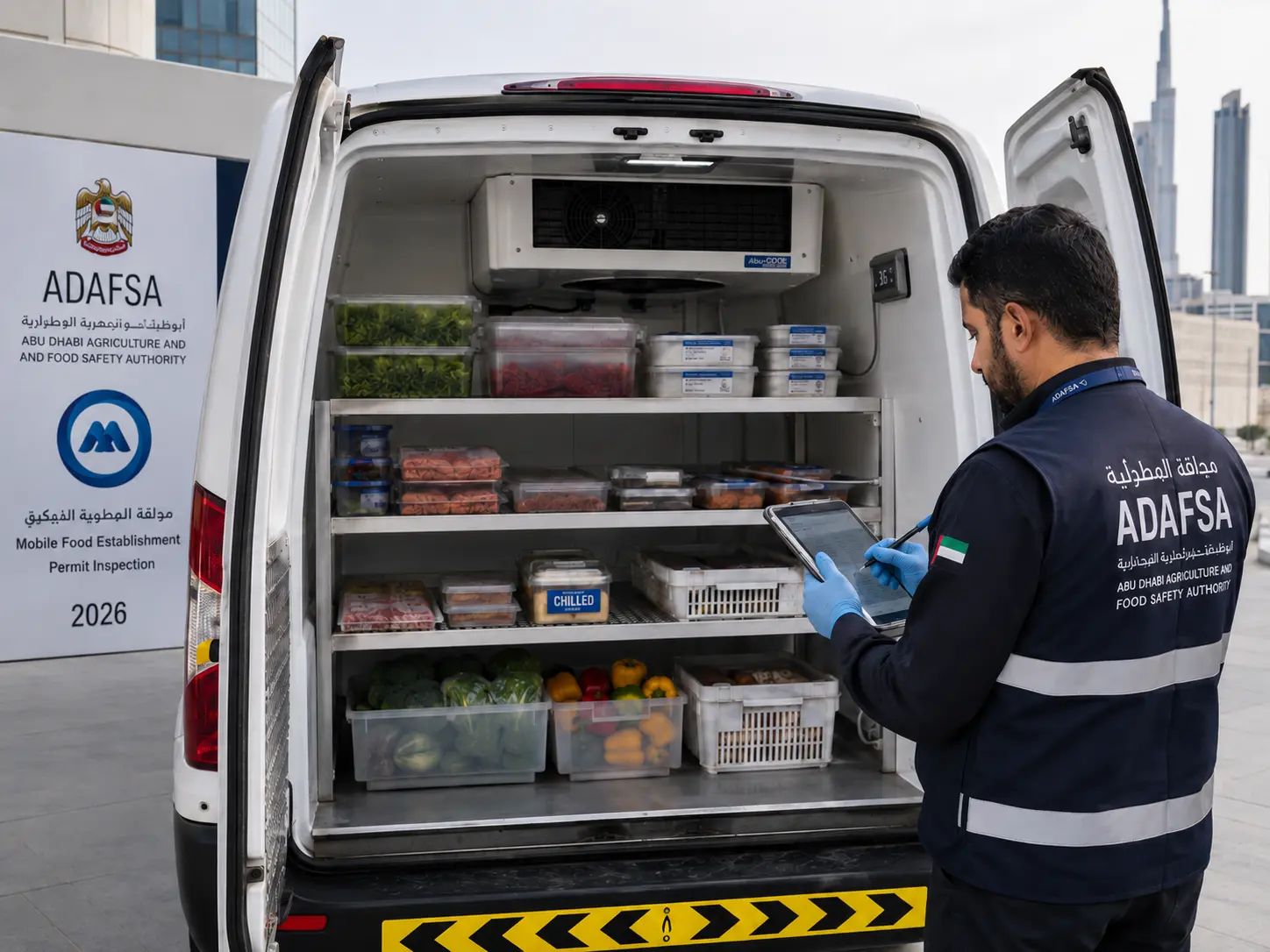
Every vehicle transporting food commercially in the Emirate of Abu Dhabi — whether it carries fresh produce from the Al Ain border, chilled dairy to Mussafah warehouses, or packaged meat to Khalifa City supermarkets — must hold a valid Mobile Food Establishment (MFE) Permit issued by the Abu Dhabi Agriculture and Food Safety Authority (ADAFSA). There are no grace periods and no informal exemptions. Operating without a current permit exposes operators to fines starting at AED 5,000 per vehicle per violation, and the ADAFSA enforcement team conducts unannounced roadside inspections throughout the emirate.
This guide walks Abu Dhabi chiller truck and van operators through the complete 2026 permit process: the legal basis, the step-by-step TAMM portal application, what the Emirates Transport inspection covers, how ASATEEL GPS integration works, what EFST driver certification requires, the full fee schedule, and the penalty matrix operators need to understand before they put a vehicle on the road.
Legal Basis: ADAFSA Regulation No. 6/2010 and Decree No. 3/2021
The Mobile Food Establishment Permit regime is grounded in two instruments. ADAFSA Regulation No. 6/2010 on Food Safety in Abu Dhabi established the authority’s mandate over all food handling, storage, and transport within the emirate. It defined the hygiene standards for refrigerated vehicles, temperature record-keeping obligations, and the permit renewal cycle.
Decree No. 3/2021 significantly strengthened enforcement by expanding the penalty schedule and introducing mandatory ASATEEL GPS tracking as a non-negotiable permit condition. Under this decree, evading ASATEEL monitoring is treated as a standalone offence separate from any underlying food safety violation — meaning an operator can be fined for the GPS evasion and the food safety breach in the same inspection.
Food transport vehicles operating under the permit are classified as Mobile Food Establishments under the same regulatory umbrella as mobile kitchens and food market stalls. This classification matters because it means the permit, the vehicle, and the responsible person (the named permit holder) are all liable — not just the business entity.
Who Needs the ADAFSA Mobile Food Establishment Permit?
The permit is required for any vehicle that transports food commercially within Abu Dhabi emirate, including Al Ain and Al Dhafra. The regulation does not distinguish between business size or frequency of operation.
- Chiller vans and trucks carrying fresh, chilled, or frozen food at any temperature band
- Insulated dry vehicles transporting ambient-temperature food products (flour, canned goods, confectionery)
- Tanker vehicles carrying liquid food commodities (cooking oil, juices, dairy in bulk)
- Mobile catering units and food trucks with on-board preparation facilities
- Cross-emirate vehicles entering Abu Dhabi from Dubai, Sharjah, or other emirates with a food load
Vehicles that are exempt include those carrying non-food agricultural produce (raw cotton, animal feed not for direct consumption) and private vehicles carrying food for personal use only. If there is any commercial intent — even a single paid delivery — the permit applies.
For operators running chilled cargo out of Dubai Investment Park (DIP) into Abu Dhabi, the cross-emirate requirement is particularly important. A Dubai Municipality DM Card does not substitute for the ADAFSA permit. Both are required simultaneously. See our guide to chiller van rental in Abu Dhabi for how we handle dual-emirate compliance for our clients.
Step-by-Step: Applying via the TAMM Portal
Abu Dhabi has unified its government services under the TAMM platform (tamm.abudhabi). The MFE permit application is processed entirely online through TAMM, with physical inspection booked as part of the digital workflow. There is no separate walk-in option.
Step 1: Register or Log In to TAMM
Access the TAMM portal using a UAE Pass digital identity account. If you do not have UAE Pass, download the app and register with your Emirates ID. Business applicants should log in under their trade licence entity rather than their personal account, as the permit is issued to a legal entity, not an individual.
Step 2: Navigate to Food Establishment Licensing
Under the ADAFSA services section, select Mobile Food Establishment Permit — New Application. You will need to upload the following documents before the application can progress:
- Valid trade licence (must include food transport in the permitted activities list)
- Vehicle registration card (Mulkiya) for each vehicle in the application
- Vehicle insurance documents
- Proof of ASATEEL device installation (device serial number and activation confirmation from an approved ASATEEL service provider)
- EFST (Essential Food Safety Training) certificates for all drivers assigned to each vehicle
- Calibration certificate for the onboard digital temperature monitoring system (issued by an accredited calibration lab, valid within 12 months)
- Most recent refrigeration unit service record
Step 3: Pay the Application Fee and Book Inspection
Once documents are verified, the portal generates an inspection booking with Emirates Transport. The standard inspection fee is AED 350 per vehicle, payable online at this stage. Select the nearest Emirates Transport inspection station to your fleet base. Available locations in Abu Dhabi include Mussafah (main hub), Khalifa City, Al Ain, and Al Dhafra.
Step 4: Emirates Transport Vehicle Inspection
The physical inspection takes 45 to 90 minutes per vehicle. Bring the vehicle empty and pre-cooled to its rated operating temperature. An inspector will verify every item on the technical checklist (covered in the next section). Vehicles that pass receive a digitally signed inspection certificate uploaded directly to the TAMM portal. Vehicles that fail are issued a deficiency report; operators typically have 14 days to rectify and rebook without paying an additional inspection fee, though a second failure incurs a repeat booking charge.
Step 5: ADAFSA Review and Permit Issuance
ADAFSA’s Food Watch Department (FWD) reviews the inspection certificate, verifies ASATEEL integration is live, and issues the permit digitally. Standard processing time after a passed inspection is 3 to 5 working days. The permit is available for download from the TAMM portal and must be carried in the vehicle at all times — physical copy or digital display on a tablet both satisfy the requirement.
What the Emirates Transport Inspection Covers
Inspectors follow ADAFSA’s technical specifications for food transport vehicles, which are aligned with the Gulf Standardisation Organisation (GSO) food vehicle standards. The inspection is far more detailed than a standard RTA vehicle test — operators who treat it as a routine roadworthiness check consistently fail.
Cargo Compartment Integrity
The entire interior must be constructed of food-grade, non-porous, non-toxic material — typically SS304 stainless steel or seamless fibreglass with antimicrobial resin. Any exposed wood, cracked plastic, porous foam edges, or corroded metalwork is an immediate failure point. Interior corners must be coved (curved, not square) to prevent bacterial accumulation. All internal fixtures — hooks, shelving brackets, drainage channels — must be removable for cleaning.
Insulation and Thermal Bridging
Inspectors check insulation thickness at multiple points, including door frames, wheel well cut-outs, and any penetrations for wiring or drainage. Minimum polyurethane foam thickness is 75mm for chilled vehicles and 100mm for frozen-rated vehicles. Thermal imaging may be used to detect hidden cold bridges; any heat signature around door seals or structural penetrations will result in a failure note requiring the vehicle to return after remediation.
Refrigeration Unit Performance
The refrigeration unit must demonstrate it can pull the cargo compartment down to rated temperature within the specified time and hold it there with the cargo doors closed. For 2026 inspections, the unit must also be connected to the IoT temperature monitoring system, and the inspector will verify that live readings are transmitting correctly to the ADAFSA FoodWatch portal. If the digital sensor and the inspector’s calibrated probe differ by more than 0.5°C, the unit fails the calibration check.
Door Seals and Pest Exclusion
Rear door rubber gaskets are checked for elasticity, tears, and compression set. Strip curtains (PVC flap barriers) are required on any vehicle with side-opening or roll-up rear doors to prevent warm air ingress during loading. Inspectors also check for gaps around drainage outlets and any unsealed penetrations that could allow pest entry.
Drainage System
The cargo floor must slope toward a rear drainage point. Drainage outlets must have closeable, hygienic caps — they cannot be left permanently open. Drains connected directly to the underside of the vehicle are acceptable; drains discharging into an interior collection tray are also permitted but the tray must be removable and cleanable.
Interior Lighting
LED or fluorescent strip lighting of sufficient lux to allow inspection of cargo during loading and delivery. Lights must be covered with food-safe protective shields to prevent broken glass contamination.
ASATEEL GPS: The Non-Negotiable Permit Condition
Since Decree No. 3/2021, ASATEEL (Abu Dhabi’s mandatory fleet tracking system, managed by the Integrated Transport Centre) is a hard permit condition — not a recommendation and not a future requirement. Every food transport vehicle operating in Abu Dhabi emirate must have an ASATEEL-approved On-Board Unit (OBU) installed and active before the ADAFSA permit application can be approved.
What ASATEEL Tracks
ASATEEL collects real-time GPS position, vehicle speed, idle time, trip history, and — for food transport vehicles specifically — temperature data from the cargo compartment sensor. This data is accessible to ADAFSA inspectors during roadside checks via a central dashboard. An inspector can pull up a vehicle’s full route and temperature history for the past 90 days in seconds.
How to Get ASATEEL Installed
OBUs must be purchased and fitted by an ITC-approved ASATEEL service provider. A list of approved providers is available on the ITC Abu Dhabi website. Installation typically takes one working day per vehicle. Once installed, the device must be activated in the ASATEEL portal, and an activation confirmation (with the device serial number) is required as a document upload during the TAMM permit application.
ASATEEL Costs
OBU hardware costs vary by provider but typically fall in the range of AED 800 to AED 1,200 per device, with annual subscription fees of AED 400 to AED 600 per vehicle per year. These are unavoidable operating costs for any Abu Dhabi food transport operation.
The Penalty for ASATEEL Evasion
Under Decree No. 3/2021, operating a food transport vehicle in Abu Dhabi with a tampered, deactivated, or missing ASATEEL device carries a specific penalty of AED 1,000 per incident, applied on top of any other violations found during the same inspection. This fine was introduced specifically to close the loophole where operators would install the device to pass inspection and then disable it in service.
When you rent a chiller truck or van from Manchu Transport for Abu Dhabi routes, all our Abu Dhabi-registered vehicles come with ASATEEL pre-installed and active. Compliance documentation is available on request for any vehicle in our fleet.
EFST Driver Certification: Essential Food Safety Training
Every driver operating a food transport vehicle under an ADAFSA MFE permit must hold a valid Essential Food Safety Training (EFST) certificate. EFST is the Abu Dhabi equivalent of Dubai’s OHC (Occupational Health Card) — but the two are not interchangeable. A Dubai DHA OHC card does not satisfy the EFST requirement in Abu Dhabi, and vice versa. Cross-emirate operators must ensure their drivers hold both.
What EFST Covers
EFST is a structured food safety awareness programme covering:
- Personal hygiene requirements for food handlers
- Temperature control principles and the cold chain
- Cross-contamination prevention during loading and delivery
- Proper cleaning and sanitisation of cargo compartments
- Abu Dhabi food safety regulations and driver responsibilities under ADAFSA
- How to use and interpret the onboard temperature monitoring system
How to Get EFST Certified
EFST courses are offered by ADAFSA-approved training providers. Training is available in English, Arabic, Hindi, and Urdu — important for Abu Dhabi’s diverse driver workforce. The course typically runs for one day, followed by a short written assessment. Successful candidates receive a digital EFST certificate valid for two years, after which renewal training is required.
Approved training providers and the current fee schedule are listed on the ADAFSA website and the TAMM portal. Fees are generally in the range of AED 150 to AED 250 per driver depending on the provider and language of instruction.
Permit Fee Schedule (2026)
ADAFSA’s fee structure for the Mobile Food Establishment Permit is tiered by permit type and duration. All fees are paid through the TAMM portal at the time of application or renewal.
| Permit Type | Duration | Fee (AED) | Applicable To |
|---|---|---|---|
| Annual Commercial Permit | 12 months | 3,000 per vehicle | Standard commercial food transport fleets |
| Short-Term / Seasonal Permit | Up to 3 months | 500 per vehicle | Ramadan operations, seasonal event catering, temporary contracts |
| Educational / Non-Commercial Permit | 12 months | 200 per vehicle | School meal transport, charity food distribution, government nutrition programmes |
| Emirates Transport Inspection Fee | Per inspection | 350 per vehicle | All permit types — paid at inspection booking stage |
| Re-inspection Fee (second failure) | Per visit | 350 per vehicle | Applies if vehicle fails a second time; first re-inspection after initial failure is typically free within 14 days |
For a single vehicle on an annual commercial permit, the total first-year cost of compliance — permit, inspection, ASATEEL hardware, and EFST for one driver — typically ranges from AED 4,700 to AED 5,500. Subsequent years are lower as ASATEEL hardware is a one-off cost.
Penalty Schedule: What Violations Cost in 2026
Under Decree No. 3/2021, ADAFSA penalties follow a tiered structure. Understanding the schedule is important because enforcement in Abu Dhabi operates differently from Dubai — roadside inspections are frequent on major routes including the Abu Dhabi–Al Ain highway, Mussafah industrial corridors, and ICAD access roads.
| Violation | Fine (AED) | Notes |
|---|---|---|
| Operating without a valid MFE permit | 5,000 per vehicle | Base fine; vehicle may be impounded pending permit issuance |
| Expired permit (renewal overdue) | 5,000 per vehicle | Same as no permit — grace period is not automatic |
| ASATEEL device tampered, deactivated, or absent | 1,000 per incident | Applied in addition to any other violations found in same inspection |
| Driver without valid EFST certificate | 2,000 per driver | Each uncertified driver is a separate offence |
| Cross-emirate operation without dual compliance | 7,500 per vehicle | Dubai DM Card alone is insufficient; both DM Card and ADAFSA permit required |
| Temperature deviation — cargo above safe zone | 5,000 to 10,000 | Depends on commodity and degree of deviation; spoiled cargo may be seized and destroyed at operator’s cost |
| Interior hygiene failure (mould, pest evidence, chemical contamination) | 10,000 to 25,000 | Serious violations trigger immediate vehicle suspension |
| Repeat violation within 12 months | Double the base fine | ADAFSA enforcement database tracks operator history across all vehicles |
The cross-emirate penalty of AED 7,500 catches operators by surprise most often. Many Dubai-based businesses that run occasional deliveries into Abu Dhabi assume their DM Card covers them. It does not. Both permits must be current simultaneously.
Annual Renewal: What to Prepare
The MFE permit must be renewed annually before the expiry date shown on the current permit. ADAFSA does not send automatic reminders — it is the operator’s responsibility to track expiry dates and initiate renewal through TAMM before the permit lapses. An expired permit carries the same fine as no permit at all.
Renewal requires a fresh Emirates Transport vehicle inspection (same checklist as initial issuance), updated ASATEEL activation confirmation if the subscription has been renewed, and updated EFST certificates for any drivers whose two-year certification has expired during the year.
The most efficient approach for fleet operators is to align all vehicle renewal dates to the same month. This allows a single TAMM renewal session and a coordinated inspection booking that minimises vehicle downtime. When taking over an existing vehicle from a previous operator, confirm the permit expiry date before the first Abu Dhabi run — permits are issued per vehicle but are not automatically transferred on ownership change.
Al Ain and Al Dhafra: Same ADAFSA Authority, Different Logistics
Al Ain and Al Dhafra (the western region including Madinat Zayed, Liwa, and Ruwais) fall within Abu Dhabi emirate and therefore under ADAFSA jurisdiction. The same MFE permit, ASATEEL requirement, and EFST certification apply.
Al Ain operations have additional considerations. The city sits at the UAE–Oman border, and vehicles crossing into Oman and returning with a food load re-enter under customs and ADAFSA food import inspection procedures — distinct from the domestic MFE permit. Operators running regular Al Ain routes should also be aware that the Al Ain Free Zone (AAFZ) has its own zone authority that co-ordinates with ADAFSA, and vehicles entering AAFZ premises must present a valid MFE permit on request.
For Al Ain specifically, our chiller van rental Al Ain and chiller truck rental Al Ain pages cover the local route context and vehicle options in more detail.
Outsourcing vs. Own Fleet: The Compliance Calculation
For businesses that do not operate their own delivery fleet, the compliance costs above illustrate why many Abu Dhabi food businesses choose to outsource transport entirely. Building a compliant own-fleet operation in Abu Dhabi requires:
- ADAFSA MFE permit per vehicle (AED 3,000/year + AED 350 inspection)
- ASATEEL OBU per vehicle (AED 800–1,200 hardware + AED 400–600/year subscription)
- EFST certification per driver (AED 150–250, renewable every two years)
- Refrigeration unit annual service and calibration certification
- Full vehicle insurance covering commercial food transport liability
For a small operation with two vehicles and three drivers, this adds up to approximately AED 10,000 to AED 14,000 in year-one compliance costs, before vehicle purchase or lease, fuel, maintenance, or driver salaries.
A third-party chiller rental — where all of the above compliance sits with the transport provider — typically costs a fraction of that at AED 350 to AED 400 per day for a 1-ton van, with all ADAFSA, ASATEEL, and EFST compliance included. For seasonal peaks, Ramadan, or new market entry into Abu Dhabi, the outsourced model eliminates both the capital outlay and the compliance overhead entirely.
If you need a compliant chiller van or truck for Abu Dhabi operations, get a quote from Manchu Transport — our Abu Dhabi fleet is fully permitted, ASATEEL-active, and driver-certified.
Summary: ADAFSA MFE Permit at a Glance
| Item | Detail |
|---|---|
| Issuing authority | ADAFSA Food Watch Department (FWD) |
| Application platform | TAMM portal (tamm.abudhabi) |
| Inspection conducted by | Emirates Transport (authorised by ADAFSA) |
| Inspection fee | AED 350 per vehicle |
| Annual permit fee | AED 3,000 per vehicle (commercial) |
| Short-term permit fee | AED 500 per vehicle (up to 3 months) |
| ASATEEL GPS | Mandatory — hard permit condition |
| Driver certification | EFST certificate — 2-year validity |
| Penalty for no permit | AED 5,000 per vehicle |
| Cross-emirate penalty | AED 7,500 per vehicle |
| ASATEEL evasion penalty | AED 1,000 per incident (additional) |
| Permit validity | 12 months (annual renewal required) |
| Applies to | All Abu Dhabi emirate including Al Ain and Al Dhafra |
The ADAFSA Mobile Food Establishment Permit is straightforward when operators approach it systematically — the TAMM portal is well-designed, the Emirates Transport inspection is consistent, and the requirements have not changed significantly since the 2021 decree update. The operators who face fines are almost always those who delay renewal past the expiry date or who run cross-emirate without understanding that two separate permit regimes apply simultaneously.
Frequently Asked Questions
How much does the ADAFSA Mobile Food Establishment Permit cost?
The annual commercial permit is AED 3,000 per vehicle, plus a AED 350 per-vehicle Emirates Transport inspection fee. Short-term permits (up to 3 months) cost AED 500 per vehicle.
What is the fine for operating without an ADAFSA permit in Abu Dhabi?
Operating without a valid Mobile Food Establishment Permit carries a fine of AED 5,000 per vehicle, with the same fine applying to an expired, unrenewed permit.
Do I need both a Dubai DM Card and an ADAFSA permit for cross-emirate deliveries?
Yes. A Dubai Municipality DM Card does not substitute for the ADAFSA permit. Operating cross-emirate without both carries a separate fine of AED 7,500 per vehicle.
How do I apply for the ADAFSA Mobile Food Establishment Permit?
Applications are submitted online through the TAMM portal using a UAE Pass account, with required documents including trade licence, vehicle registration, ASATEEL activation proof, and EFST driver certificates.
Does the ADAFSA permit cover Al Ain and Al Dhafra?
Yes. Al Ain and Al Dhafra fall within Abu Dhabi emirate and are covered under the same ADAFSA Mobile Food Establishment Permit, ASATEEL, and EFST requirements as Abu Dhabi city.
If you have questions about compliance for your specific operation, or need a compliant hired fleet for Abu Dhabi food transport, contact the Manchu Transport team — we have been running permitted chiller operations across Dubai and Abu Dhabi for 14 years.
Need Reliable Refrigerated Transport?
Get a free quote for chiller van, truck, or trailer rental in Dubai and across the UAE.
Get a Free QuoteRecommended Services
Our Refrigerated Transport Services
Choose the vehicle that matches your route, payload, and temperature requirements.
 Abu Dhabi
Chiller Truck Rental Abu Dhabi
ADAFSA and ASATEEL-compliant truck rentals for Mussafah, KIZAD, Khalifa City, and Al Ain.
View Service
Dubai
Chiller Truck Rental Dubai
3-Ton to 10-Ton refrigerated trucks for supermarket, pharma, and wholesale distribution.
View Service Last-Mile
Chiller Van Rental Dubai
1-Ton and 1.5-Ton chiller vans for last-mile cold chain, catering, and pharmacy routes.
View Service Cross-Border
Chiller Trailer Rental Dubai
20-Ton and 25-Ton reefer trailers for port clearances, warehouse transfers, and GCC routes.
View Service