The question “Which chiller truck size do we need?” sounds simple until you price the wrong answer. In the UAE, a truck that is too small creates repeat trips, blocked airflow, overloaded pallets, and late deliveries. A truck that is too large creates access problems, weaker route economics, and unnecessary rental spend. For supply-chain teams moving chilled or frozen goods across Dubai, Abu Dhabi, and Al Ain, the real decision is not whether to rent a refrigerated truck. It is whether the route calls for a 3-ton, 7-ton, or 10-ton vehicle.
This guide is written for commercial buyers evaluating 3 ton chiller truck, 7 ton chiller truck rental, and 10 ton chiller truck rental options in the UAE. If you are buying for supermarket supply, catering, food manufacturing, pharmaceutical distribution, or warehouse transfers, the framework below is designed to help you choose the right truck before you request pricing.
If you want the short version: choose 3-ton for tighter multi-stop city work, 7-ton for medium-volume wholesale and regional routes, and 10-ton for bulk warehouse or port-linked transfers. The detailed breakdown below explains where that simple rule changes.
The Practical Decision Framework for Chiller Truck Sizing
Before looking at tonnage, start with four operating questions:
- How much does the cargo weigh? A low-weight, high-volume load behaves very differently from dense palletized frozen cargo.
- How many pallets or stops are involved? One warehouse transfer and a twelve-stop city route should not use the same truck by default.
- Is the route urban, industrial, or inter-emirate? Access constraints matter.
- Is the cargo chilled, frozen, or mixed-temperature? Size and temperature strategy need to match.
The most common mistake is focusing only on tonnage and ignoring route design. A 10-ton truck may look more efficient on paper, but if the delivery point cannot receive it easily, the bigger truck becomes the more expensive option.
Quick Comparison: 3-Ton vs 7-Ton vs 10-Ton
| Truck Size | Typical Payload | Pallet Range | Best Use Case | Route Profile | When Not to Use It |
|---|---|---|---|---|---|
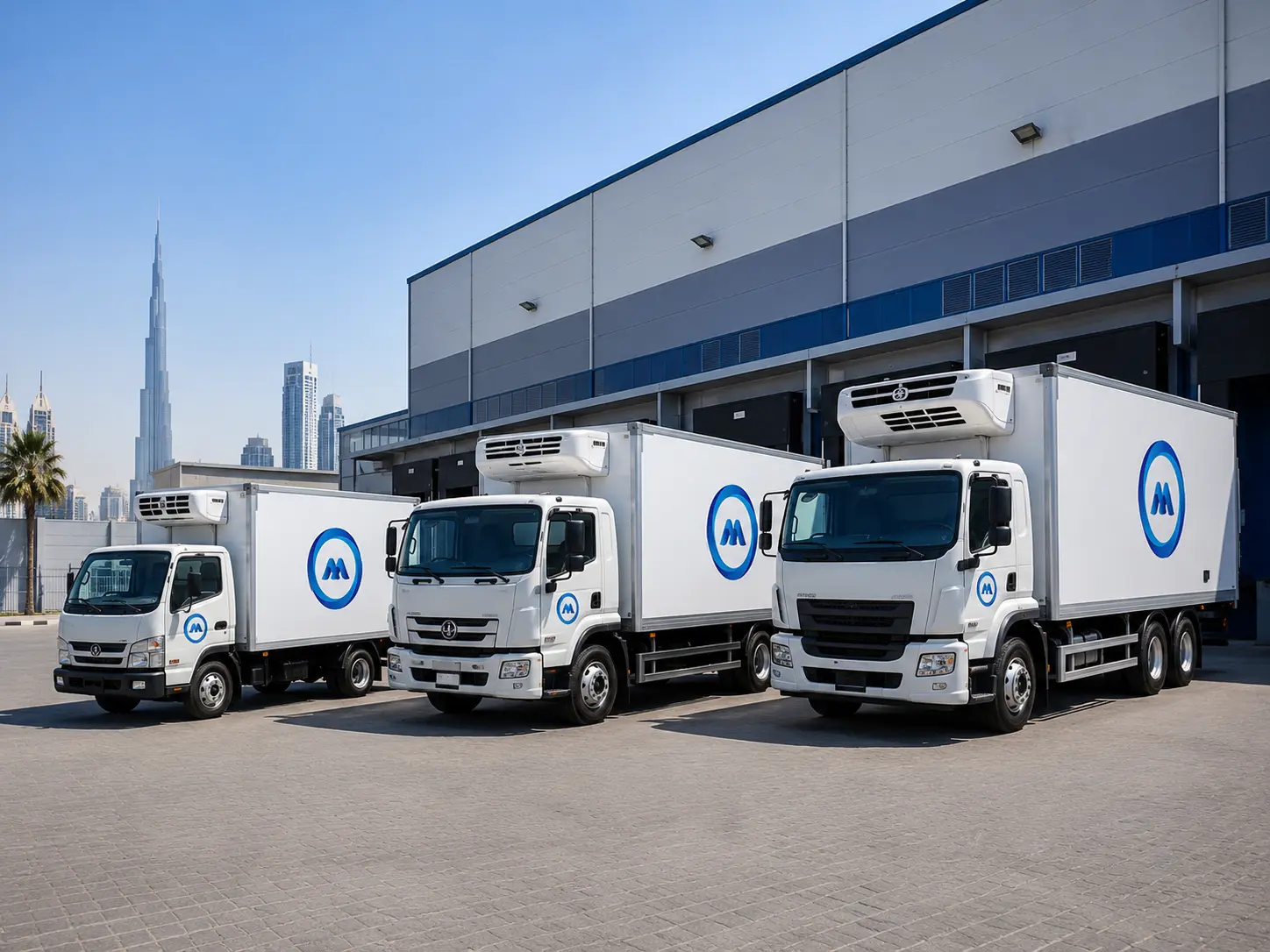
| 3-Ton | Up to 3,000 kg | 4 to 6 pallets | Urban supermarket restocking, catering, clinic and pharmacy supply | City routes, tight access, multi-stop delivery | Large warehouse transfers or heavy bulk freight |
| 7-Ton | Up to 7,000 kg | 8 to 10 pallets | Wholesale distribution, food manufacturing supply, inter-city chilled runs | Industrial and regional routes | Highly fragmented last-mile city runs with restricted access |
| 10-Ton | Up to 10,000 kg | 10 to 14 pallets | Bulk cold-store transfers, port-linked logistics, long-haul industrial supply | Warehouse-to-warehouse, port-to-depot, long-haul transit | Smaller sites with limited loading space or low volume |
Current UAE Chiller Truck Price Guide by Size
For commercial buyers, truck-size evaluation should always include a pricing benchmark. Based on Manchu Transport’s current truck pricing structure, the clearest planning guide is:
| Truck Size | Starting Daily Rate | Best Commercial Fit |
|---|---|---|
| 3-Ton Chiller Truck | AED 600/day | City distribution, supermarket restocking, catering, pharma support |
| 7-Ton Chiller Truck | AED 700/day | Wholesale and industrial distribution, food manufacturing, regional chilled runs |
| 10-Ton Chiller Truck | AED 800/day | Bulk transfers, port-linked logistics, long-haul industrial routes |
For buyers running repeated weekly routes, monthly contracts usually improve cost efficiency and fleet continuity. Daily pricing is useful for one-off moves and overflow demand, but repeated chilled distribution is where contract structuring starts to matter more than rack rate alone.
If you already know your pallet count and route pattern, you can request a quote with the pickup location, delivery zones, number of stops, and cargo temperature range. That usually makes fleet selection much more accurate than choosing by tonnage alone.
3-Ton Chiller Truck: Best for Urban Distribution and Dense Multi-Stop Routes
The 3-ton chiller truck is the workhorse of practical day-to-day cold distribution. It gives buyers a meaningful step up from van capacity without moving into a vehicle class that becomes awkward in tighter city environments.
Typical strengths of the 3-ton class include:
- 4 to 6 pallet capacity for consistent mid-volume delivery work
- better maneuverability for mixed commercial and residential zones
- faster loading and unloading for frequent-stop operations
- strong fit for chilled and light frozen distribution where turnaround speed matters
In Dubai, 3-ton trucks are especially effective for retail and hospitality routes where access is tighter and stop frequency is high. In Abu Dhabi, they are a strong fit for Khalifa City, urban commercial districts, and smaller deliveries from Mussafah into retail or institutional receiving points.
If your load profile is supermarket top-ups, catering ingredients, clinic supply, or recurring chilled deliveries with several stops, the 3-ton class usually gives the best balance of capacity and agility. For current service context, see our chiller truck rental Dubai page and our chiller truck rental Abu Dhabi page.
7-Ton Chiller Truck: Best for Regional Wholesale and Food Manufacturing Supply
The 7-ton chiller truck is where refrigerated transport starts to feel like true distribution logistics rather than enlarged city delivery. It is built for businesses that need more serious pallet count and more stable economics on medium-volume routes.
This class is often the best fit when your operation looks like any of the following:
- distribution from food-processing plants into retail depots
- wholesale chilled or frozen deliveries from industrial areas
- repeat runs between Abu Dhabi and Al Ain
- higher-volume hotel, catering, or institutional supply
- multi-pallet supermarket distribution where a 3-ton truck is too small
Operationally, the 7-ton class is strong in ICAD, Mussafah, and other industrial or mixed regional routes where traffic access is still manageable but the delivery volume is too heavy for smaller chassis. This is also the vehicle class where buyers often start comparing rigid trucks against trailers, especially if the route is mostly warehouse-based.
If your business is making too many trips in a 3-ton truck, but a 10-ton vehicle feels oversized for the receiving points, the 7-ton option is usually where the route starts to optimize properly.
10-Ton Chiller Truck: Best for Bulk Transfers, Ports, and Long-Haul Industrial Supply
The 10-ton chiller truck is the heavy rigid option for serious payload movement. It is designed for cold stores, import logistics, and warehouse transfers where volume efficiency matters more than tight-site flexibility.
The 10-ton class is commonly used for:
- bulk transfers from Jebel Ali to inland warehouses
- KEZAD / KIZAD and Khalifa Port distribution work
- high-volume meat, seafood, dairy, or FMCG replenishment
- long-haul chilled or frozen runs to Al Ain, Ruwais, or other regional destinations
- single-destination loads where 10 to 14 pallets move together
This is not the truck class to default to just because “bigger is better.” A 10-ton truck makes sense when the site can receive it, the route justifies it, and the payload is consistently high enough to use the truck efficiently. On the wrong route, it adds cost without adding value.
Operational Constraints Buyers Should Check Before Upsizing
Moving from a 3-ton truck to a 7-ton or 10-ton truck does not only change payload. It also changes the route conditions the vehicle can handle comfortably. Larger trucks are more exposed to:
- receiving-bay limits, especially where loading space is shallow or shared
- turning-radius constraints in dense commercial areas
- yard access and forklift sequencing at industrial facilities
- route windows and heavy-vehicle movement restrictions on major corridors
That is why many buyers overestimate the value of a 10-ton truck on mixed routes. If half the route behaves like warehouse freight and the other half behaves like urban retail distribution, the bigger truck may look cheaper per kilogram but perform worse in practice. Route reality should decide the fleet, not just the pallet count.
City Delivery vs Warehouse Transfer: Why Route Profile Changes Everything
The same cargo can require two different truck sizes depending on route structure. Consider these examples:
- A 3-ton truck is better for four supermarket deliveries across city districts because it unloads faster and fits smaller receiving points.
- A 7-ton truck is better for one production plant dispatching to two wholesale depots because the pallet density is higher and stop frequency is lower.
- A 10-ton truck is better for a warehouse-to-warehouse cold-store transfer because the route is cleaner and the payload is consolidated.
In other words, truck sizing should follow delivery geometry, not just cargo description. Procurement teams that ignore route profile usually overpay in the city and underperform in industrial corridors.
Temperature Recovery and Number of Stops
Stop frequency is one of the least discussed but most important sizing variables in UAE cold logistics. Every door opening introduces ambient heat. The larger the dead air volume in the truck, the more energy the refrigeration system needs to restore the target temperature.
That matters because:
- a multi-stop route often favors a smaller truck with less wasted air volume
- a large single-destination load favors a larger truck because the doors stay closed longer
- frozen cargo is less forgiving than chilled cargo if unloading discipline is poor
- mixed routes need better planning than a simple tonnage upgrade
This is also why buyers handling both chilled and frozen products should think beyond truck size alone. In some cases, the right solution is not just a larger truck but a better-configured one.
When a Reefer Trailer Is Better Than a 10-Ton Truck
There is a point where adding more rigid-truck capacity stops being efficient. If your operation regularly exceeds the upper practical limit of a 10-ton truck, you should start comparing it against a refrigerated trailer instead of stacking more rigid runs.
A trailer is usually the better choice when:
- the payload consistently exceeds what a 10-ton rigid truck should carry in one movement
- the route is mainly warehouse-to-warehouse or port-to-warehouse
- the destination has proper yard space and loading infrastructure
- you want to reduce the number of vehicles needed for one consolidated movement
If your volume is moving toward full cold-store consolidation, explore our chiller trailer rental Dubai options rather than forcing the wrong job into a rigid-truck structure.
Regulatory Fit Still Matters, Especially Across Emirates
The truck may be the right size and still be the wrong operational choice if compliance is weak. For food and temperature-controlled logistics in the UAE, buyers should confirm that the fleet being deployed is aligned with the route jurisdiction and cargo type.
That means checking for:
- food-transport documentation and municipal acceptance
- temperature-monitoring process
- Abu Dhabi route readiness, including ASATEEL requirements where applicable
- driver readiness for regulated food transport work
- fit between chilled, frozen, and mixed-load requirements
For a broader view of the compliance environment behind truck selection, read our complete guide to cold chain logistics in the UAE.
Frequently Asked Questions: Chiller Truck Sizes in the UAE
How many pallets fit in a 3-ton chiller truck?
A 3-ton chiller truck is typically best for 4 to 6 standard pallets, depending on the body layout and cargo format.
How many pallets fit in a 10-ton chiller truck?
A 10-ton truck is generally the right class for 10 to 14 standard pallets, which is why it is widely used for bulk warehouse and port-linked cold-chain movements.
When should I choose a 7-ton truck instead of a 3-ton truck?
If your route has moved beyond urban restocking and now involves higher-volume distribution, industrial pickups, or repeated inter-city chilled deliveries, a 7-ton truck is usually the next logical step.
When is a trailer better than a 10-ton truck?
A trailer becomes the better option when the route is highly consolidated, the receiving site can handle articulated equipment, and the shipment volume regularly exceeds what a 10-ton rigid truck can move efficiently in one trip.
Is the biggest truck always the cheapest option per trip?
No. A larger truck may lower the cost per pallet on bulk transfers, but it can underperform badly on tight, multi-stop, mixed-access routes. The right truck is the one that fits both the load and the route structure.
Three Common Sizing Mistakes Buyers Make
1. Choosing by payload only
Payload matters, but pallet layout, unloading sequence, and receiving-point access matter just as much.
2. Upsizing for “safety”
Many buyers choose a 10-ton truck to avoid running short on capacity, then discover the route or loading dock is inefficient for that size.
3. Ignoring route frequency
A truck that works for one large transfer may perform badly on a fragmented route with repeated door openings and tighter urban delivery geometry.
How to Choose the Right Size for Your Supply Chain
If you want a simplified rule set:
- Choose 3-ton for city distribution, frequent stops, and 4 to 6 pallets.
- Choose 7-ton for wholesale and regional distribution where 8 to 10 pallets move efficiently.
- Choose 10-ton for bulk cold-store, industrial, and port-linked transfers where payload concentration is high.
- Choose a trailer when your volume consistently exceeds the practical limit of a rigid 10-ton truck.
The best truck size is not the one with the biggest box. It is the one that matches your cargo weight, pallet count, temperature band, number of stops, and receiving-site reality.
Once you’ve picked the right size, the next question is usually whether to rent or buy it — see our refrigerated truck rent-vs-buy cost breakdown.
If you want help matching the route to the right vehicle, request a quote and send your pallet count, cargo type, pickup point, delivery zones, and stop pattern. We will help you choose the right 3-ton, 7-ton, or 10-ton configuration for the job.
This article is a practical fleet-selection guide for B2B buyers. Route restrictions, permit requirements, and site-access rules can change — cross-check time-sensitive transport conditions against the latest official notice or your fleet provider documentation before dispatch.
Need Reliable Refrigerated Transport?
Get a free quote for chiller van, truck, or trailer rental in Dubai and across the UAE.
Get a Free QuoteRecommended Services
Our Refrigerated Transport Services
Choose the vehicle that matches your route, payload, and temperature requirements.
 Abu Dhabi
Chiller Truck Rental Abu Dhabi
ADAFSA and ASATEEL-compliant truck rentals for Mussafah, KIZAD, Khalifa City, and Al Ain.
View Service
Dubai
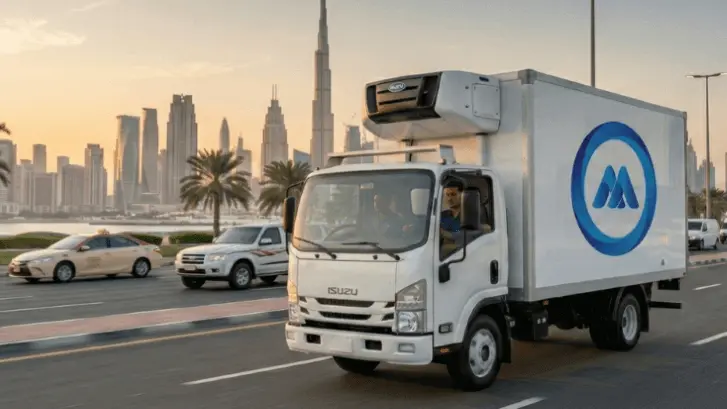
Chiller Truck Rental Dubai
3-Ton to 10-Ton refrigerated trucks for supermarket, pharma, and wholesale distribution.
View Service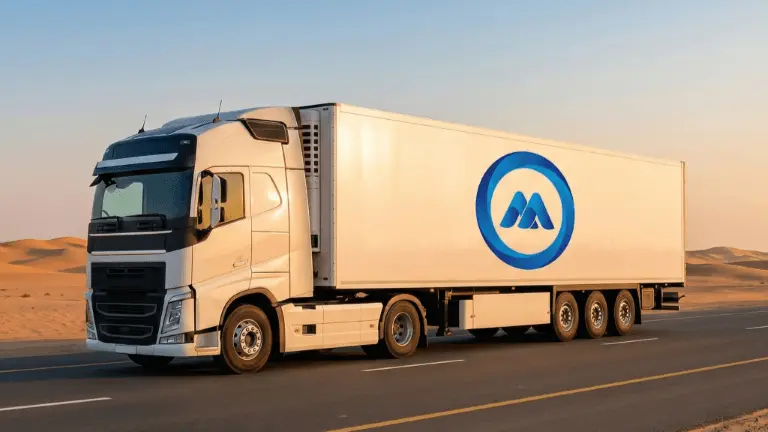 Cross-Border
Chiller Trailer Rental Dubai
20-Ton and 25-Ton reefer trailers for port clearances, warehouse transfers, and GCC routes.
View Service Last-Mile
Chiller Van Rental Dubai
1-Ton and 1.5-Ton chiller vans for last-mile cold chain, catering, and pharmacy routes.
View Service