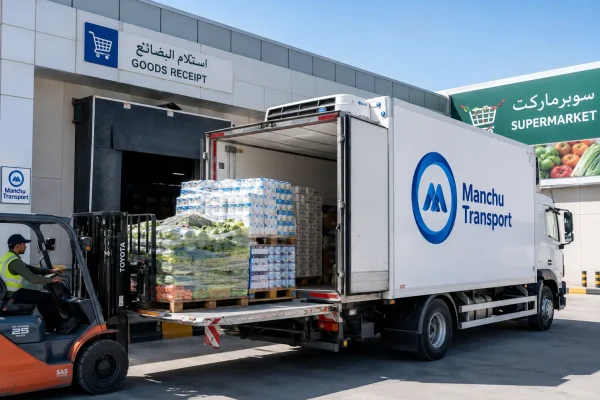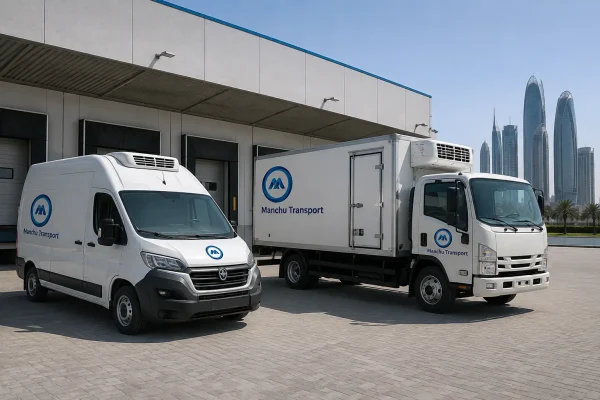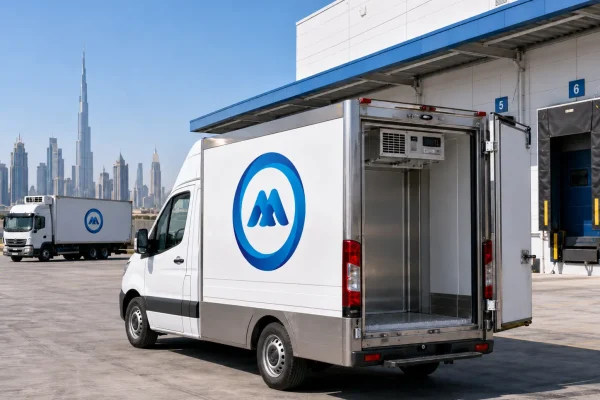
If you transport food commercially in Dubai or Abu Dhabi, two numbers define your legal exposure: 60°C minimum for hot food and 5°C maximum for cold food. Drop below 60°C on a hot delivery or rise above 5°C on a chilled one, and you are inside the Temperature Danger Zone, where pathogens multiply fast enough to cause a foodborne illness outbreak, a DM inspection failure, and fines ranging from AED 1,000 to AED 50,000. This guide gives you the exact thresholds, the rules in both Dubai and Abu Dhabi, and the practical steps to stay compliant.
UAE Food Holding Temperature Reference Table (2026)
These are the mandatory temperature ranges enforced by Dubai Municipality (DM) under the Dubai Food Code 2.0 and by ADAFSA under Regulation No. 6 of 2010. They apply to every commercial food transport vehicle in the UAE.
| Category | Required Temperature | Typical Products | Reject Delivery If |
|---|---|---|---|
| Hot holding | Minimum 60°C (target 63°C) | Cooked meals, catering trays, soups, hot casseroles | Core temperature below 60°C at point of delivery |
| Chilled perishables | 0°C to 5°C maximum | Dairy, raw meat, poultry, ready-to-eat meals, fresh fish | Arrives above 8°C or with visible condensation from temperature abuse |
| Fresh produce | +2°C to +8°C | Fruits, leafy greens, vegetables | Signs of freezer burn (below 0°C) or wilting from excess heat |
| Fresh seafood | 0°C to +4°C | Fresh fish, shellfish, raw prawns | Arrives above 4°C or with off-odor indicating spoilage onset |
| Sensitive pharmaceuticals | +2°C to +8°C | Vaccines, liquid medications, biologics | Any temperature excursion outside the 2–8°C band |
| Deep frozen | -18°C or below | Frozen meat, seafood, ice cream, frozen ready meals | Core product temperature rises above -12°C |
| Dry and ambient goods | Maximum 30°C | Canned goods, grains, dry spices, bottled water | Packaging damaged by heat or humidity, or signs of pest ingress |
Hot Holding Temperature in Dubai: The 60°C Rule Explained
The Dubai Food Code 2.0 mandates that all ready-to-eat food must be held at a minimum of 60°C continuously from the moment it leaves the kitchen until it reaches the customer. The target operational temperature is 63°C, which provides a thermal buffer for the heat loss that occurs when the delivery vehicle doors open at each stop.
Why exactly 60°C? At this temperature and above, the pathogenic bacteria most dangerous in cooked food — Salmonella, Staphylococcus aureus, and Listeria — cannot survive. Cooked food is uniquely vulnerable because the cooking process destroys competing microbes, leaving a sterile environment where any surviving pathogens face no biological competition. A cooked chicken that cools from 75°C to 45°C during a 40-minute delivery without active heating is not just warm food — it is a medium for unchecked bacterial growth.
What Counts as Hot Holding in a Transport Context
- Catering companies delivering prepared meals to offices, hospitals, or schools
- Cloud kitchens and dark kitchens fulfilling aggregator (Talabat, Noon Food, Deliveroo) orders where the delivery time exceeds 15 minutes
- Hotel and event caterers transporting buffet items to external venues
- Institutional suppliers delivering hot lunches to schools, labor camps, or government canteens
The Dubai Food Code’s 2-Hour and 4-Hour Rule applies when hot food falls out of temperature control. Food that has been in the Danger Zone (5°C to 60°C) for under 2 hours can be returned to temperature control or consumed immediately. Between 2 and 4 hours, it must be consumed and cannot be re-heated or chilled for later. Over 4 hours, it must be discarded. This window shrinks rapidly during UAE summers, where ambient temperatures in a parked vehicle can exceed 65°C.
Reheating Rules Under Abu Dhabi ADAFSA
If food requires reheating at the point of delivery in Abu Dhabi, ADAFSA’s standards are stricter than Dubai’s. Liquid foods must be heated until bubbling throughout (reaching 86°C instantaneously), or sustained at 70°C for a minimum of 2 minutes. This matters specifically for catering operations delivering partially cooled food to Abu Dhabi venues who plan to reheat on-site before service.
Cold Holding Temperatures: Dubai vs Abu Dhabi Differences
This is where operators managing cross-emirate routes need to pay close attention. The cold holding thresholds are similar in both emirates but have meaningful differences in application and documentation.
Dubai Municipality (DM) Cold Chain Rules
Under the Dubai Food Code, perishable chilled food must be transported at a maximum of 5°C. The regulation allows a temporary operational tolerance up to 8°C only under specific documented conditions related to short transit times and commodity type. In practice, DM inspectors treat 5°C as the hard ceiling. Dairy arriving at a supermarket above 5°C will be rejected. Meat arriving above 5°C will be confiscated.
Dubai’s enforcement has been significantly digitized. The DMChecked app and the broader FoodDXB.AI ecosystem allow inspectors to log temperature failures at point of delivery directly into a database that flags the transport operator for follow-up auditing. A single documented failure creates an inspection trail — multiple failures trigger enhanced monitoring and escalated fines.
ADAFSA Cold Chain Rules (Abu Dhabi, Al Ain, Al Dhafra)
In Abu Dhabi emirate, ADAFSA’s Regulation No. 6 of 2010 sets the same 5°C maximum for sensitive chilled items, but with a tighter practical band: inspectors reference a target range of 1°C to 5°C for high-risk products including fresh meat, poultry, dairy, and ready-to-eat food. The lower end of the band (staying closer to 1–3°C) is explicitly encouraged to create a margin for the temperature rise that inevitably occurs during loading and delivery in 50°C ambient conditions.
A critical additional requirement in Abu Dhabi that does not apply in Dubai: every driver operating a commercial food vehicle must hold an Essential Food Safety Training (EFST) certificate. This is a government-mandated training program administered by the Abu Dhabi Quality and Conformity Council (QCC). Dispatching a Dubai-based driver without EFST certification to an Al Ain or Abu Dhabi delivery point is a compliance violation, regardless of whether the vehicle itself is ADAFSA-permitted.
Frozen Food Transport: The -18°C Baseline
UAE regulations, aligned with international Codex Alimentarius standards, set -18°C as the non-negotiable minimum for all frozen food in transit. A temporary tolerance to -15°C is acknowledged during the physical act of loading and unloading only, provided the core product temperature never rises above -12°C. Any reading above -15°C in a moving vehicle is a cold chain breach and grounds for cargo rejection.
The products most commonly affected by improper freezer transport in the UAE context:
- Ice cream — requires -25°C to maintain molecular structure. At -18°C, ice cream can remain compliant but loses texture quality during extended transit. At -10°C, the product is destroyed and cannot be refrozen to commercial standard.
- Deep-frozen meat and poultry — halal certification in the UAE requires unbroken frozen storage. Any thawing and refreezing cycle must be documented and reported.
- Frozen seafood — DM and ADAFSA both require incoming frozen seafood to show no signs of surface thawing (ice crystals, pooled moisture) at delivery. Surface thawing at -8°C indicates the vehicle failed mid-transit.
- Frozen ready meals — subject to the same temperature tracking and documentation requirements as raw proteins.
Temperature Monitoring Requirements: What You Must Record
Both Dubai Municipality and ADAFSA require active temperature monitoring, not just a functional refrigeration unit. Compliance means documentation.
Minimum requirements under Dubai Food Code 2.0
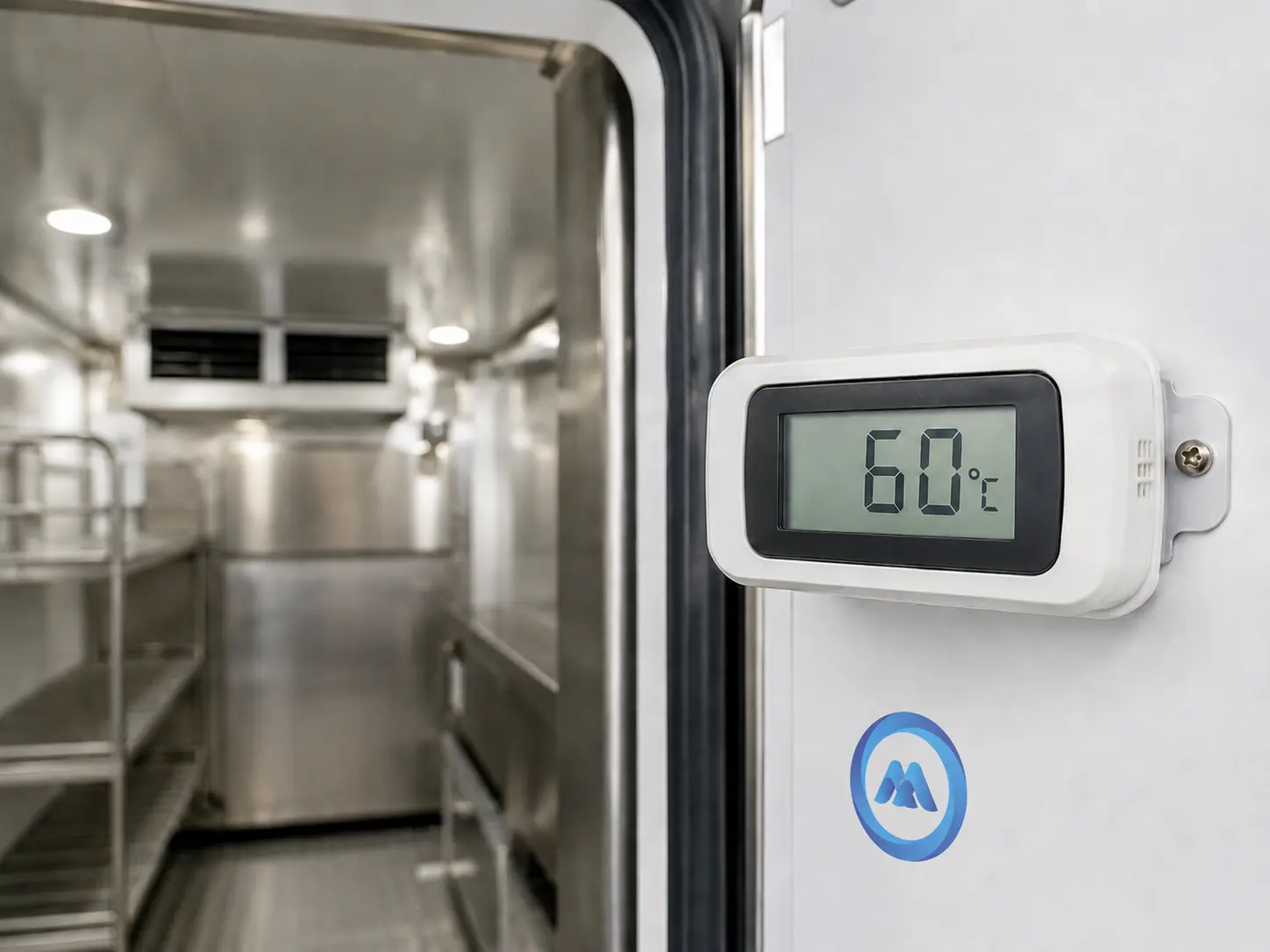
- A calibrated digital thermometer readable from outside the cargo compartment without opening the doors
- Temperature logs at departure, mid-transit (for journeys over 60 minutes), and delivery handoff
- Pre-cooling verification: the cargo bay must reach target temperature before loading. Minimum pre-cool time is 30 minutes in summer conditions.
- All logs maintained for a minimum of 90 days and available for inspection on request
ASATEEL IoT Integration for Abu Dhabi Routes
For vehicles operating in Abu Dhabi and Al Ain, the ASATEEL platform operated by the Integrated Transport Centre (ITC) mandates GPS On-Board Units (OBU) on all commercial food vehicles. Advanced ASATEEL-compliant systems integrate with IoT temperature sensors inside the cargo bay, transmitting real-time temperature data to the ITC’s central database. This means a compressor failure at 3am on the E66 between Dubai and Al Ain registers as a temperature breach in the system before the driver has reached the next petrol station. ADAFSA inspectors can act on this data during their next visit without being physically present at the time of the incident.
Fines and Penalties: UAE Food Temperature Violations
The UAE’s penalty structure for food temperature violations is deliberate and escalating. First-time financial fines are significant. Repeat violations result in doubled fines, vehicle impoundment, and business closure.
| Violation | Authority | Fine (AED) | Additional Action |
|---|---|---|---|
| Operating a food vehicle without a valid permit (DM Card) | Dubai Municipality | 1,000 to 50,000 | Vehicle seized, transferred to inspection center |
| Transporting chilled food above 5°C (without documentation) | Dubai Municipality / ADAFSA | 1,000 to 10,000 | Cargo confiscated and destroyed |
| Transporting frozen food above -15°C in transit | Dubai Municipality / ADAFSA | Up to 50,000 | Full cargo rejection, supplier audit triggered |
| No temperature logs or calibrated monitoring equipment | Dubai Municipality | 500 to 5,000 | Permit suspension pending rectification |
| Operating without ASATEEL GPS registration (Abu Dhabi) | ITC / ADAFSA | 1,000 per vehicle + 4,000 for no active GPS | Vehicle grounded, operating permit suspended |
| Repeat violation within 12 months | All authorities | Fine doubled, maximum AED 100,000 | Business license suspension or revocation |
Beyond the statutory fine, the true cost of a temperature failure is the downstream damage. An administrative closure of a restaurant triggered by a documented cold chain failure from its transport provider costs an average of AED 40,000 to AED 60,000 in dead overhead per week — rent, staff salaries, and stock write-offs — before accounting for the reputational damage that follows a public naming on ADAFSA’s Zadna Rating system.
Practical Pre-Cooling Rules for UAE Operators
The most common point of failure for food temperature compliance in the UAE is not a broken refrigeration unit — it is the loading process. A freezer van parked in direct Dubai sunlight can reach 65°C inside the cargo bay within 30 minutes. Loading frozen meat into this environment begins thawing before the vehicle moves.
Both DM and ADAFSA guidelines call for the following pre-loading protocol:
- Pre-cool the cargo bay for a minimum of 30 minutes before the first item is loaded. In summer (June to September), extend this to 45 minutes for freezer vehicles.
- Schedule loading before 7:00 AM to minimise ambient thermal load on the refrigeration compressor. Afternoon loading in 50°C heat requires the compressor to work at 140% capacity and risks thermal overshoot.
- Keep the vehicle plugged into standby power overnight if the fleet has access to cold storage dock power, maintaining target temperature through the morning loading window without compressor stress.
- Record the cargo bay temperature before loading and include it in the delivery documentation. This is your proof that you did not load warm food into a cold vehicle, which is a frequent source of disputes at delivery points.
- Stack cargo away from the interior walls and floor to allow cold air to circulate. Pallets stacked against the walls block airflow and create hot spots where temperature rises into the Danger Zone while the thermostat reading looks compliant.
Dubai Versus Abu Dhabi: Key Compliance Differences at a Glance
| Requirement | Dubai (DM) | Abu Dhabi / Al Ain (ADAFSA) |
|---|---|---|
| Vehicle permit | DM Food Vehicle Permit (annual) | ADAFSA Mobile Food Establishment Permit (annual) |
| Cold holding maximum | 5°C (tolerance to 8°C with documentation) | 5°C (target band 1–5°C for high-risk items) |
| Hot holding minimum | 60°C (target 63°C) | 60°C (reheating to 70°C for 2 mins or 86°C instantaneous) |
| Frozen minimum | -18°C | -18°C (temporary tolerance to -15°C during loading only) |
| Driver certification | DM Occupational Health Card | EFST Certificate (mandatory for all food transport drivers) |
| GPS tracking | SecurePath (SIRA / RTA mandate) | ASATEEL OBU (ITC mandate, AED 4,000 fine if not active) |
| Digital platform | DMChecked / FoodDXB.AI | ADAFSA Smart Inspection / TAMM portal |
| Cross-contamination rule | Separate compartments required for raw/RTE | Physical thermal partition required for multi-temp loads |
How to Stay Compliant Without Owning a Fleet
For most small and medium food businesses in Dubai and Abu Dhabi, the most cost-effective path to full temperature compliance is using a certified chiller rental provider rather than purchasing and maintaining specialist vehicles. When evaluating a provider, verify:
- Valid Dubai Municipality DM Food Vehicle Permit on every vehicle (sticker visible in cargo bay)
- Valid ADAFSA Mobile Food Establishment Permit for Abu Dhabi and Al Ain routes
- Active ASATEEL GPS registration for Abu Dhabi-bound vehicles with a live OBU certificate
- EFST-certified drivers for all Abu Dhabi and Al Ain deliveries
- Calibrated digital thermometers and pre-trip temperature logs on every run
- SecurePath registration for Dubai-based fleet
Manchu Transport operates a fully dual-certified fleet covering both Dubai Municipality and ADAFSA requirements. Every vehicle carries a current DM Card and ADAFSA permit, our Abu Dhabi drivers hold EFST certification, and our entire fleet is ASATEEL-registered with active GPS tracking.
Running food deliveries in Dubai or Abu Dhabi? Request a chiller van quote or call us directly for same-day dispatch. Our fleet is compliant from the first delivery.
For a full breakdown of the permit process, see our guide to the Dubai Municipality Food Vehicle Permit and our ADAFSA Mobile Food Establishment Permit guide.
Frequently Asked Questions
What is the hot holding temperature in Dubai?
Dubai Municipality requires ready-to-eat hot food to be held at a minimum of 60°C, with a target operational temperature of 63°C, continuously from the moment it leaves the kitchen until delivery.
What is the hot holding temperature in Abu Dhabi?
ADAFSA applies the same 60°C minimum as Dubai for hot holding. For reheating, liquid foods must reach 86°C instantaneously or be sustained at 70°C for at least 2 minutes.
What is the cold holding temperature in Dubai?
Chilled perishables must be held at a maximum of 5°C under the Dubai Food Code. Dairy, raw meat, and ready-to-eat meals arriving above 5°C, or above 8°C without documentation, can be rejected.
What is the correct reheating temperature in Dubai?
Under ADAFSA standards followed across the UAE, food being reheated for hot holding must reach 70°C for a minimum of 2 minutes, or bubble throughout at 86°C instantaneously.
What happens if a delivery vehicle fails a temperature check in Dubai or Abu Dhabi?
Fines range from AED 1,000 to AED 50,000 depending on the violation, with cargo confiscation, vehicle impoundment, and doubled fines (up to AED 100,000) for repeat violations within 12 months.
Need Reliable Refrigerated Transport?
Get a free quote for chiller van, truck, or trailer rental in Dubai and across the UAE.
Get a Free QuoteRecommended Services
Our Refrigerated Transport Services
Choose the vehicle that matches your route, payload, and temperature requirements.
 Abu Dhabi
Chiller Truck Rental Abu Dhabi
ADAFSA and ASATEEL-compliant truck rentals for Mussafah, KIZAD, Khalifa City, and Al Ain.
View Service Last-Mile
Chiller Van Rental Dubai
1-Ton and 1.5-Ton chiller vans for last-mile cold chain, catering, and pharmacy routes.
View Service
Dubai
Chiller Truck Rental Dubai
3-Ton to 10-Ton refrigerated trucks for supermarket, pharma, and wholesale distribution.
View Service Cross-Border
Chiller Trailer Rental Dubai
20-Ton and 25-Ton reefer trailers for port clearances, warehouse transfers, and GCC routes.
View Service