Every vehicle transporting food in Dubai must carry a valid Dubai Municipality food transport permit before it moves a single kilogram of cargo. There are no exceptions. A catering company running an unregistered chiller van faces fines between AED 5,000 and AED 10,000 per vehicle — and that is before any food safety violation is even considered. Despite this, a significant number of operators still attempt to navigate the permit process without a clear understanding of what it involves, which is why failure rates at inspection centres remain high for first-time applicants.
This guide covers the complete 2026 process: where to get inspected, what the inspector checks, how to obtain a DM Card for every driver, how FoodWatch connects everything, what the fines look like, and how Abu Dhabi’s requirements differ for operators running cross-emirate routes.
What Is the Dubai Municipality Food Transport Vehicle Permit?
The Dubai Municipality (DM) Food Transport Vehicle Permit is the primary legal authorisation that allows a vehicle to carry food commercially within the Emirate of Dubai. It is issued by the Food Safety Department of Dubai Municipality after a physical inspection confirms that the vehicle meets the engineering and hygiene standards of the Dubai Food Code and DM Circular No. 171.
The permit is not a one-off registration. It must be renewed annually, and it is linked to the vehicle’s RTA registration (Mulkiya), the company’s FoodWatch account, and the Occupational Health Cards of every driver assigned to that vehicle. Miss any one of these and the entire compliance chain breaks.
Authorised Inspection Centres in Dubai (2026)
Dubai Municipality has partnered with authorised third-party testing centres located near the city’s major logistics and industrial zones. Choose the centre closest to your base of operations to minimise vehicle downtime.
| Inspection Centre | Location | Best For |
|---|---|---|
| Tasjeel (Al Warsan) | Al Warsan | Heavy trucks and primary distribution fleets |
| Tasjeel (Jebel Ali) | Jebel Ali Free Zone | Import/export and JAFZA-based logistics |
| Shamil (Al Qusais) | Al Qusais Industrial | SME fleets and last-mile delivery vans |
| Tamam (Ras Al Khor) | Ras Al Khor | Wholesale market and central kitchen transport |
| Aber Vehicle Testing | Dubai-wide | Mobile and corporate fleet certifications |
Light vehicles (vans) take 30 to 45 minutes to inspect. Heavy, multi-compartment refrigerated trucks take up to 90 minutes — the extra time accounts for refrigeration unit stabilisation and the more detailed examination of partitioned cargo holds.
What the Inspector Checks: The Full Technical Checklist
Inspectors follow a structured checklist derived from the Dubai Food Code standards. Understanding every point in advance is the difference between passing first time and paying a re-inspection fee while your vehicle sits idle.
1. Interior Surfaces and Lining
The entire cargo compartment must be lined with food-grade, non-porous, non-toxic material. The 2026 standard favours SS304 stainless steel or seamless, professional-grade fiberglass with anti-bacterial resin. Any presence of wood, exposed wiring, cracked plastic, or porous surfaces is grounds for immediate failure. The rationale is straightforward: these surfaces must withstand daily high-pressure chemical sanitisation without degrading or harbouring bacteria.
2. Thermal Integrity: Insulation and Door Seals
Inspectors examine the rubber gaskets on rear and side doors for elasticity and hermetic sealing. Insulation thickness must meet category-specific minimums — typically 50mm to 100mm of polyurethane foam depending on whether the vehicle is rated for chilled or frozen cargo. Thermal bridges — gaps in insulation around door frames or wheel wells — are now detected using thermal imaging, and any condensation trail visible during the inspection will fail the vehicle.
3. Refrigeration Unit and IoT Temperature Monitoring
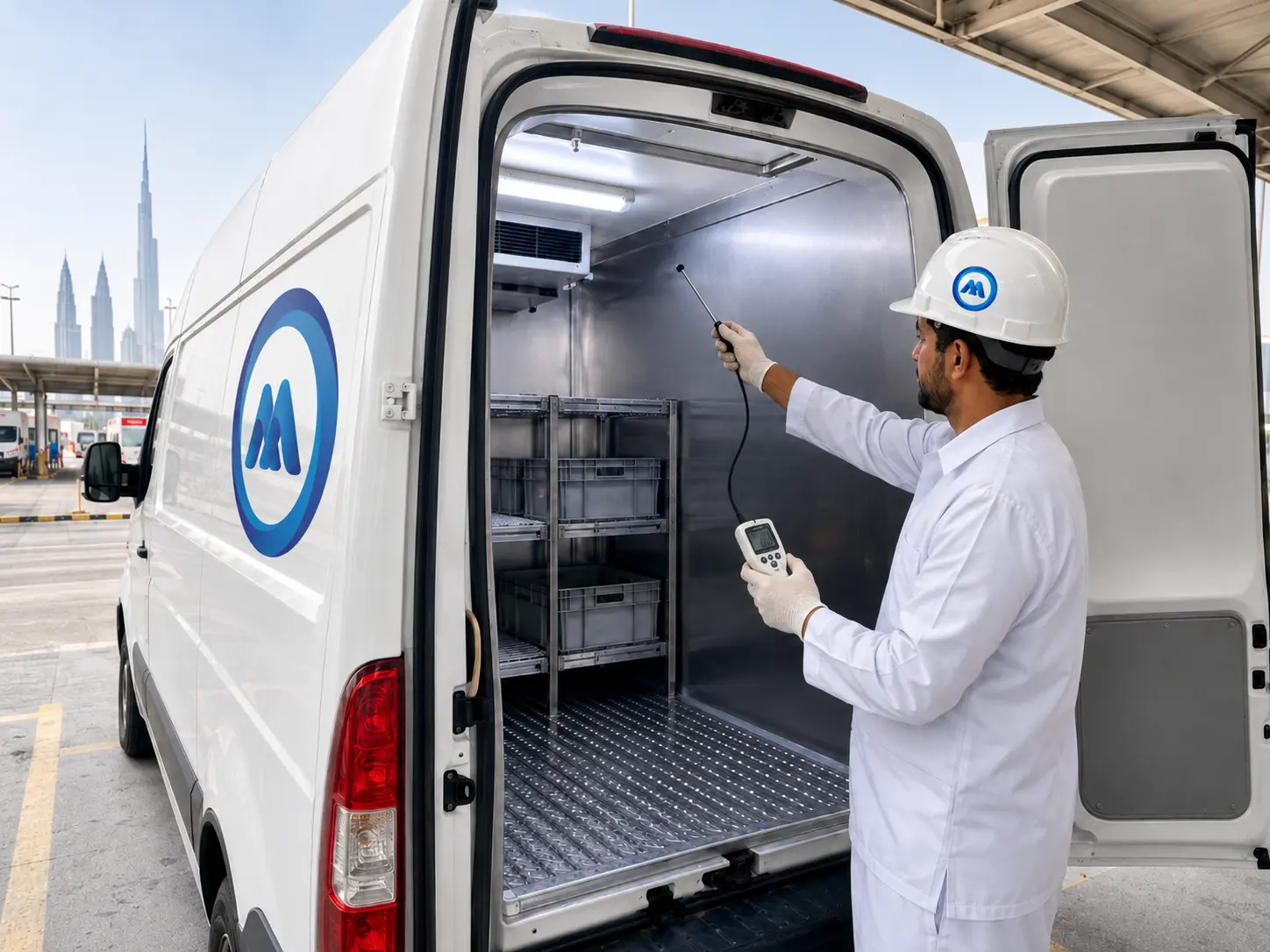
The refrigeration unit must demonstrate it can reach and maintain the designated temperature within a specified pull-down time. For 2026, all units must be equipped with calibrated, IoT-enabled temperature recording devices that retain data for at least 12 months and transmit real-time readings to the company’s FoodWatch portal. If the digital sensor reading differs from the inspector’s independent probe by more than 0.5°C, the vehicle fails.
4. Drainage and Hygiene Infrastructure
The floor drainage system must be designed to fully evacuate melt water and cleaning fluids. Drain holes must be fitted with one-way positive-seal plugs that allow water out but block the entry of pests and dust. A drain that is absent, cracked, or not flush with the floor is one of the most common — and most preventable — reasons for rejection.
5. Dedicated Usage Restriction
A vehicle holding a food transport permit is legally prohibited from carrying non-food items — chemicals, construction materials, waste, or general cargo — even in sealed packaging. Inspectors check the vehicle for residue, odours, or storage hooks inconsistent with food transport. Any evidence of dual-use results in permit suspension.
Permit Fees and Renewal Cycle
| Service | Fee (AED) | Validity |
|---|---|---|
| Light food transport vehicle inspection | 150 | 1 year |
| Heavy food transport vehicle inspection | 250 | 1 year |
| Re-inspection fee (after first failure) | 75 | N/A |
| Annual food truck permit | 3,000 | 1 year |
| Temporary event permit (1–7 days) | 160 | Event duration |
Renewal is annual and is synchronised with the vehicle’s RTA Mulkiya to create a single compliance checkpoint. Missing the renewal window does not simply mean an expired permit — it triggers an automatic flag on the company’s trade license file.
The Colour-Coded Sticker System
Once a vehicle passes inspection, Dubai Municipality issues a colour-coded sticker that must be displayed on the vehicle at all times. This system allows roadside enforcement officers to verify compliance instantly without digital checks.
| Sticker Colour | Temperature Designation | Authorised Cargo |
|---|---|---|
| Green | Refrigerated / Chilled (0°C to +8°C) | Fresh dairy, meat, poultry, produce, pharmaceuticals |
| Orange | Frozen (-18°C and below) | Ice cream, frozen meat, deep-freeze seafood |
| Yellow | Dry food transport | Grains, canned goods, bottled water, packaged snacks |
| Red | Heated / Hot food | Catering, ready-to-eat meals, hot bakery items |
Carrying cargo that does not match the vehicle’s sticker colour is a food safety violation, not a paperwork issue. Transporting frozen chicken (which requires -18°C) in a green-stickered chiller van (rated for 0°C to +8°C) will result in a fine starting at AED 500 and escalating to AED 5,000 or more if the violation is part of a systemic failure in the company’s HACCP plan. In severe cases involving spoiled food reaching consumers, Federal Law No. 10 of 2015 allows for fines up to AED 500,000 and potential imprisonment.
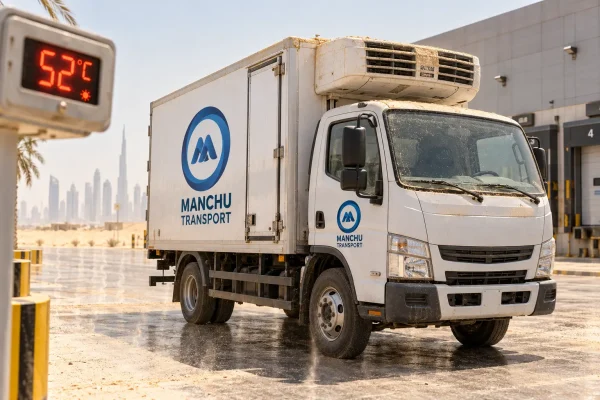
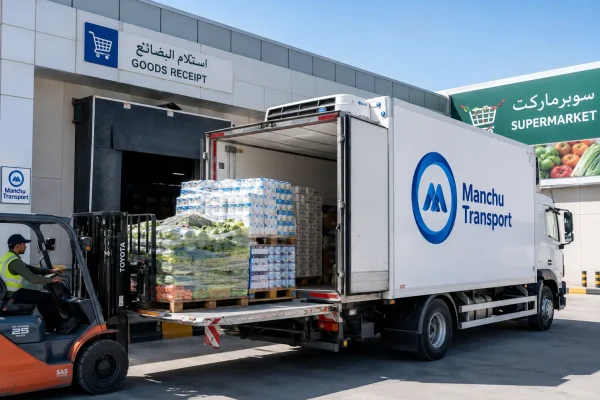
All Manchu Transport vehicles carry valid DM permits with the correct sticker for each vehicle’s temperature rating. See our chiller van rental in Dubai and chiller truck rental in Dubai pages for fleet specifications.
The DM Card: Occupational Health Card (OHC) for Drivers
The vehicle permit covers the hardware. The Occupational Health Card (OHC) — commonly called the DM Card — covers the human element. It is mandatory for every person who has direct or indirect contact with food during transport: drivers, loaders, and warehouse staff involved in food handling.
What the Medical Examination Involves
- Blood tests: Screening for Hepatitis, HIV, and Typhoid
- Chest X-ray: Mandatory screening for Tuberculosis
- Stool analysis: Testing for Salmonella, parasites, and other enteric pathogens
- Physical examination: Assessment of skin health, focusing on infected wounds or dermatitis that could harbour Staphylococcus bacteria
OHC Fees in 2026
| OHC Type | Fee (AED) | Notes |
|---|---|---|
| Standard food handler screening (DHA/DM) | 290 – 350 | For most logistics and transport staff |
| Free zone company screening (Trakhees-licensed) | 320 | For JAFZA, DAFZA, and other free zone operators |
| Fast-track processing | 500 – 600 | Results within 24–48 hours |
| Late renewal fine | 310 | Applied automatically 30 days after expiry |
OHC validity is strictly one year. Renewal must be initiated at least 30 days before expiry — the system does not send reminders, and an expired card triggers an automatic block on the company’s labour portal, which can prevent visa renewals for all staff across the business, not just the individual with the expired card.
FoodWatch: The Digital Backbone of Dubai’s Food Safety System
FoodWatch (foodwatch.dubai.ae) is Dubai Municipality’s mandatory digital compliance platform. By 2026, it is not a secondary requirement — it is the gateway through which all other permits flow. No municipality food transport permit can be issued without an active FoodWatch account, and the account must be maintained with current data at all times.
How FoodWatch Connects Everything
When a vehicle passes its DM inspection at Tasjeel, the permit is automatically updated in FoodWatch via a backend API. When a driver receives their OHC, it appears in the company’s digital staff list. This creates a live compliance dashboard that DM inspectors can access remotely. If a company has 10 vehicles on its trade license but only 5 valid permits showing on FoodWatch, the discrepancy is flagged automatically for a physical site visit.
What Must Be Maintained on FoodWatch
- Daily temperature logs uploaded from all transport units
- An updated list of the appointed Person in Charge (PIC) with a valid PIC certificate
- Supplier information for full food traceability
- Current vehicle permit and OHC records for all drivers
Failure to maintain accurate FoodWatch records carries fines ranging from AED 5,000 for temperature log gaps to AED 50,000 to AED 100,000 for serious traceability failures. Base account registration is free, but the investment in IoT temperature logging hardware is real — this cost is built into the daily rate of any legitimate certified rental provider.
Step-by-Step: The Full Application Process
The order of these steps matters. Attempting an inspection before FoodWatch registration, or sending staff for OHC tests before the trade license activity codes are correct, creates delays that can push your timeline out by weeks.
Phase 1: Commercial and Digital Foundation
- Secure a trade license from the Department of Economy and Tourism (DET) with food transport or trading activity codes correctly listed
- Register the company on FoodWatch immediately — this is the prerequisite for everything that follows
- Appoint a Person in Charge (PIC) and ensure they hold a valid PIC certificate
Phase 2: Vehicle Technical Preparation
- Fit the vehicle’s cargo compartment with SS304 stainless steel or seamless fiberglass lining
- Verify insulation thickness meets the required minimum for the intended temperature category
- Install and calibrate IoT temperature sensors connected to your FoodWatch account
- Fit positive-seal drain plugs flush with the floor
Phase 3: Physical Inspections
- Present the vehicle at an authorised centre (Tasjeel, Shamil, or Tamam) with the Mulkiya and trade license
- Send all drivers and food-handling staff for OHC medical tests at DHA-authorised centres simultaneously to avoid sequential delays
Phase 4: Activation
- Once the inspection is passed, the permit is issued digitally and synced to FoodWatch automatically
- Apply the colour-coded sticker to the vehicle in the approved position
- Confirm all driver OHC records appear in the FoodWatch staff list before the vehicle goes operational
Total timeline for a new company going from zero to a legally operating fleet: 8 to 12 weeks, assuming no vehicle rejections during the fit-out stage. Companies that attempt shortcuts on interior lining or skip the FoodWatch setup routinely extend this to 16 weeks or more.
Common Reasons for Inspection Failure
First-time failure rates are high among operators who have not researched the 2026 standards in advance. These are the most frequent rejection reasons:
- Surface porosity: Aluminium or plastic lining with visible scratches or cracks. The only compliant solution is SS304 stainless steel or professional-grade fiberglass — no halfway measures.
- Thermal bridges: Insulation gaps around door frames or wheel arches, detected via thermal imaging. Visible condensation during inspection = automatic failure.
- Inadequate drainage: Missing drain plug, cracked plug, or a plug not flush with the floor. A AED 75 re-inspection fee for a AED 20 part is avoidable.
- Calibration discrepancy: Digital sensor reading differs from the inspector’s probe by more than 0.5°C. Calibrate sensors the day before inspection, not weeks beforehand.
- Illegal modifications: Any structural modification affecting RTA roadworthiness is flagged before the DM inspector even begins their check — the RTA assessment happens first.
Fines and Enforcement: The 2026 Schedule
| Offence | Fine (AED) | Enforcing Authority |
|---|---|---|
| Operating without a valid DM vehicle permit | 5,000 – 10,000 | Dubai Municipality |
| Expired OHC per staff member | 500 – 1,000 | DM / DHA |
| FoodWatch temperature log gap | 5,000 | Dubai Municipality |
| Cargo mismatch with sticker colour | 500 – 5,000 | Dubai Municipality |
| Unauthorised vehicle branding | 1,000 – 5,000 | RTA / Police |
| Serious food traceability failure | 50,000 – 100,000 | Dubai Municipality |
Enforcement is a dual-track effort between DM inspectors conducting scheduled and surprise audits, and Dubai Police during roadside checks. A single vehicle operating without a permit for one month can cost more in fines than an entire year of legitimate compliance fees.
Does the Dubai Permit Cover Other Emirates?
The DM food transport permit covers operations within the Emirate of Dubai. Vehicles delivering into Sharjah must comply with Sharjah Municipality and SEDD rules for delivery activity — in some cases requiring Sharjah-specific commercial plates or local delivery permits ranging from AED 500 for motorcycles to AED 3,500 for larger vehicles.
For Abu Dhabi operations, the regulatory framework is entirely separate and in some respects more demanding.
Abu Dhabi Requirements: ADAFSA, ASATEEL, and EFST
Operators running chiller vans in Abu Dhabi or chiller trucks in Abu Dhabi face three requirements that have no Dubai equivalent:
ADAFSA Permit
The Abu Dhabi Agriculture and Food Safety Authority (ADAFSA) is the equivalent of Dubai Municipality’s Food Safety Department. All food transport vehicles in Abu Dhabi must carry a valid ADAFSA permit, obtained through the Food Watch Department (FWD). The vehicle inspection criteria are similar to Dubai’s but emphasise industrial zone compliance for KIZAD, Mussafah, and ICAD operations.
ASATEEL GPS Tracking
The Integrated Transport Centre (ITC) mandates that every commercial vehicle in Abu Dhabi carry an ITC-approved GPS On-Board Unit (OBU). For refrigerated vehicles, the OBU must also monitor cargo temperature. This data is transmitted to the ASATEEL platform in real time. Non-compliance fines reach AED 10,000 per violation — significantly higher than most Dubai penalties.
EFST Certification for Drivers
While Dubai uses the DM Card (OHC), Abu Dhabi mandates the Essential Food Safety Training (EFST) certificate for every food handler and driver. The training is available in multiple languages and covers food safety principles, cold chain management, and ADAFSA-specific compliance requirements. Every driver operating in Abu Dhabi must hold a current EFST certificate alongside their standard UAE driving licence.
Renting a Pre-Certified Vehicle: The Faster Path to Compliance
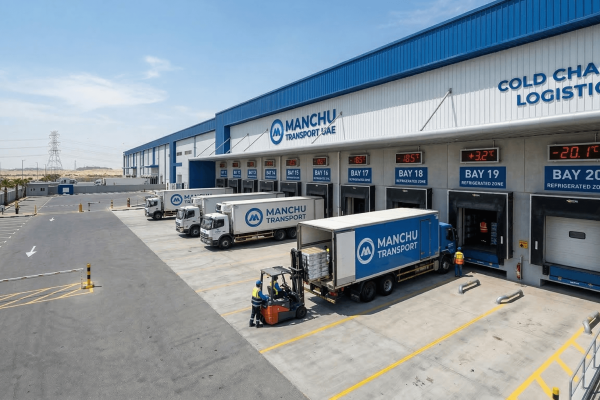
For businesses that need to move food now rather than wait 8 to 12 weeks for fleet certification, renting from a provider with pre-certified vehicles is the practical solution. All Manchu Transport vehicles carry current DM permits with valid colour-coded stickers, all drivers hold active OHC cards, every vehicle is registered on FoodWatch with real-time temperature logging, and our Abu Dhabi fleet meets ADAFSA, ASATEEL, and EFST requirements.
You handle your trade license and FoodWatch company registration — we handle every vehicle and driver compliance requirement from day one. Request a free quote and specify whether your operation is in Dubai, Abu Dhabi, or both. Or call us at +971 54 7171 345 to discuss your requirements directly.
Need Reliable Refrigerated Transport?
Get a free quote for chiller van, truck, or trailer rental in Dubai and across the UAE.
Get a Free QuoteRecommended Services
Our Refrigerated Transport Services
Choose the vehicle that matches your route, payload, and temperature requirements.
 Abu Dhabi
Chiller Truck Rental Abu Dhabi
ADAFSA and ASATEEL-compliant truck rentals for Mussafah, KIZAD, Khalifa City, and Al Ain.
View Service Last-Mile
Chiller Van Rental Dubai
1-Ton and 1.5-Ton chiller vans for last-mile cold chain, catering, and pharmacy routes.
View Service
Dubai
Chiller Truck Rental Dubai
3-Ton to 10-Ton refrigerated trucks for supermarket, pharma, and wholesale distribution.
View Service Cross-Border
Chiller Trailer Rental Dubai
20-Ton and 25-Ton reefer trailers for port clearances, warehouse transfers, and GCC routes.
View Service