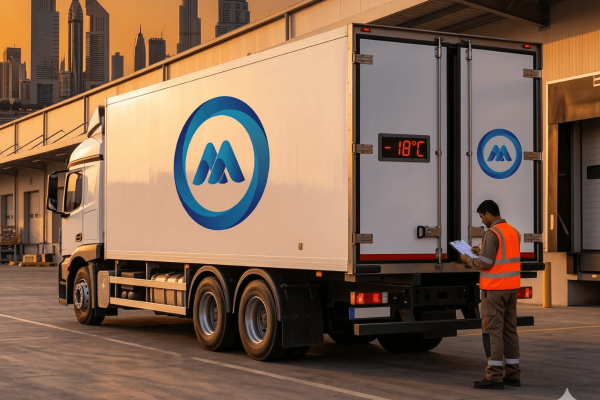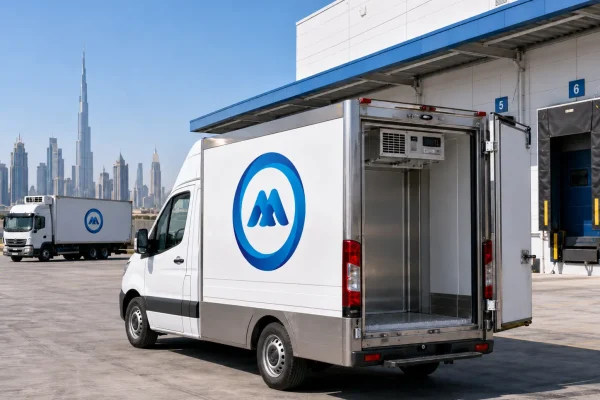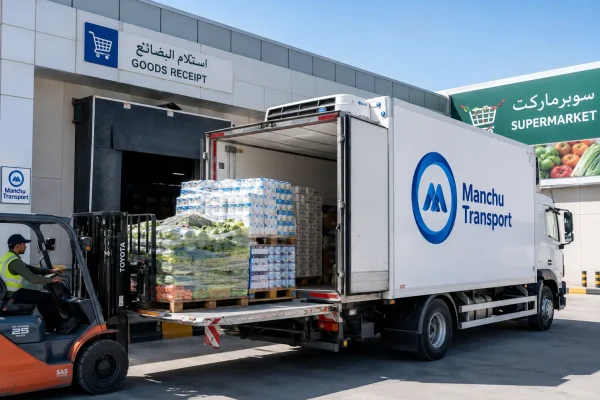
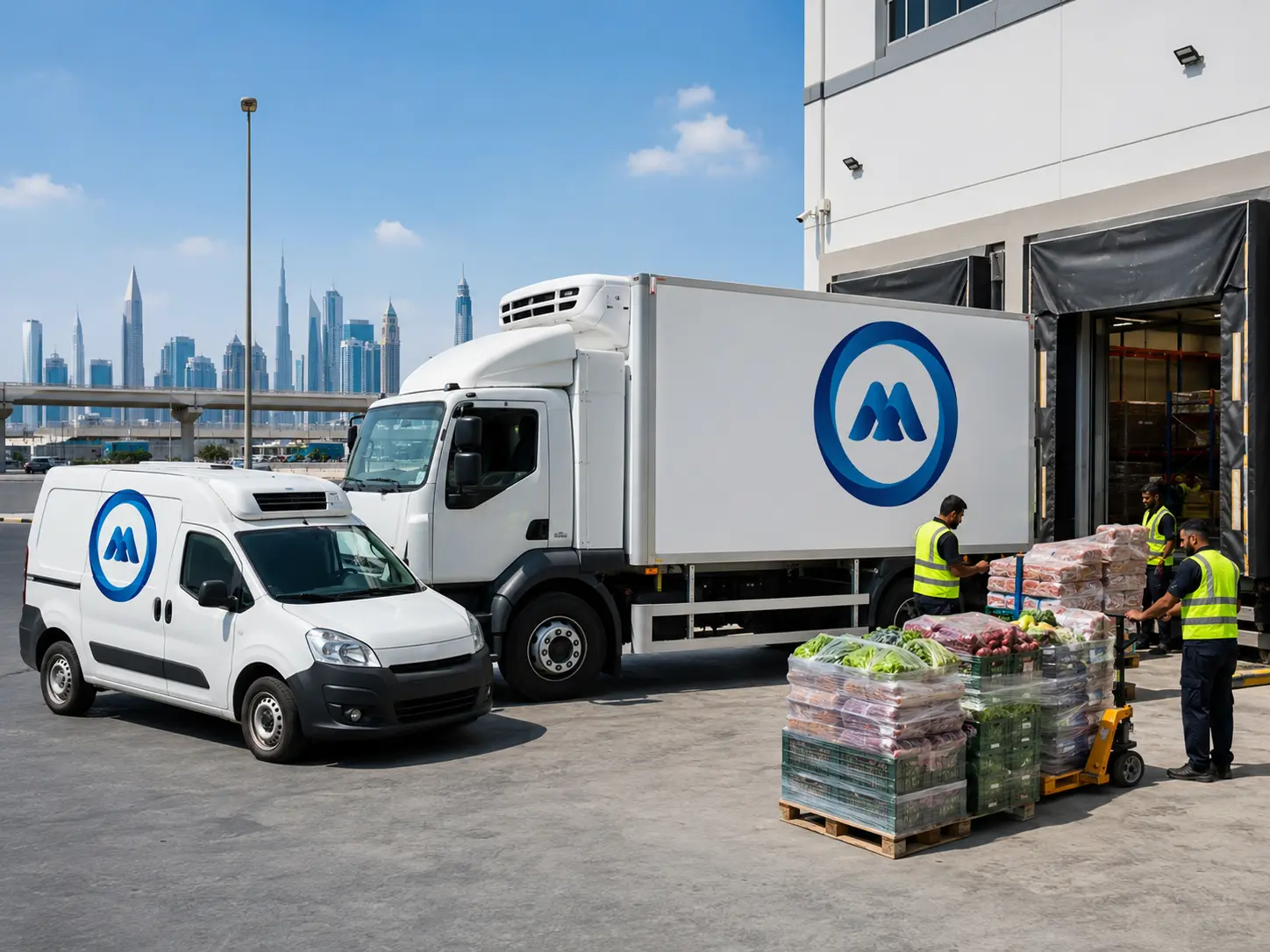
The Dubai to Abu Dhabi corridor is one of the busiest refrigerated delivery routes in the UAE. Food distributors, catering companies, pharmaceutical suppliers, supermarkets and cold storage operators move chilled and frozen cargo between the two emirates every day.
The route looks simple on a map. In practice, it needs careful planning.
A vehicle leaving Dubai may be fully legal under Dubai Municipality rules, but once it crosses into Abu Dhabi it enters a different compliance environment. The route, vehicle size, driver documents, temperature records and fleet tracking setup all matter. A small mistake can mean delivery delays, rejected cargo or avoidable fines.
This guide explains how to plan a Dubai to Abu Dhabi refrigerated delivery in 2026, including:
- E11 vs E311 route selection
- DM Card and ADAFSA requirements
- ASATEEL registration for Abu Dhabi operations
- Best vehicle type by delivery zone
- Transit times from Dubai Investment Park
- Fuel cost estimates
- Common mistakes that cause failed cold chain deliveries
Quick Answer: Which Route Should You Use?
For most refrigerated trucks, the correct route from Dubai to Abu Dhabi is the E311 corridor, especially for 3-Ton, 7-Ton and 10-Ton chiller trucks.
For smaller 1-Ton and 1.5-Ton chiller vans, the E11 can still be practical for Abu Dhabi city deliveries because these vehicles are lighter and easier to route into urban loading areas.
As a rule of thumb:
| Vehicle Type | Best Route | Best Use |
|---|---|---|
| 1-Ton chiller van | E11 | Abu Dhabi city, hotels, restaurants, pharmacies |
| 1.5-Ton chiller van | E11 | Multi-stop city deliveries and urgent small loads |
| 3-Ton chiller truck | E311 | Mussafah, ICAD, Al Ain and distributor runs |
| 7-Ton chiller truck | E311 | Palletized loads, warehouses, hypermarket supply |
| 10-Ton chiller truck | E311 | High-volume industrial and wholesale deliveries |
| Chiller trailer | E311 and industrial corridors | KIZAD, Khalifa Port and full-truckload movements |
The safest operational rule is simple: use vans for city access and trucks for industrial routes.
E11 vs E311: Why Vehicle Size Matters
There are two main highway corridors between Dubai and Abu Dhabi.
The E11 coastal route is the familiar direct highway into Abu Dhabi city. It is usually the best option for light chiller vans going to hotels, restaurants, pharmacies and small supermarket branches.
The E311 inland route is more suitable for commercial freight, industrial zones and heavy refrigerated trucks. From Dubai Investment Park, it gives practical access toward Mussafah, ICAD, KIZAD and other freight-heavy destinations without sending trucks through dense city traffic.
In late 2025, Abu Dhabi introduced tighter heavy vehicle movement controls on key routes including E11 and E10. For refrigerated logistics teams, the practical impact is that heavy trucks should not be planned like light vans. Dispatchers need to match the route to the vehicle class before the trip starts.
| Route | Vehicle Class | Approx. Distance from DIP | Practical Notes |
|---|---|---|---|
| E11 coastal route | 1-Ton and 1.5-Ton chiller vans | 115 km to Abu Dhabi city | Best for city deliveries and smaller urgent loads |
| E311 inland route | 3-Ton to 10-Ton trucks and trailers | 100 km to Mussafah | Best for industrial zones, bulk loads and heavy vehicles |
| E75 and freight connectors | Heavy freight | Varies by destination | Used for industrial access and truck diversions |
Many of these cross-emirate loads terminate in Abu Dhabi’s industrial heartland — our KIZAD and Mussafah cold chain guide covers the destination zones in detail.
Heavy vehicle peak-hour restrictions in Abu Dhabi can also affect dispatch planning. For early morning and afternoon deliveries, confirm the current movement windows before sending a truck. A refrigerated load may be ready, but a truck stuck outside a time window is still a failed schedule.
Compliance: Dubai DM Card Is Not Enough for Abu Dhabi
One of the most common mistakes on this route is assuming that a Dubai Municipality Food Transport Vehicle Permit, often called a DM Card, is enough for Abu Dhabi deliveries.
It is not.
The DM Card confirms that a food transport vehicle meets Dubai Municipality requirements for hygiene, refrigeration and food transport suitability. It is essential for Dubai operations, but Abu Dhabi has its own food safety and transport requirements.
For Dubai to Abu Dhabi refrigerated delivery, the compliance picture usually includes:
- Dubai Municipality Food Transport Vehicle Permit for food transport in Dubai
- ADAFSA compliance for food and agricultural products entering Abu Dhabi
- ASATEEL registration for commercial vehicle movement in Abu Dhabi
- Continuous temperature records for chilled or frozen cargo
- Correct driver documents and health certification where required
In practical terms, a vehicle serving both emirates should be prepared for both systems. A restaurant supplier, supermarket receiver or pharmaceutical warehouse in Abu Dhabi may ask for temperature records, vehicle documents and proof that the vehicle is approved for the work.
ADAFSA Requirements for Referred Food Shipments
ADAFSA stands for Abu Dhabi Agriculture and Food Safety Authority. When food cargo moves from Dubai into Abu Dhabi, it may be treated as a referred food shipment from another emirate.
That means the receiving side and logistics operator need to be ready for inspection and documentation checks.
ADAFSA may look at:
- Temperature logs from the full journey
- Whether chilled cargo stayed at safe refrigerated temperatures
- Whether frozen cargo stayed at freezer temperature
- Vehicle cleanliness and cargo segregation
- Permits, approvals and receiving documentation
For chilled food, many UAE food safety references use 5 degrees Celsius or below as a key control point. For frozen meat, seafood and similar products, -18 degrees Celsius is commonly used as the safe frozen benchmark. Your exact requirement depends on cargo type, product label and receiver policy.
The best practice is to pre-cool the vehicle, load quickly, keep doors closed during transit and keep a clean temperature record from pickup to delivery.
ASATEEL: The Abu Dhabi Fleet Tracking Requirement
ASATEEL is Abu Dhabi’s commercial transport platform managed by Abu Dhabi Mobility through the Integrated Transport Centre. It is designed to improve safety, accountability and monitoring for commercial transport activity in the emirate.
For Dubai-based companies that regularly enter Abu Dhabi with commercial freight vehicles, ASATEEL is not something to leave until the day of dispatch. Vehicles may need approved GPS tracking and registration before operating in Abu Dhabi.
Dubai operators should check:
- Whether the company is registered correctly for Abu Dhabi commercial transport activity
- Whether vehicles entering Abu Dhabi are added to the ASATEEL system
- Whether GPS devices are approved and transmitting correctly
- Whether drivers and vehicle documents are up to date
- Whether freight permits are needed for the exact operation
For refrigerated transport, ASATEEL matters because a delivery can be operationally perfect but still fail on fleet compliance. If the cargo is valuable, do not send the vehicle first and ask compliance questions later.
Delivery Zones from Dubai Investment Park
Manchu Transport operates from Dubai Investment Park, which is a useful base for Dubai to Abu Dhabi refrigerated transport. DIP sits close to the E311 and E611 networks, so vehicles can move toward Abu Dhabi without crossing central Dubai first.
The four main Abu Dhabi delivery zones have different vehicle needs.
Mussafah and ICAD
Mussafah and ICAD are the core industrial delivery zones for food manufacturing, cold storage, wholesale distribution and production facilities.
These locations usually need palletized cargo movement, scheduled receiving times and larger refrigerated trucks. A 3-Ton truck can work for mid-size distributor loads, while 7-Ton and 10-Ton trucks are better for warehouse-to-warehouse delivery.
- Approx. distance from DIP: 100 km
- Typical transit time: 1 hour 10 minutes in clear conditions
- Best vehicles: 3-Ton, 7-Ton and 10-Ton chiller trucks
Khalifa Port and KIZAD
KIZAD and Khalifa Port are important for importers, exporters, food manufacturers and raw material movements. The distance from DIP can be shorter than a city delivery, but the documentation burden is higher.
These trips often involve customs coordination, port timing, temperature records and large-volume cargo. A chiller trailer or 7-Ton to 10-Ton truck is often more suitable than a van.
- Approx. distance from DIP: 55 km
- Typical transit time: 45 minutes in clear conditions
- Best vehicles: 7-Ton trucks, 10-Ton trucks and chiller trailers
Abu Dhabi City Centre
Abu Dhabi city deliveries are different. Hotels, restaurants, pharmacies and smaller retail branches often need smaller loads, tight delivery windows and easy access to loading bays.
This is where a 1-Ton or 1.5-Ton chiller van is usually the better choice. A large truck may look cheaper per kilogram, but it can be the wrong tool for narrow city access and multi-stop deliveries.
- Approx. distance from DIP: 115 km
- Typical transit time: 1 hour 20 minutes plus last-mile time
- Best vehicles: 1-Ton and 1.5-Ton chiller vans
Al Ain
Al Ain is part of Abu Dhabi emirate and has the same broad compliance considerations. It is a longer sustained run from Dubai, often used for agriculture, regional distribution, pharmaceutical delivery and FMCG supply.
Because the drive is longer, vehicle condition and refrigeration strength matter. In summer, weak cooling units show their problems on this route quickly.
- Approx. distance from DIP: 130 km
- Typical transit time: 1 hour 30 minutes
- Best vehicles: 3-Ton and 7-Ton chiller trucks, depending on load size
For a full list of areas covered, see our Areas We Serve page.
Delivery Zone Comparison
| Destination | Main Cargo Type | Approx. Distance from DIP | Typical Transit Time | Best Vehicle |
|---|---|---|---|---|
| Mussafah / ICAD | Manufacturing, distribution, palletized food | 100 km | 1 hr 10 min | 3-Ton to 10-Ton trucks |
| Khalifa Port / KIZAD | Imports, exports, bulk perishables | 55 km | 45 min | 7-Ton to 10-Ton trucks, trailers |
| Abu Dhabi City | Hotels, restaurants, pharmacies | 115 km | 1 hr 20 min | 1-Ton to 1.5-Ton vans |
| Al Ain | Agriculture, pharma, regional distribution | 130 km | 1 hr 30 min | 3-Ton to 7-Ton trucks |
Choosing the Right Refrigerated Vehicle
The best vehicle is not always the biggest vehicle. The best vehicle is the one that matches the route, delivery point, cargo volume and temperature requirement.
1-Ton Chiller Van
Best for small chilled deliveries, restaurant supply, pharmacy restocking and urgent city work. It is easy to park, quick to load and suitable for multi-stop routes.
Manchu Transport price: from AED 350 per day.
1.5-Ton Chiller Van
Best for higher-volume city deliveries where a 1-Ton van is too small but a truck is too large. It is a practical choice for hotels, catering companies and online grocery routes.
Manchu Transport price: from AED 400 per day.
3-Ton Chiller Truck
Best for distributor routes, supermarket supply, medium palletized loads and Dubai to Mussafah or Dubai to Al Ain deliveries. It gives more capacity without moving into the complexity of the largest trucks.
Manchu Transport price: from AED 600 per day.
7-Ton and 10-Ton Chiller Trucks
Best for bulk deliveries, food manufacturing, hypermarket warehouses and high-volume refrigerated transport. These vehicles need proper route planning, receiving coordination and compliance checks before dispatch.
Manchu Transport prices:
- 7-Ton Chiller Truck: from AED 700 per day
- 10-Ton Chiller Truck: from AED 800 per day
Chiller Trailer
Best for full-truckload transfers, port work, KIZAD movements and high-volume industrial shipments. Trailers are not ideal for multi-stop city deliveries because door openings create thermal loss and slow the whole route.
Manchu Transport price: from AED 900 per day.
Fuel Cost Estimates for Dubai to Abu Dhabi Routes
Fuel is a serious cost on refrigerated delivery routes because the cooling system keeps working throughout the journey. A chiller van or truck uses more fuel than a dry cargo vehicle on the same route.
The estimates below use diesel at AED 4.33 per litre, which was the working assumption in the June 2026 cost model. Actual fuel prices change monthly in the UAE, so treat these as planning estimates.
Assumptions:
- 1.5-Ton chiller van: around 10 km per litre with active cooling
- 3-Ton to 10-Ton chiller truck: around 4.5 km per litre with active cooling
| Route from DIP | Approx. Round Trip | Estimated Van Fuel Cost | Estimated Truck Fuel Cost |
|---|---|---|---|
| DIP to Mussafah | 200 km | AED 87 | AED 192 |
| DIP to Abu Dhabi City | 230 km | AED 100 | AED 221 |
| DIP to Al Ain | 260 km | AED 113 | AED 250 |
Fuel is only one line item. Tolls, driver time, waiting time, replacement vehicle cover, permits, maintenance and insurance also affect the real cost of the route.
Daily Rental vs Monthly Contract
For one-off deliveries, daily rental is simple. For repeated Dubai to Abu Dhabi refrigerated delivery, monthly rental is often more cost-effective.
For example, a 1.5-Ton chiller van at AED 400 per day adds up quickly if used every working day. A monthly contract can bring the effective daily cost down and may include a cleaner operating structure for maintenance, replacement vehicles and compliance.
Monthly rental makes sense when:
- You deliver to Abu Dhabi more than 10 to 12 days per month
- The same route repeats every week
- You need guaranteed vehicle availability
- You want one provider responsible for maintenance and compliance support
- Your team cannot afford delivery failure during peak season
Daily rental makes sense when:
- You have a single urgent delivery
- You are testing a new Abu Dhabi customer route
- Demand is seasonal or event-based
- You need temporary overflow capacity
4 Mistakes That Cause Failed Deliveries
1. Sending a Dubai-only vehicle into Abu Dhabi
A vehicle may have a valid DM Card and still be missing the Abu Dhabi side of compliance. For regular Abu Dhabi deliveries, check ADAFSA and ASATEEL requirements before the first run.
2. Using the wrong vehicle for the destination
A 10-Ton truck might be efficient for a warehouse, but it is usually the wrong choice for hotel and restaurant deliveries in Abu Dhabi city. A smaller chiller van can complete the route faster and with fewer access problems.
3. Loading into a hot cargo box
In UAE summer, a parked refrigerated vehicle can become extremely hot inside. The chiller unit should be running before loading begins. For frozen cargo, pre-cooling is especially important because the unit is designed to maintain temperature, not rescue cargo loaded into a hot box.
4. Leaving gaps in temperature records
If a receiver or inspector asks for temperature history, a missing record creates doubt. Keep the unit running, use calibrated sensors where required and make sure temperature data is available for the full trip.
Practical Checklist Before Dispatch
Before sending a refrigerated vehicle from Dubai to Abu Dhabi, confirm:
- Cargo temperature requirement
- Vehicle size and route
- DM Card status
- Abu Dhabi compliance requirements
- ASATEEL registration where applicable
- Driver documents and health certification
- Pre-cooling time
- Temperature logger is working
- Receiving window and unloading access
- Backup plan if the vehicle is delayed
This checklist is basic, but it prevents most avoidable failures.
Need a Compliant Dubai to Abu Dhabi Chiller Vehicle?
Manchu Transport provides refrigerated vehicle rental from Dubai Investment Park for Abu Dhabi routes, including Mussafah, ICAD, KIZAD, Khalifa Port, Abu Dhabi city and Al Ain.
Our fleet includes:
- 1-Ton Chiller Van: from AED 350/day
- 1.5-Ton Chiller Van: from AED 400/day
- 3-Ton Chiller Truck: from AED 600/day
- 7-Ton Chiller Truck: from AED 700/day
- 10-Ton Chiller Truck: from AED 800/day
- Chiller Trailer: from AED 900/day
For van routes, visit: Chiller Van Rental Abu Dhabi
For truck routes, visit: Chiller Truck Rental Abu Dhabi
For urgent availability, call +971 54 7171 345 or request a quote at: Get a Quote
Need Reliable Refrigerated Transport?
Get a free quote for chiller van, truck, or trailer rental in Dubai and across the UAE.
Get a Free QuoteRecommended Services
Our Refrigerated Transport Services
Choose the vehicle that matches your route, payload, and temperature requirements.
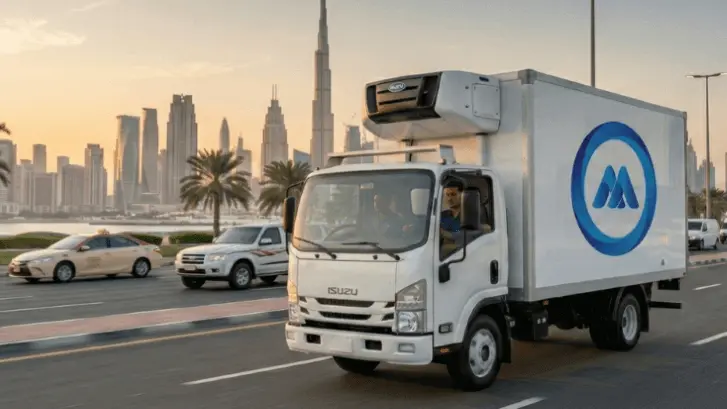 Abu Dhabi
Chiller Truck Rental Abu Dhabi
ADAFSA and ASATEEL-compliant truck rentals for Mussafah, KIZAD, Khalifa City, and Al Ain.
View Service Last-Mile
Chiller Van Rental Dubai
1-Ton and 1.5-Ton chiller vans for last-mile cold chain, catering, and pharmacy routes.
View Service
Dubai
Chiller Truck Rental Dubai
3-Ton to 10-Ton refrigerated trucks for supermarket, pharma, and wholesale distribution.
View Service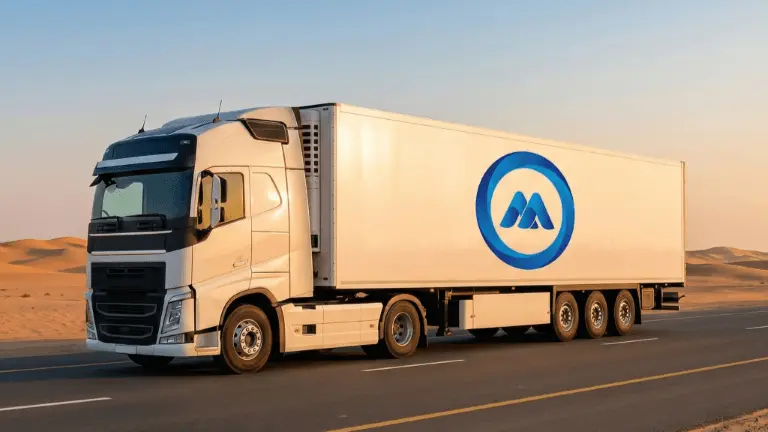 Cross-Border
Chiller Trailer Rental Dubai
20-Ton and 25-Ton reefer trailers for port clearances, warehouse transfers, and GCC routes.
View Service