Turning a chiller van’s thermostat down as far as it goes does not make it a freezer truck. That single misunderstanding causes more frozen-cargo losses in the UAE than almost any other operational mistake, because a standard chiller van set to its coldest setting typically bottoms out around -5°C to -8°C — nowhere near the -18°C regulatory minimum for frozen food. This guide explains why deep-freeze transport (-18°C to -25°C) is a fundamentally different engineering problem than chilled transport, what actually breaks when it is handled with the wrong vehicle, and what UAE regulations require before you load a single pallet.
Chilled Cools Cargo Down. Frozen Just Has to Keep It There.
This is the distinction that gets missed most often. Chilled transport is active cooling — fresh produce keeps respiring and generating heat even after harvest, so the refrigeration unit is continuously pulling heat out of the cargo itself to hold it in the 0°C to +8°C range.
Deep-freeze transport does not do this. The freezing itself happens at a blast-freezer facility before the goods are ever loaded — the vehicle’s only job is to hold thermal equilibrium and intercept ambient heat before it reaches the cargo. That sounds like an easier job, but it is not: when water inside frozen product starts to melt, it absorbs an enormous amount of energy (the latent heat of fusion) before its temperature even begins to rise. In a 45–50°C UAE summer, an underinsulated or underpowered vehicle will let exactly that happen at the edges of a pallet, even while the display panel still reads a “safe” number.
Why the Insulation Has To Be Different, Not Just Thicker
Vehicle insulation performance is measured by its K-value (heat transfer coefficient, in W/m²K) — the lower the number, the better it resists heat. International standards (the ATP framework, referenced by UAE food transport regulation) draw a hard line here:
| Classification | Max K-Value | Permitted Use | Fits Deep-Freeze? |
|---|---|---|---|
| Normally Insulated (IN) | ≤ 0.7 W/m²K | Chilled cargo, 0°C to +8°C | No — heat ingress overwhelms the unit |
| Heavily Insulated (IR / FRC) | ≤ 0.4 W/m²K | Frozen cargo, -18°C to -25°C | Yes — required standard |
Reaching an FRC-grade K-value takes meaningfully thicker polyurethane foam (typically 120–150mm versus 75–100mm for a chiller build), injected under pressure to avoid gaps, plus thermal breaks in the body structure. Without a thermal break, the metal chassis itself becomes a direct heat conduit straight from a 50°C exterior into a -18°C compartment — no amount of compressor power fixes a structural leak like that.
Airflow: Frozen Cargo Needs the Opposite Setup From Chilled Cargo
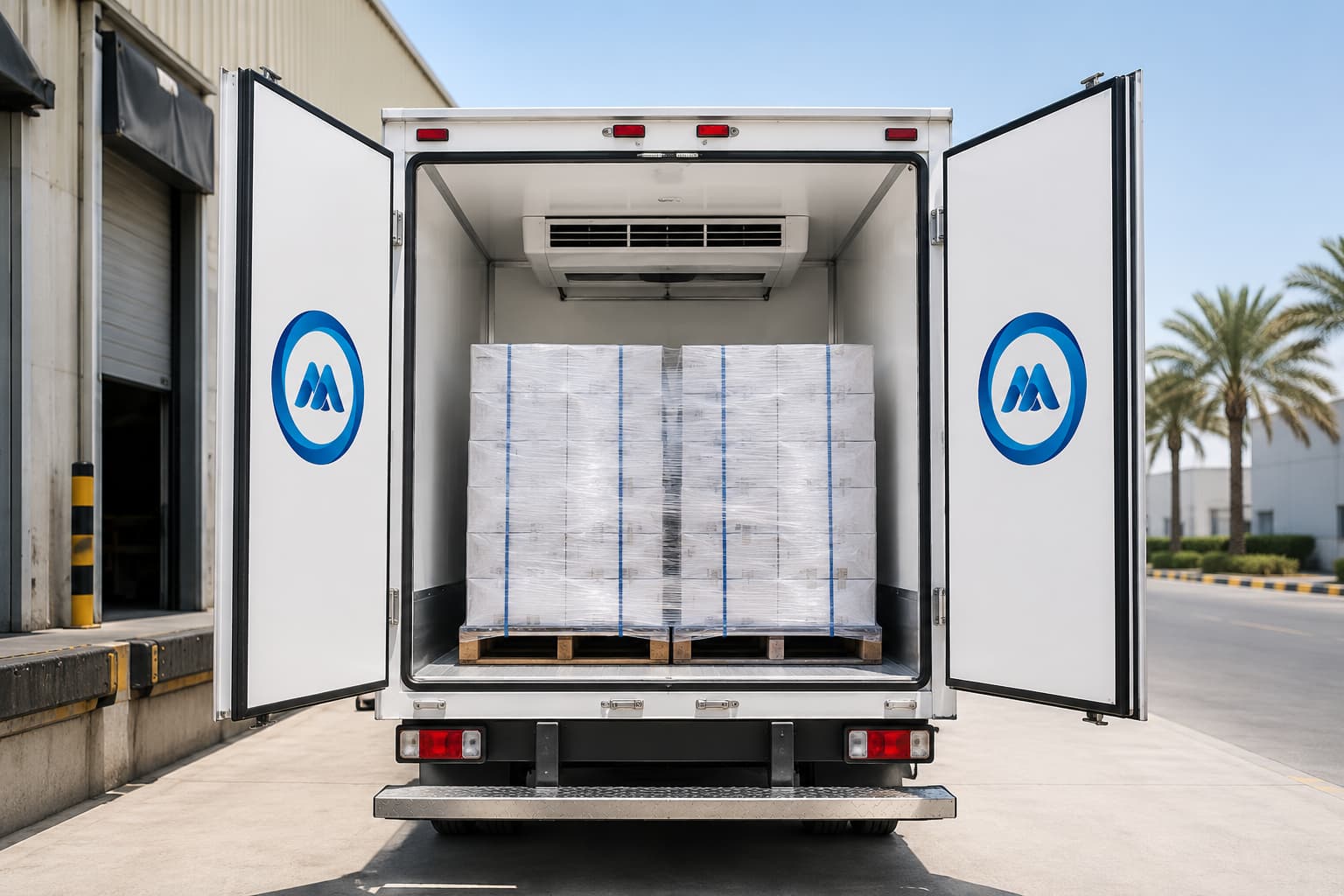
Because frozen cargo is not generating its own heat the way fresh produce does, the goal shifts from “push cold air through the load” to “wrap the load in a cold air shield and keep it away from the walls.” That requires specific structural features that a standard chiller body does not have:
- T-bar aluminium floors — raised channels that let cold air travel the full length of the vehicle underneath the pallets, instead of pooling under a flat floor where the lowest cargo tier sits directly against sun-heated flooring
- Return-air bulkheads — a partition near the front that forces the returning air to be drawn from floor level, so cold air is not short-circuiting straight back to the evaporator without ever reaching the rear doors
- Delivery air chutes — ceiling ducting that carries discharge air all the way to the back of the load, which is otherwise the area most exposed to heat when the doors open
Loading discipline matters just as much as the hardware: cargo stacked flush to the ceiling, walls, or rear doors blocks this airflow entirely. A minimum 10–15cm clearance above the load is not a suggestion — without it, the discharge air short-cycles back to the sensor near the front, the controller reads “target reached,” and the compressor throttles down while the rear of the load is quietly absorbing ambient heat.
Why Frost Buildup Is a Freezer-Specific Problem
Every time the rear doors open on a delivery in 45–50°C heat, humid ambient air rushes in and hits the evaporator coil — well below freezing — where it instantly turns to frost. Left unmanaged, that frost builds into ice that insulates the coil and blocks airflow through it, eventually stopping cooling altogether.
Standard chilled units can defrost passively — running fans without the compressor while ambient air above 0°C slowly melts the frost. That trick is physically impossible inside a -18°C compartment, because the surrounding air is already below freezing. Deep-freeze units instead rely on active defrost, most commonly hot-gas defrost, which reroutes hot compressor discharge gas directly into the evaporator to melt the ice from the inside in roughly 12–20 minutes, with only a 1–3°C swing in cabin temperature. This is a mechanical feature a chilled-only vehicle simply does not have, and it is one of the clearest signs of whether a truck was actually built for frozen work.
What Happens to the Cargo When This Goes Wrong
Temperature drift in frozen cargo does not just make it “less cold” — it causes specific, often irreversible damage depending on the product:
- Frozen meat and poultry: Even brief warming melts the smallest ice crystals inside the muscle tissue. When it refreezes, that water migrates onto larger crystals, which grow and physically rupture the cell structure. The visible result at thaw is heavy drip loss and a tougher, drier product — damage that cannot be reversed by refreezing it colder again.
- Frozen seafood: Certain species (tuna, mackerel, mahi-mahi) carry naturally occurring bacteria that convert to histamine once the surface temperature rises. Histamine is heat-stable — once it forms, neither refreezing nor cooking removes the food-safety risk.
- Ice cream: Requires -18°C to -25°C specifically because its stabilised sugar-and-fat structure is sensitive to even small temperature swings. Fluctuation drives sugar (lactose) crystallisation and ice-crystal regrowth, producing the gritty, “sandy” texture that gets a shipment rejected on sight.
- Pharmaceuticals and biologics: The most severe case — protein-based products can lose their structure and therapeutic effect from a temperature excursion with zero visible sign, making continuous, logged monitoring non-negotiable rather than optional.
UAE Regulatory Requirements for Frozen Transport
Deep-freeze transport is regulated more tightly than chilled transport across both major emirates, and the requirements are enforced at the vehicle level, not just the facility level.
- Abu Dhabi (ADAFSA Regulation No. 6 of 2010): Mandates HACCP-based controls across the full food chain, including transport, with “one step backward, one step forward” traceability so a temperature-abused batch can be isolated and recalled quickly. Using a vehicle not structurally certified for frozen transport is a direct violation of this framework. See our guide to the ADAFSA Mobile Food Establishment Permit for the full permit process.
- Dubai (Dubai Municipality Food Code): Section 3.2.3.2 requires frozen food to be held at -18°C or below continuously, with mandatory temperature monitoring throughout transport. Vehicle-specific requirements are detailed in DM-FSD-GU63, and every commercial food vehicle must be separately inspected and approved before operating.
- Digital traceability: Dubai Municipality’s FoodWatch platform requires continuous digital temperature logs, not paper records. Presenting evidence that frozen goods travelled in a chilled-only vehicle, or gaps in the temperature log, is treated as a critical violation — with fines that can escalate from AED 50,000 into six figures for serious repeat breaches, alongside permit suspension.
For the general permit and DM Card process behind all food transport (chilled or frozen), see our guide to the Dubai Municipality Food Transport Vehicle Permit.
Checklist: Confirming a Vehicle Is Actually Built for Deep-Freeze
- FRC/IR insulation rating — not a “chiller van turned down cold,” a purpose-built frozen body
- T-bar floor and return-air bulkhead — confirms proper internal airflow design, not just a strong compressor
- Active hot-gas defrost — off-cycle defrost alone means the vehicle was not designed for sub-zero operation
- Calibrated sensor with continuous digital logging — required for ADAFSA and Dubai Municipality compliance, and the only real evidence the cold chain held
- Pre-trip temperature log — showing the cargo bay reached -18°C or below before loading began, not after
Frequently Asked Questions
Can I use a chiller van for frozen goods if I set the temperature as low as it goes?
No. A standard chiller van typically bottoms out around -5°C to -8°C, well short of the -18°C regulatory minimum, and lacks the insulation, airflow design, and active defrost system frozen cargo needs. It is also a direct compliance violation under both ADAFSA and Dubai Municipality rules.
What temperature does frozen food actually need to stay at during UAE transport?
-18°C or below for standard frozen goods, and -25°C specifically for ice cream, per Dubai Municipality’s Food Code and ADAFSA’s food safety regulations.
Why does my frozen cargo arrive damaged even though the display showed the right temperature?
Most commonly, blocked airflow — cargo packed too tight against the ceiling or walls causes the discharge air to short-cycle back to the sensor near the front, so the display reads “on target” while the rear of the load is actually absorbing ambient heat.
Is deep-freeze transport more expensive than chilled transport in the UAE?
Yes, generally — the heavier insulation, T-bar flooring, and hot-gas defrost hardware all add cost, and the compressor works harder against the same 45–50°C ambient heat. It is not a configuration you can substitute with a cheaper chilled vehicle without real compliance and cargo risk.
Need a genuinely freezer-rated vehicle, not a chiller van turned down cold? Every Manchu Transport freezer vehicle is built for -18°C to -25°C with ADAFSA and ASATEEL compliance as standard. Request a quote, or see our freezer truck rental Abu Dhabi and freezer van rental Al Ain pages for current availability.
Need Reliable Refrigerated Transport?
Get a free quote for chiller van, truck, or trailer rental in Dubai and across the UAE.
Get a Free QuoteRecommended Services
Our Refrigerated Transport Services
Choose the vehicle that matches your route, payload, and temperature requirements.
 Abu Dhabi
Chiller Truck Rental Abu Dhabi
ADAFSA and ASATEEL-compliant truck rentals for Mussafah, KIZAD, Khalifa City, and Al Ain.
View Service
Dubai
Chiller Truck Rental Dubai
3-Ton to 10-Ton refrigerated trucks for supermarket, pharma, and wholesale distribution.
View Service Last-Mile
Chiller Van Rental Dubai
1-Ton and 1.5-Ton chiller vans for last-mile cold chain, catering, and pharmacy routes.
View Service Cross-Border
Chiller Trailer Rental Dubai
20-Ton and 25-Ton reefer trailers for port clearances, warehouse transfers, and GCC routes.
View Service