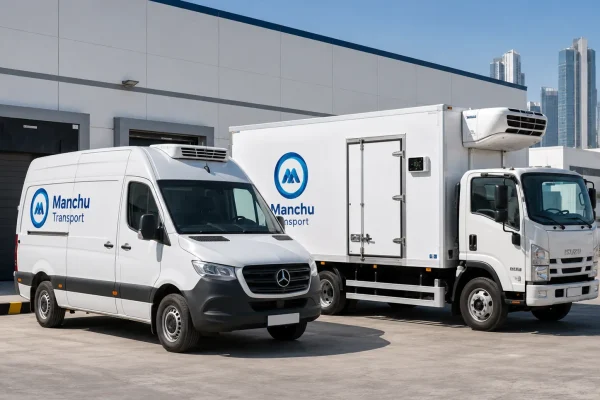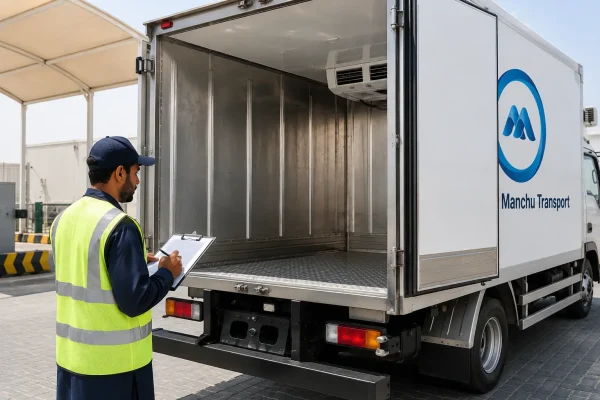
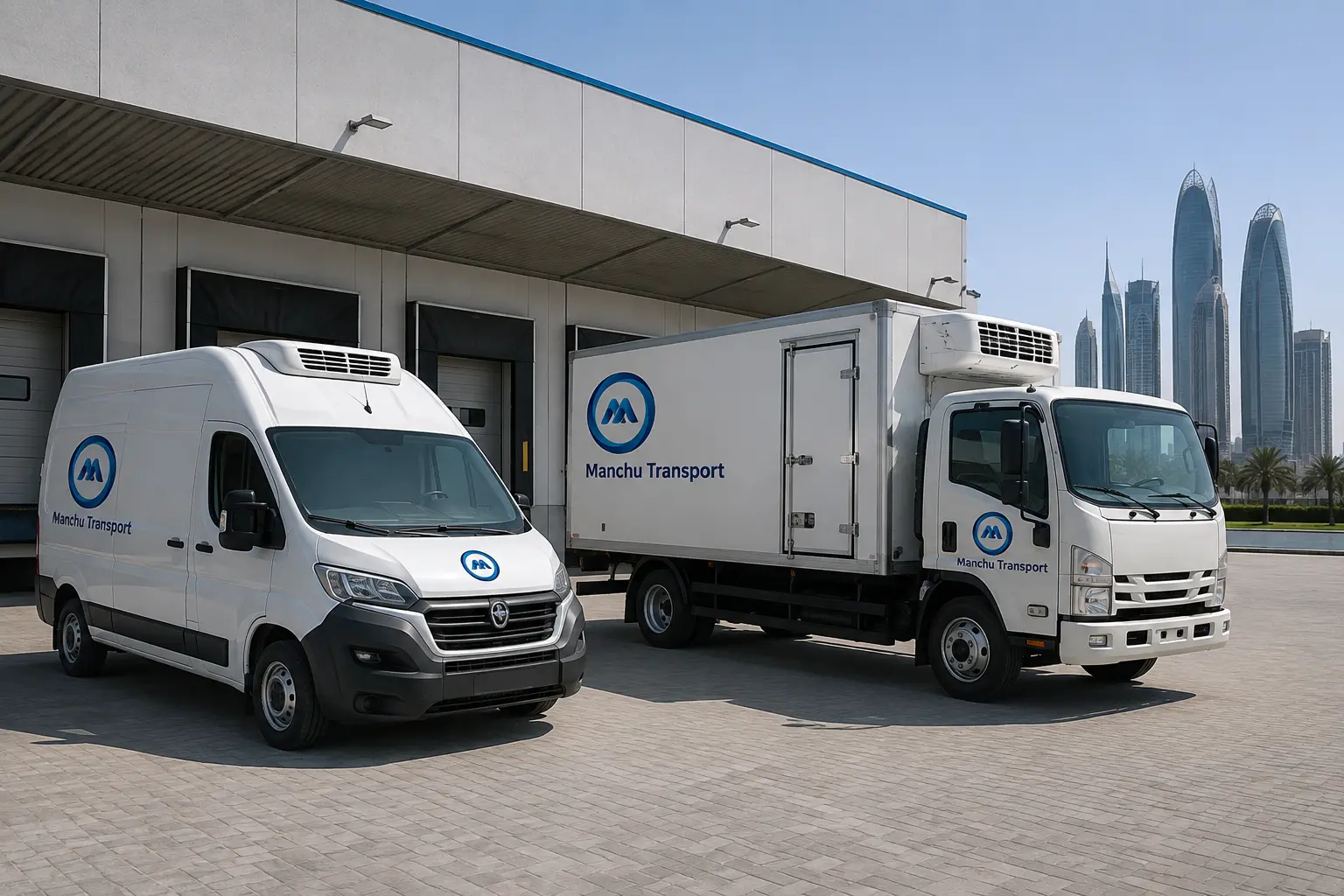
Choosing refrigerated transport in Abu Dhabi starts with two questions: what temperature must the cargo maintain, and how much usable space and payload does the route require? A chiller van is usually the practical choice for smaller chilled deliveries with several city stops. A freezer van is appropriate for small frozen loads only when the specific unit can hold the required set point. A 3-ton, 7-ton, or 10-ton refrigerated truck becomes more efficient as loads become palletized, heavier, or concentrated around warehouses and industrial zones.
The words chiller, freezer, refrigerated, and reefer are often used loosely. That makes it easy to book a vehicle that sounds suitable but cannot meet the actual cargo specification. This guide gives procurement teams a practical way to compare a chiller van rental in Abu Dhabi with freezer vans and larger refrigerated trucks without relying on labels alone.
The Quick Vehicle-Selection Rule
- Choose a standard chiller van for small chilled loads, frequent stops, and tighter loading areas.
- Choose a high-roof chiller van when vertical clearance matters more than extra payload.
- Choose a freezer van for compact frozen loads after confirming the unit’s tested temperature capability.
- Choose a 3-ton refrigerated truck for medium-volume, palletized distribution.
- Choose a 7-ton or 10-ton truck for consolidated warehouse, wholesale, and industrial routes.
This is a starting point, not a loading authorization. The exact vehicle must still be checked against its registration, body specification, refrigeration-unit rating, cargo arrangement, and permitted gross weight.
Chiller, Freezer, Refrigerated, and Reefer: What Do They Mean?
A refrigerated vehicle is the broad category. It includes vans, rigid trucks, and trailers with insulated cargo bodies and mechanical temperature control. Reefer is industry shorthand for refrigerated equipment and may describe a truck, body, or trailer.
A chiller is normally configured to maintain cargo above freezing. It is commonly used for dairy, produce, fresh food, catering, flowers, and products whose labels specify a chilled range. A freezer is configured for sub-zero operation and requires an appropriate refrigeration unit, insulation, seals, and operating procedure.
Do not assume that changing a thermostat turns any chiller into a freezer. Ask the provider for the working range of the actual vehicle being supplied, not the fleet category shown in an advertisement. Product labels, the shipper’s food-safety plan, and applicable authority requirements should determine the set point.
Abu Dhabi Refrigerated Vehicle Comparison
| Vehicle | Best Fit | Typical Route | Important Check |
|---|---|---|---|
| 1-Ton Chiller Van | Small chilled cartons and multi-stop supply | Abu Dhabi city, Khalifa City, retail and hospitality | Usable payload, internal dimensions, required set point |
| 1.5-Ton High-Roof Van | Tall racks, flowers, catering trolleys, bulky light cargo | Hotels, events, healthcare and city distribution | Actual internal height and safe load restraint |
| Freezer Van | Smaller frozen-food consignments | Restaurant, retail and cloud-kitchen replenishment | Verified frozen capability and temperature record |
| 3-Ton Refrigerated Truck | Medium-volume or palletized distribution | Mussafah, ICAD and retail replenishment | Legal payload after body and equipment weight |
| 7-Ton Refrigerated Truck | Wholesale and industrial distribution | ICAD, KEZAD and inter-city routes | Site access, route conditions and unloading equipment |
| 10-Ton Refrigerated Truck | Bulk, consolidated cold-chain movements | Warehouse, port and production-facility transfers | Receiving-bay access and route restrictions |
When a Standard Chiller Van Is the Better Choice
A standard van earns its place on routes where agility and stop frequency matter more than maximum box volume. Restaurants, cafés, pharmacies, caterers, florists, and small retailers often need several drops rather than one full warehouse transfer. A compact vehicle is easier to position at busy loading areas and normally exposes less unused cargo-box air each time the doors open.
The published starting rate for Manchu Transport’s 1-ton chiller van is AED 350 per day. Before booking, confirm the product’s required temperature, cargo weight, carton dimensions, number of stops, and whether the goods will be loaded pre-cooled.
When High-Roof Space Matters
A high-roof van addresses volume and vertical-clearance problems; it does not automatically provide a higher legal payload. It can be useful for upright flower arrangements, rolling catering racks, tall cartons, and other goods that should not be laid flat or crushed through stacking.
Measure the loaded item, including its pallet, trolley, rail, or packaging, and compare it with the actual door opening and internal height. Our detailed high-roof versus standard-roof chiller van guide explains the trade-offs. Manchu Transport’s published starting rate for a 1.5-ton chiller van is AED 400 per day.
When a Freezer Vehicle Is Required
Frozen cargo should travel in a vehicle demonstrated to maintain the product’s specified frozen condition throughout the planned journey. Ask for the unit’s operating range, recent maintenance condition, door-seal condition, and temperature-monitoring arrangement. A standard chiller vehicle should not be treated as a freezer simply because its controller displays a low setting.
Frozen meat, seafood, prepared foods, and ice cream can also react differently to brief temperature excursions. The cargo owner’s documented requirement remains the correct reference. For larger frozen loads, compare a dedicated freezer truck with the available freezer truck rental options in Abu Dhabi.
When to Move from a Van to a Refrigerated Truck
A truck becomes useful when the load is too heavy or bulky for a van, requires pallet handling, or can be consolidated into fewer drops. Manchu Transport publishes the following starting daily rates:
| Vehicle | Starting Daily Rate | Commercial Fit |
|---|---|---|
| 3-Ton Chiller Truck | AED 600/day | Medium-volume retail, catering, food and healthcare distribution |
| 7-Ton Chiller Truck | AED 700/day | Wholesale, production and regional distribution |
| 10-Ton Chiller Truck | AED 800/day | Bulk warehouse and industrial movements |
| Chiller Trailer | AED 900/day | Large consolidated loads where the sites can receive a trailer |
These are starting rates. Longer-term quotations depend on the vehicle, route, rental duration, operating hours, cargo specification, driver arrangement, and other contract details.
Match the Vehicle to the Cargo Specification
There is no single temperature that applies to every refrigerated product. Dairy, produce, fresh meat, seafood, frozen food, flowers, prepared catering items, and medicines each have product-specific requirements. Some cargo also needs humidity control, segregation, tamper control, or validated monitoring in addition to temperature.
- Fresh and chilled food: use the product specification and food-safety plan; avoid freezing products that are not designed to be frozen.
- Frozen food: book a confirmed freezer configuration and minimize loading and door-open time.
- Raw and ready-to-eat food: plan effective segregation to reduce contamination risk.
- Pharmaceuticals: follow the labelled storage condition and the shipper’s approved distribution procedure. A generic food vehicle is not automatically a validated pharmaceutical solution.
- Flowers: confirm the variety-specific temperature, humidity, packaging, and airflow requirements.
Route Fit Across Abu Dhabi
Vehicle selection changes with the receiving environment. Abu Dhabi city and Khalifa City routes may favor vans or smaller trucks when parking, turning space, and delivery windows are constrained. Mussafah and ICAD are better suited to palletized industrial work. KEZAD/KIZAD and Khalifa Port routes often involve consolidated loads, formal gates, and warehouse receiving procedures.
Do not copy a historical truck-restriction schedule into a permanent delivery plan. Restrictions and exemptions can change by road, vehicle class, day, and official notice. Check current instructions from Abu Dhabi Mobility before dispatching a heavy vehicle.
ADAFSA, EFST, and ASATEEL: What Buyers Should Verify
Food transport in Abu Dhabi should follow the relevant requirements of the Abu Dhabi Agriculture and Food Safety Authority (ADAFSA). The correct requirements depend on the cargo and activity. Buyers should confirm the appropriate food-transport approvals, hygienic cargo surfaces, cleaning controls, segregation, and temperature-monitoring process with the responsible authority or food-safety professional.
Food handlers working within the Abu Dhabi food chain may also fall under the Essential Food Safety Training (EFST) framework. Confirm the required training for the personnel’s actual duties rather than assuming every driver has the same handling role.
For commercial freight, Abu Dhabi Mobility explains that companies use ASATEEL to obtain activity, vehicle, and driver permits. Registered companies install approved on-board tracking devices, and vehicle permits are available only when a functioning tracking device is installed. See our practical ASATEEL compliance guide, then verify current requirements through Abu Dhabi Mobility’s official commercial transport service.
A Text-Based Fleet Selection Flowchart
- Write down the product specification. Is it chilled, frozen, controlled ambient, or subject to a validated range?
- Calculate the real load. Include cargo, pallets, racks, containers, and handling equipment.
- Measure the cargo. Compare total dimensions with the door opening and usable internal box.
- Map the stops. Several tight city drops generally favor a smaller vehicle; one consolidated transfer may favor a larger truck.
- Check unloading. Confirm forklift access, tail-lift need, receiving-bay height, and turning space.
- Verify compliance. Confirm permits, tracking, driver credentials, hygiene controls, and temperature records relevant to the job.
- Inspect the assigned unit. The actual truck specification matters more than a generic fleet description.
Questions to Ask Before Booking
- What temperature range can the assigned vehicle maintain under the planned operating conditions?
- What are its verified usable payload, internal dimensions, and door dimensions?
- Is it configured as a chiller, freezer, or multi-temperature vehicle?
- How is cargo temperature monitored and how can records be supplied?
- Which Abu Dhabi commercial-transport permits apply to the vehicle and driver?
- What is the breakdown and replacement-vehicle procedure?
- Who is responsible for loading, restraint, cleaning, fuel, tolls, and route planning?
Frequently Asked Questions
What is the difference between a chiller van and a freezer van?
A chiller van is normally configured for above-freezing transport, while a freezer van is designed for sub-zero work. Confirm the actual vehicle’s insulation, refrigeration unit, tested range, and cargo requirements before booking.
Is a high-roof van allowed to carry more weight?
Not necessarily. A high roof adds vertical space, but the vehicle must remain within its verified legal weight limits. Never calculate payload from roof height alone.
Does every commercial freight vehicle need ASATEEL registration?
Abu Dhabi’s freight framework requires operators and vehicles conducting regulated commercial transport activity to obtain the applicable permits through ASATEEL. Check the official regulation and any exemption relevant to the exact vehicle and activity.
Can one truck carry chilled and frozen goods together?
Only when it has a suitable multi-temperature configuration or another validated segregation method capable of maintaining each product’s requirement. A loose divider does not automatically create two controlled zones.
Which vehicle is best for Mussafah and ICAD deliveries?
A 3-ton or larger refrigerated truck often suits palletized industrial deliveries, but load weight, receiving access, delivery windows, and the actual route should make the final decision.
How much does refrigerated vehicle rental cost?
Published starting rates range from AED 350/day for a 1-ton chiller van to AED 900/day for a chiller trailer. Request a tailored quotation for the required temperature, route, duration, and vehicle configuration.
Request the Right Vehicle, Not Just the Biggest One
Ghabt Al Manchu Transport L.L.C supplies chiller vans, refrigerated trucks, and trailers for commercial routes across Abu Dhabi and the UAE. To receive a useful recommendation, provide the cargo type, required temperature, total weight and dimensions, pickup point, delivery areas, number of stops, and rental duration.
Call +971 54 7171 345, email manchutransport@gmail.com, message us on WhatsApp, or request a refrigerated transport quote.
Regulations, road restrictions, permits, and product requirements can change. Confirm current requirements with the relevant authority and the cargo owner’s approved procedure before dispatch.
Need Reliable Refrigerated Transport?
Get a free quote for chiller van, truck, or trailer rental in Dubai and across the UAE.
Get a Free QuoteRecommended Services
Our Refrigerated Transport Services
Choose the vehicle that matches your route, payload, and temperature requirements.
 Abu Dhabi
Chiller Truck Rental Abu Dhabi
ADAFSA and ASATEEL-compliant truck rentals for Mussafah, KIZAD, Khalifa City, and Al Ain.
View Service
Dubai
Chiller Truck Rental Dubai
3-Ton to 10-Ton refrigerated trucks for supermarket, pharma, and wholesale distribution.
View Service Last-Mile
Chiller Van Rental Dubai
1-Ton and 1.5-Ton chiller vans for last-mile cold chain, catering, and pharmacy routes.
View Service Cross-Border
Chiller Trailer Rental Dubai
20-Ton and 25-Ton reefer trailers for port clearances, warehouse transfers, and GCC routes.
View Service