The UAE imports over 80% of its food supply, and with summer temperatures regularly exceeding 45 degrees Celsius, the cold chain is not just a logistics consideration but a matter of national food security and public health. Whether you operate a restaurant, distribute pharmaceuticals, or manage a supermarket supply chain, understanding how cold chain logistics works in the UAE is essential for compliance, cost control, and product quality.
This guide covers the full landscape of temperature-controlled logistics across Dubai, Abu Dhabi, and the wider UAE, from regulatory requirements and vehicle classifications to infrastructure hubs and the technology driving the industry forward.
In this guide: What is Cold Chain? | Market Size | Temperature Standards | Dubai Municipality Rules | ADAFSA Abu Dhabi | Vehicle Types | Infrastructure Hubs | Technology | Last Mile | Pharma Cold Chain
What Is Cold Chain Logistics?
Cold chain logistics refers to the uninterrupted management of temperature-sensitive products through every stage of the supply chain: storage, transport, and delivery. The chain begins at the point of production or import and ends when the product reaches the consumer or end user. A single break in the chain, even a few minutes of temperature deviation during a loading dock transfer, can render a product unsafe or unsaleable.
In the UAE context, the cold chain encompasses three distinct sectors, each with its own regulatory framework:
- Food and beverage — governed by Dubai Municipality and ADAFSA (Abu Dhabi Agriculture and Food Safety Authority)
- Pharmaceuticals — regulated by the Emirates Drug Establishment (EDE), the Dubai Health Authority (DHA), and the Abu Dhabi Department of Health (DoH)
- Specialty goods — including fresh flowers, live cultures, and laboratory specimens, often subject to both food and pharmaceutical standards depending on the product
UAE Cold Chain Market: Size and Growth
The UAE cold chain logistics market is valued at approximately USD 700 million and is projected to exceed USD 1.1 billion by 2030, growing at a compound annual rate of 9 to 10 percent. Several structural factors are driving this expansion:
- Population growth — the UAE reached 9.4 million residents in 2023, with continued growth in urban centres like Dubai and Abu Dhabi
- E-commerce acceleration — quick commerce platforms now promise 1 to 3 hour delivery windows for chilled and frozen goods, requiring distributed micro-fulfillment networks rather than single large warehouses
- Pharmaceutical expansion — Abu Dhabi’s development as a regional healthcare hub, supported by the Hayat Biotech Life Sciences Park at KEZAD and the Hope Consortium vaccine distribution network, has significantly increased demand for GDP-compliant cold chain infrastructure
- Dubai’s D33 and Abu Dhabi’s Economic Vision 2030 — strategic economic diversification plans that position logistics as a core growth sector
For transport operators and businesses that rely on refrigerated vehicles, these numbers translate into sustained demand for chiller van rental in Dubai, chiller truck rental in Dubai, and chiller trailer rental in Dubai across every industry vertical.
Temperature Standards by Product Category
Both Dubai Municipality and ADAFSA enforce specific temperature ranges for different product categories during transport and storage. Failure to maintain these ranges during any part of the journey can result in product rejection, fines, or facility closure orders.
| Product Category | Required Temperature | Examples |
|---|---|---|
| Frozen foods | -18°C or below | Frozen meat, seafood, ice cream |
| Chilled dairy and meat | 0°C to 4°C | Milk, yogurt, fresh poultry, deli meats |
| Fresh fish | 0°C (on crushed ice) | Whole fish, shellfish, sushi-grade products |
| Chilled produce | 2°C to 8°C | Cucumbers, peppers, leafy greens |
| Warm-sensitive produce | 10°C to 13°C | Bananas, tomatoes, avocados |
| Pharmaceuticals (standard) | 2°C to 8°C | Vaccines, insulin, biologics |
| Pharmaceuticals (frozen) | -20°C to -10°C | mRNA vaccines, specialized therapies |
| Dry goods (summer transport) | Below 25°C | Canned goods, bottled water, juices |
A critical point many operators overlook: even dry goods require temperature management during UAE summers. ADAFSA regulations require that non-refrigerated vehicles transporting food maintain cargo temperatures below 25 degrees Celsius, which realistically requires at least basic insulation or ventilation systems between May and October.
Regulatory Framework: Dubai Municipality
In Dubai, the Food Safety Department of Dubai Municipality is the primary regulator. Compliance involves three interconnected requirements.
The FoodWatch Platform
FoodWatch is Dubai’s centralized digital system for food safety management. Every food business, including third-party logistics providers and transport fleets, must be registered on FoodWatch. The platform tracks vehicle inspection status, personnel certification, and HACCP implementation. An outdated FoodWatch profile can trigger administrative penalties even if your physical operations are fully compliant.
The DM Card (Occupational Health Card)
Every worker directly involved in handling, storing, or transporting food must hold a valid Occupational Health Card, commonly called the DM Card. The process involves medical screening (blood tests, chest X-rays, stool analysis) at a DHA-approved medical centre, with fees ranging from AED 170 to AED 600 depending on the job category. The card must be renewed annually and new employees must apply within 30 days of starting work. Operating with an uncertified employee exposes the business to escalating fines.
Person in Charge (PIC) and Food Safety Training
Every food facility must have at least one certified Person in Charge present during all working hours. The PIC supervises hygiene practices, oversees temperature logs, and ensures HACCP protocols are followed. Delivery drivers and warehouse staff require at minimum a Basic Food Safety Training (Level 1) certificate, which covers the temperature danger zone (5 to 60 degrees Celsius), cross-contamination prevention, and proper handling during multi-drop deliveries.
Regulatory Framework: ADAFSA (Abu Dhabi)
In Abu Dhabi, the Abu Dhabi Agriculture and Food Safety Authority enforces cold chain standards through its Code of Practice and specific food safety regulations. ADAFSA’s approach is notably more granular than Dubai Municipality’s, with detailed temperature mandates for a broader range of product subcategories.
Key differences for operators working in Abu Dhabi:
- EFST certification — all food transport drivers in Abu Dhabi must hold an Essential Food Safety Training certificate, which is separate from and in addition to the DM Card
- ASATEEL registration — all commercial vehicles operating in Abu Dhabi must be registered on the ASATEEL GPS tracking platform with an approved On-Board Unit (OBU) that transmits real-time location and temperature data to the Integrated Transport Centre
- Continuous temperature recording — ADAFSA requires that refrigerated vehicles carry devices capable of providing historical proof of temperature compliance, not just point-in-time readings
- The Golden Food Product List — a trade facilitation initiative that allows products with five consecutive compliant shipments to bypass customs waiting periods, reducing both cost and temperature exposure risk
For businesses expanding into the Abu Dhabi market, these additional requirements often come as a surprise. Understanding them before you begin operations avoids costly delays and compliance failures.
Vehicle Types for Cold Chain Transport
The UAE cold chain relies on a range of vehicle types matched to cargo volume, temperature requirements, and delivery patterns.
| Vehicle Type | Capacity | Temperature Range | Common Uses | Daily Rate (Hire) |
|---|---|---|---|---|
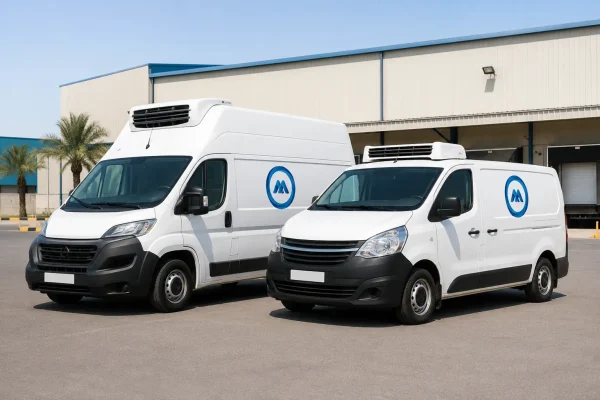
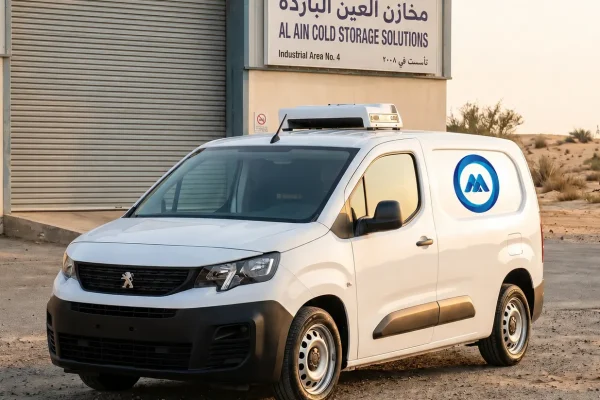
| Chiller van | 1 to 1.5 tonnes | 0°C to +5°C | Restaurant deliveries, dairy distribution, bakery supply, catering | From AED 350/day |
| Freezer van | 1 to 3 tonnes | -18°C to -23°C | Seafood, frozen meat, ice cream | From AED 400/day |
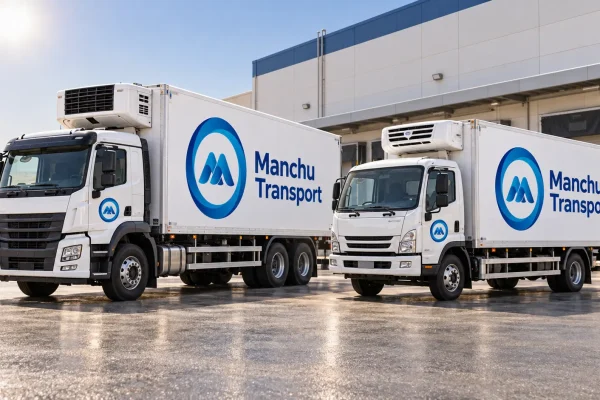
| Chiller/freezer truck | 3 to 10 tonnes | Multi-zone capable | Wholesale distribution to hotels, supermarkets, retail chains | From AED 600/day |
| Refrigerated trailer | 20 to 25 tonnes | Multi-zone capable | Bulk distribution, cross-border GCC transport, warehouse-to-warehouse | From AED 900/day |
| Pharma reefer | 1 to 5 tonnes | +2°C to +8°C (precise) | Vaccine distribution, biologic medicines, clinical samples | On request |
Multi-temperature vehicles are increasingly common in the UAE market. These trucks use movable bulkheads to create separate compartments within the same cargo hold, allowing a single vehicle to carry frozen, chilled, and ambient products simultaneously. This reduces the number of vehicles needed for mixed-product deliveries and improves operational efficiency for distributors serving diverse customers.
Cold Chain Infrastructure Hubs
The UAE’s physical cold chain infrastructure is concentrated around three major logistics zones, each offering connectivity between sea, air, and road transport.
Jebel Ali and JAFZA (Dubai)
The anchor of the region’s cold chain. Jebel Ali Port and JAFZA house some of the world’s most advanced cold storage, including the Americold flagship hub (opened 2025) with 40,000 pallet positions across multi-temperature zones, ISO 22000 and HACCP certification, and 27 loading docks. The JAFZA Logistics Park provides nearly a million square feet of Grade A cold and dry storage, and was fully leased before construction completed, indicating the intensity of demand.
KEZAD and Khalifa Port (Abu Dhabi)
KEZAD’s Logistics Park Phase 21 provides over 75,000 square metres of pre-built cold storage with temperature ranges down to -25 degrees Celsius and 17-metre eave heights designed for high-density pallet racking. The adjacent Abu Dhabi Food Hub centralises food processing, packaging, and cold storage to reduce total food miles and minimise temperature exposure during transfers.
Dubai South and EZDubai
Located around Al Maktoum International Airport, Dubai South is purpose-built for rapid movement of temperature-sensitive goods. RSA Cold Chain operates an ammonia-based refrigeration facility here, chosen for ammonia’s superior thermodynamic efficiency and zero global warming potential. The Logistics Corridor allows goods to move between Jebel Ali Port and Dubai South in under four hours.
Technology Driving the Modern Cold Chain
The transition from manual spot-checks to continuous, automated monitoring defines the current evolution of UAE cold chain logistics.
IoT Temperature Monitoring
Modern cold chain systems use a three-layer IoT architecture. Wireless sensors at the edge layer collect temperature and humidity data at intervals as short as one minute. A network layer manages connectivity across 5G, Wi-Fi, and LoRaWAN, maintaining data transmission even when vehicles enter dead zones or shielded warehouse environments. Cloud-based analytics platforms at the application layer process raw data into actionable intelligence, using AI to predict equipment failures before they cause temperature excursions.
Blockchain Traceability
Blockchain-enabled cold chains create immutable, tamper-proof records of temperature data at every handoff point. Each stakeholder, from the manufacturer to the logistics provider to the last-mile driver, signs off on a timestamped digital record. This eliminates disputes about where a cold chain break occurred and significantly reduces audit times for both Dubai Municipality and ADAFSA inspections.
Vehicle Tracking Requirements
Dubai’s RTA mandates GPS tracking systems on all heavy vehicles exceeding 2.5 tonnes, with installation costs around AED 1,620 including the annual subscription. For refrigerated trucks, these systems integrate with cargo temperature sensors, providing real-time alerts if temperature exceeds permitted levels. In Abu Dhabi, the ASATEEL platform performs the same function with additional integration requirements for cold chain vehicles.
Managing the Last Mile in UAE Heat
The last mile is the most risk-prone segment of the cold chain. Moving a product from a -18 degree freezer into 45 degree ambient air creates a temperature gradient of over 60 degrees. Without proper protocols, even a few minutes of exposure can compromise product safety.
Proven mitigation strategies used by UAE operators include:
- Cooled marshalling areas — staging zones maintained at 10 to 15 degrees Celsius that buffer products between warehouse storage and vehicle loading
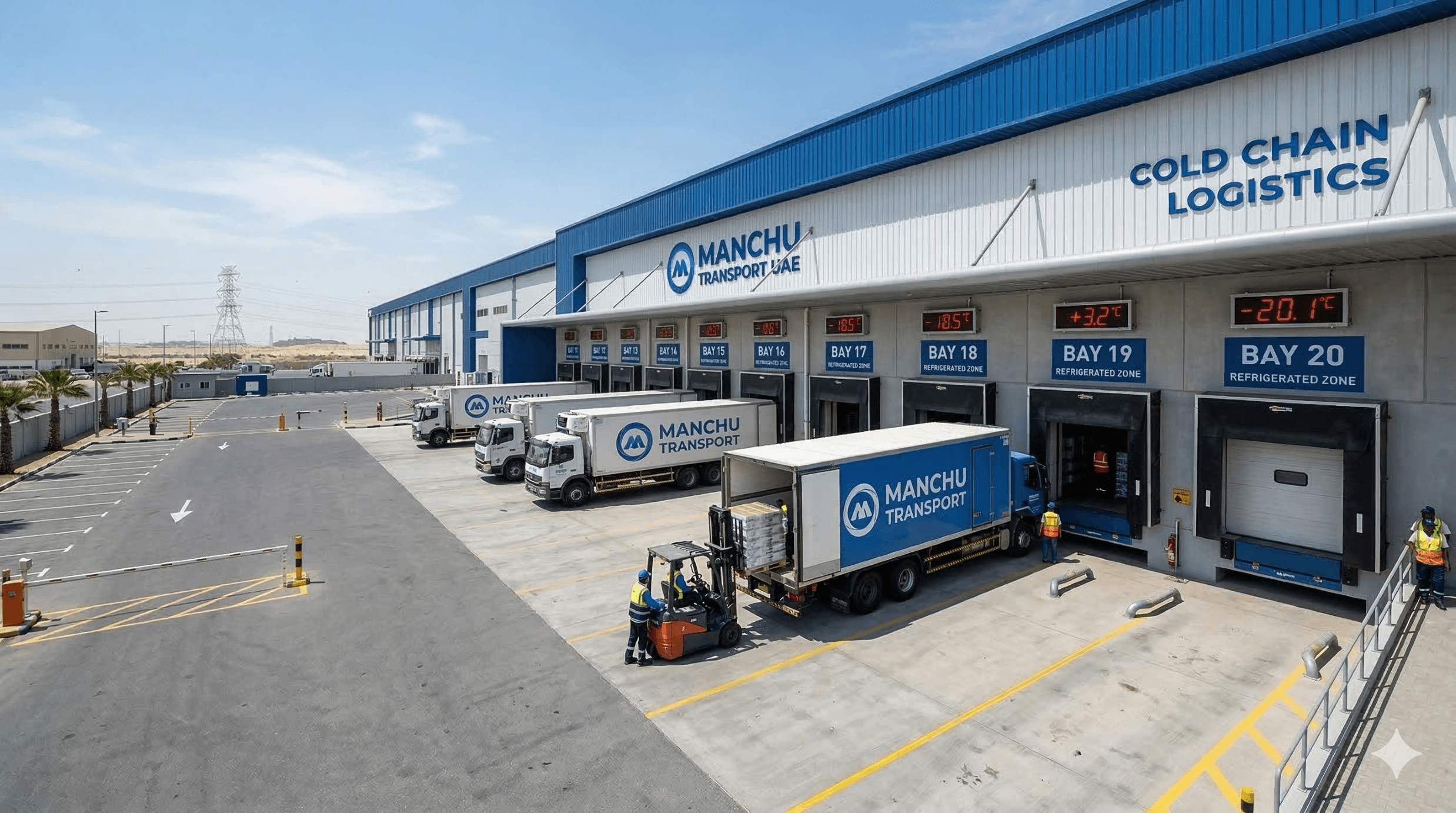
- Sealed docking shelters — foam-padded shelters that surround the truck during loading, preventing cold air escape and hot air infiltration
- Passive cooling backup — gel packs, thermal blankets, and phase change materials that maintain required temperatures even if the vehicle’s refrigeration unit fails temporarily
- AI route optimisation — scheduling deliveries during early morning or late evening hours and routing around traffic congestion to minimise transit time and door-open events
The rise of quick commerce has also driven the creation of temperature-controlled micro-fulfillment centres in high-density areas like Business Bay, Jumeirah, and Al Barsha. These small-scale facilities hold limited ranges of high-turnover perishables, reducing the distance and time that products spend in transit.
Pharmaceutical Cold Chain: Additional Requirements
Pharmaceutical cold chain logistics in the UAE is governed by the Emirates Drug Establishment under Good Distribution Practice (GDP) standards aligned with WHO and EU guidelines. Requirements go beyond food safety in several important ways:
- Temperature mapping — GDP-compliant warehouses must undergo sensor mapping to identify hot spots and poor-airflow zones, with permanent IoT sensors placed at worst-case locations
- Supply chain redundancy — the EDE mandates that marketing authorisation holders appoint at least two importers and one distributor, ensuring backup options exist if one provider’s cold chain is compromised
- Vehicle validation — pharmaceutical transport vehicles must be separately licensed by the DHA (Dubai) or DoH (Abu Dhabi), validated specifically for medical use
- Four storage zones — controlled room temperature (15 to 25 degrees C), refrigerated (2 to 8 degrees C), frozen (-20 to -10 degrees C), and ultra-cold (-60 degrees C and below for cell and gene therapies)
Choosing the Right Cold Chain Partner
Whether you manage your own fleet or work with a third-party logistics provider, the right cold chain partner should offer:
- Full regulatory compliance — DM Card certified drivers, FoodWatch registration, ASATEEL registration for Abu Dhabi operations, and EFST certification where required
- Real-time visibility — GPS tracking and IoT temperature monitoring accessible to you as the client, not just the operator
- Vehicle range — the ability to match vehicle size to your actual cargo volume, from 1-tonne chiller vans for restaurant deliveries to 25-tonne refrigerated trailers for bulk distribution
- Cross-emirate coverage — compliance in both Dubai and Abu Dhabi, avoiding the complications of using different providers for different emirates
- Maintenance and backup — a well-maintained fleet with contingency vehicles available if a unit requires unscheduled servicing
At Manchu Transport, we operate a fleet of chiller vans, trucks, and trailers that serve businesses across Dubai, Abu Dhabi, Sharjah, and the wider UAE. Every vehicle is equipped with temperature monitoring systems and our drivers hold all required certifications for both emirates.
Getting Started
Cold chain logistics in the UAE is a complex but well-regulated environment. The regulatory frameworks set by Dubai Municipality and ADAFSA exist to protect public health and product quality, and businesses that invest in compliance consistently outperform those that treat it as an afterthought.
If you need reliable refrigerated transport for your business, whether for daily restaurant deliveries, pharmaceutical distribution, or large-scale food supply chain operations, request a free quote from Manchu Transport. We will help you match the right vehicle type, capacity, and service plan to your requirements across all seven emirates.
Need Reliable Refrigerated Transport?
Get a free quote for chiller van, truck, or trailer rental in Dubai and across the UAE.
Get a Free QuoteRecommended Services
Our Refrigerated Transport Services
Choose the vehicle that matches your route, payload, and temperature requirements.
 Abu Dhabi
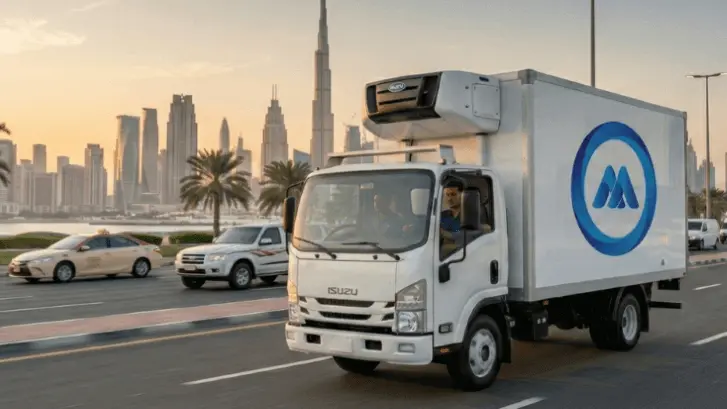
Chiller Truck Rental Abu Dhabi
ADAFSA and ASATEEL-compliant truck rentals for Mussafah, KIZAD, Khalifa City, and Al Ain.
View Service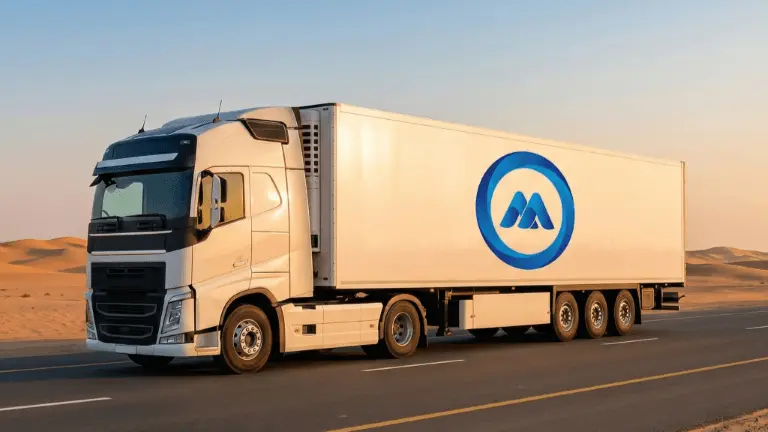 Cross-Border
Chiller Trailer Rental Dubai
20-Ton and 25-Ton reefer trailers for port clearances, warehouse transfers, and GCC routes.
View Service
Dubai
Chiller Truck Rental Dubai
3-Ton to 10-Ton refrigerated trucks for supermarket, pharma, and wholesale distribution.
View Service Last-Mile
Chiller Van Rental Dubai
1-Ton and 1.5-Ton chiller vans for last-mile cold chain, catering, and pharmacy routes.
View Service