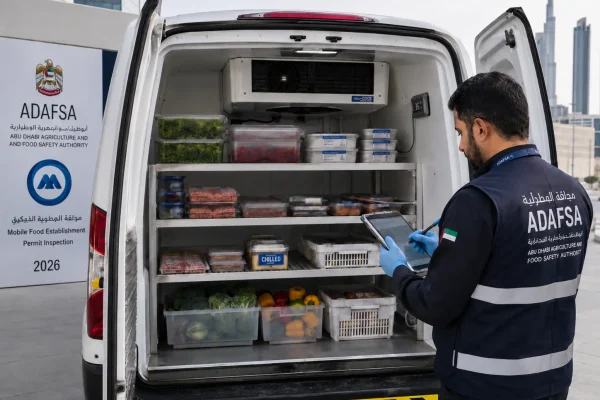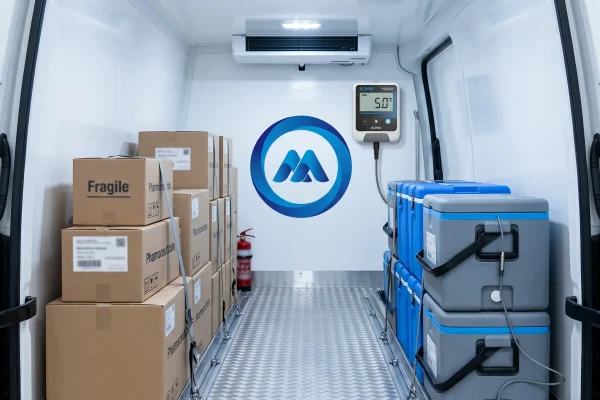

A refrigerated truck can hold a perfect -18°C all the way from the cold store to the customer’s dock, and the load can still be condemned on arrival. The technology only does half the job. The other half sits with the driver: whether the reefer unit stays on during a rest stop, whether raw and ready-to-eat pallets stay separated inside the box, and whether a compressor fault gets reported before cargo drifts into the danger zone. That is why Abu Dhabi and Dubai do not treat food safety training as optional for delivery drivers. It is a legally binding prerequisite, enforced with the same seriousness as the vehicle permit itself.
At Manchu Transport we have run chiller vans, trucks and trailers out of Dubai Investment Park for more than fourteen years, and the most common compliance question we get from operations managers is some version of “does our driver actually need this course, or is the vehicle permit enough?” The vehicle permit and the driver’s EFST certification are two separate legal requirements, checked separately, and either one missing can ground a truck. This guide covers what an EFST certification Dubai delivery driver needs, how it differs from Dubai’s own Basic Food Safety Training, the curriculum, the exam, the cost, and what happens if a driver is caught without one.
What EFST Is, and Why It Exists
The UAE’s food safety framework starts at the federal level with Federal Law No. 10 of 2015 on Food Safety, requiring every node in the supply chain, from import to final delivery, to meet strict public health protocols. Enforcement is delegated to each emirate’s own municipal authority, which is why Dubai and Abu Dhabi run two different certification programs rather than one national one.
In Abu Dhabi, the regulator is the Abu Dhabi Agriculture and Food Safety Authority (ADAFSA), operating under Food Law No. (2) of 2008 and Resolution No. (6) of 2020 concerning food health. ADAFSA has run the Essential Food Safety Training (EFST) program since 2008. The regulation’s definition of a “food handler” is deliberately broad: not just kitchen staff, but anyone who stores, packages or transports food commodities. That means every driver moving chilled or frozen cargo commercially within Abu Dhabi, Al Ain or Al Dhafra needs a valid, unexpired EFST certificate, full stop. EFST sits alongside, not instead of, the vehicle-side paperwork: the ADAFSA Food Watch Department (FWD) Mobile Food Establishment Permit and ASATEEL telematics registration, which we cover in our ASATEEL GPS fleet tracking compliance guide. A driver can be sitting in a fully permitted, ASATEEL-registered truck and still be operating illegally if their own EFST card has lapsed.
Dubai vs Abu Dhabi: Two Certifications, Not One
This is the point that trips up operations managers running routes that cross emirate borders. Dubai does not use EFST. Dubai Municipality enforces its own, administratively distinct program under Order No. 6 of 2009, known as Basic Food Safety Training (sometimes called Basic Food Hygiene Level 2), and it applies to every worker in the Dubai food industry, explicitly including delivery drivers. Dubai Municipality tracks compliance through its FoodWatch digital platform, where every registered food business must log the occupational health cards and Basic Food Safety certificates of each driver, and inspectors verify credentials against FoodWatch in real time, much as ADAFSA cross-checks the FWD permit we cover in our Dubai Municipality food transport vehicle permit guide.
The friction shows up the moment a route crosses the emirate line. A driver hauling a load out of Dubai’s Jebel Ali Free Zone into Abu Dhabi’s Mussafah industrial area, a run we’ve mapped in our KIZAD and Mussafah cold chain logistics guide, crosses a regulatory boundary as well as a physical one. A valid EFST certificate from Abu Dhabi does not automatically authorize a driver to operate in Dubai, and a Dubai Basic Food Safety certificate does not authorize operation in Abu Dhabi; the two systems are not reciprocal. Drivers on dedicated, localized routes only need the certificate for the emirate they operate in, but any fleet moving cargo across both jurisdictions needs its drivers cross-certified in both to avoid border delays or fines. It is exactly why our Abu Dhabi and Al Ain drivers are EFST-certified while our Dubai-based drivers hold Basic Food Safety Training, and why cross-emirate jobs go to drivers who hold both.
Inside the Curriculum: The Four Pillars of Food Safety
Both programs are built on the internationally recognized HACCP framework and organized around four pillars, informally known as the “4 Cs”: Cleaning, Cooking, Chilling, and avoiding Cross-Contamination. Drivers never cook anything, but the law still requires them to understand the full safety lifecycle, not just their slice of it.
Chilling and Temperature Control
The module that matters most for anyone behind the wheel of a chiller van or refrigerated truck. Drivers are trained on the “Temperature Danger Zone,” the range between 5°C and 60°C where pathogenic bacteria multiply fastest. The curriculum sets hard numbers: chilled cargo must stay between +2°C and +5°C, and frozen cargo must remain hard-frozen at or below -18°C. Drivers learn to read and calibrate digital thermometers, interpret data logger printouts, and understand why switching off the refrigeration unit at a rest stop to save fuel is a serious violation, not a harmless shortcut.
Cross-Contamination Prevention
Covers how pathogens move from raw commodities such as poultry or raw beef onto ready-to-eat items like produce or dairy. For a driver, that means keeping incompatible pallets physically separated inside the truck bed, recognizing the risk in mixed-load consolidated freight, and handling crates hygienically at the tail lift.
Cleaning, Sanitization and Pest Control
Drivers learn the difference between basic cleaning, which removes visible debris, and proper disinfection, which uses chemical or thermal agents to reduce pathogens to a safe level. The cargo hold is treated as a high-risk zone: approved sanitizers for the interior floor and walls between delivery runs, correct handling of spills, and early signs of pest activity from a compromised loading bay.
Personal Hygiene and Occupational Health
Because human handlers are the primary vector for bacterial transmission, this module enforces strict handwashing (twenty seconds with warm water and bactericidal soap), clean designated uniforms, and a clear reporting chain. A driver with gastrointestinal symptoms or an uncovered wound must report it and stand down from food transport duty until cleared.
Format, Languages and Duration
Both programs are designed to reach the UAE’s largely expatriate logistics workforce without a language barrier getting in the way of comprehension. The instructional module runs a minimum of six contact hours, either as a single-day classroom session or an interactive computer-based seminar, delivered in Arabic, English, Hindi, Urdu and Malayalam, with class sizes capped at roughly fifteen to twenty attendees. In 2025, ADAFSA introduced interactive digital modules into EFST that place drivers inside simulated scenarios, such as diagnosing a refrigeration compressor failure mid-transit on a summer desert highway.
The Exam: Structure, Passing Score, and What Happens If You Fail
After the six-hour instructional phase, every candidate sits a supervised exam at an officially designated testing center. In 2025, ADAFSA moved the entire EFST evaluation onto its proprietary Ghars digital platform, replacing paper-based testing with automated grading and real-time analytics. The exam leans on multiple-choice, situational-judgment questions: a candidate might be shown a scenario where a thermal logger reads 14°C for two hours and asked to select the compliant corrective action, or shown images and asked to identify a contamination hazard.
The two jurisdictions differ slightly in structure. Dubai’s Basic Food Safety exam runs thirty-five questions in a thirty-five-minute window; the Abu Dhabi EFST exam is a full one-hour assessment covering all four pillars. Passing thresholds differ too: ADAFSA sets the EFST pass mark firmly at 70%. On the Dubai side the picture is less uniform, with accredited academies commonly publishing a 75% requirement though some provider documentation references 60% for certain entry tiers, so confirm the exact rubric with your EIAC-accredited training provider before scheduling a driver.
The failure protocol is consistent across both programs. A candidate who fails the first attempt gets one re-examination. Fail that re-sit too, and the regulation triggers a full reset: the entire six-hour course has to be retaken before a third exam attempt is permitted. Throughout that cycle the driver is legally barred from unsupervised commercial food transport, which is why fleets with tight schedules keep a bench of certified backup drivers rather than assuming every new hire passes first time.
Certificate Validity and the Renewal Process
Neither certificate lasts forever, and the expiry dates are unforgiving. An ADAFSA EFST certificate is valid for exactly three years from the date of issue. Dubai Municipality’s Basic Food Safety certificate typically runs two to three years, depending on the accreditation body that issued it. (The higher-tier Person in Charge, or PIC, qualification for managerial food safety staff can run up to five years, but delivery drivers rarely need it.)
Renewal means completing an accredited refresher course followed by a re-certification exam before the current certificate lapses, partly to counter “drift,” where experienced drivers gradually let rigorous habits slide, and partly to update drivers on newly issued municipal rules. The moment a certificate expires, the driver’s legal authorization to handle food cargo disappears instantly, and an inspector who finds a lapsed certificate can detain the vehicle on the spot, with the employer held liable.
This is a real administrative burden for HR teams, since Dubai’s FoodWatch platform cross-references the trade license, vehicle permit, occupational health card and training status the instant a vehicle is checked, leaving zero margin for a missed renewal date. The practical fix is automated alerts sixty to ninety days before any certificate lapses, giving enough runway to book a training slot, sit the exam, and arrange shift cover without pulling a truck off the road mid-contract.
What It Costs, and Who Pays
The direct cost per driver is modest, but it is a recurring line item that never goes away as your fleet grows:
| Requirement | Governing Authority | Typical Cost | Validity |
|---|---|---|---|
| Basic Food Safety Training | Dubai Municipality (DM) | AED 100 – AED 300 | 2 to 3 years |
| Essential Food Safety Training (EFST) | ADAFSA (Abu Dhabi) | AED 150 – AED 250 | 3 years |
| Occupational Health Card (OHC) | DHA (Dubai) / DOH (Abu Dhabi) | AED 300 – AED 600 | 1 year |
| Advanced Person in Charge (PIC) Training | Dubai Municipality (DM) | AED 300 – AED 500 | Up to 5 years |
Note that the Occupational Health Card is a separate requirement from either training program. It is a clinical medical clearance rather than an educational credential, but a driver cannot legally be dispatched with only one of the two documents; both have to be valid at the same time.
Under UAE labor law, the financial responsibility sits squarely with the employer, including the driver’s standard wage for the six hours in the classroom. That said, a growing number of drivers now self-fund their EFST or Basic Food Safety certification before applying for jobs, since a pre-certified candidate skips the usual seven-to-ten-day onboarding delay for course scheduling and testing and can start revenue-generating routes immediately.
The Scale of Enforcement: 39,000 Certified in a Single Year
The infrastructure behind this is not a token compliance exercise. In 2025 alone, ADAFSA processed and certified 39,000 trainees through EFST, bringing the cumulative total to nearly 300,000 certified food handlers since the program launched in 2008. To handle that volume, ADAFSA runs more than ten accredited third-party training centers backed by two secure, centralized examination facilities, and partners with the Abu Dhabi Centre for Technical and Vocational Education and Training (ACTVET) to run unannounced quality audits of those centers year-round.
Penalties for Non-Compliance
The enforcement architecture is designed so the cost of a violation always dwarfs the cost of compliance. At the federal level, Federal Law No. 10 of 2015 treats transporting rotten, harmful or adulterated food as a serious criminal offense, carrying a minimum three-month prison term and fines up to AED 2,000,000 in severe cases. Cold chain temperature failures carry separate federal fines of AED 10,000 to AED 100,000, and repeat violations automatically double the baseline penalty.
Day-to-day enforcement happens at the municipal level. In Abu Dhabi, ADAFSA runs a graduated penalty matrix: a driver stopped without a valid EFST certificate typically starts with a formal warning, but repeated or severe non-compliance escalates into substantial fines, suspension of the company’s FWD vehicle permits, impoundment of the truck for up to thirty days, or full administrative closure, with penalized companies publicly named on the Zadna rating app. In Dubai, Municipality inspectors run unannounced checks at high-traffic points such as the Deira wholesale markets and the JAFZA gates, verifying the DM Food Vehicle Permit, Occupational Health Card and Basic Food Safety status against FoodWatch on the spot. Deploying an untrained driver or failing to maintain temperature logs triggers fines of AED 5,000 to AED 50,000, and a single expired certificate found during a roadside check can ground the vehicle until a compliant driver is dispatched.
Beyond the UAE: A Quick GCC Comparison
For fleets running occasional cross-border GCC work: EFST and Basic Food Safety Training do not transfer outside the UAE, and the reverse is equally true. Saudi Arabia’s MOMRA runs its own Balady certification, and Qatar’s Ministry of Public Health issues a three-year Food Handler License. Neither has any legal standing in the UAE. The UAE’s programs are deliberately hyper-localized to Federal Law No. 10 of 2015 and each emirate’s own rules, so a driver certified elsewhere in the GCC still has to sit the UAE course before touching a UAE cold chain route.
How Manchu Transport Keeps Every Driver Compliant
We built our compliance stack around the fact that a vehicle permit and a driver certificate are two separate legal requirements, and both have to hold at all times. Every truck and van in our fleet carries the correct vehicle-side paperwork, the Dubai Municipality DM Card, the ADAFSA FWD permit for Abu Dhabi routes, and active ASATEEL registration, while our drivers carry the matching certification: EFST for our Abu Dhabi and Al Ain teams, Basic Food Safety Training for our Dubai-based drivers, and both for anyone on cross-emirate runs. We track renewal dates internally so a client never discovers mid-delivery that a driver’s certificate lapsed the week before.
That matters whether you are booking a single chiller van rental in Dubai for a same-day HORECA run, a chiller truck in Abu Dhabi for an ICAD or KEZAD delivery, or ongoing coverage across Dubai, Abu Dhabi, Al Ain and the wider UAE. You are outsourcing the entire driver-compliance function that would otherwise sit on your own HR desk, not just hiring a vehicle. Our FAQ page covers more of the recurring compliance questions we get from operations managers.
Frequently Asked Questions
What exactly is EFST, and which employees need it?
EFST stands for Essential Food Safety Training, a mandatory certification run by ADAFSA. It is required for anyone classified as a food handler in Abu Dhabi, and that definition explicitly includes delivery drivers moving chilled or frozen cargo, since they are responsible for the thermal integrity of the load in transit.
Can a driver with an Abu Dhabi EFST certificate work in Dubai without any other paperwork?
No. The foundational knowledge is similar, but the jurisdictions are independent. Abu Dhabi requires ADAFSA’s EFST, Dubai requires Dubai Municipality’s Basic Food Safety Training, and one does not substitute for the other. Fleets running routes across both emirates typically cross-certify their drivers in both.
How long does the EFST course take and what languages is it taught in?
A minimum of six contact hours, delivered in a classroom or interactive digital format, taught in Arabic, English, Hindi, Urdu and Malayalam. The instructional phase is followed immediately by a one-hour multiple-choice exam.
What happens if a driver fails the EFST or DM Basic Food Safety exam?
A candidate gets one re-examination after an initial failure. Fail the re-sit too, and they must retake the entire six-hour course before attempting the exam a third time. Throughout that cycle the driver is legally barred from unsupervised commercial food transport.
How often does the certificate need to be renewed?
The ADAFSA EFST certificate is valid for three years from issue. Dubai’s Basic Food Safety certificate typically runs two to three years depending on the issuing accreditation body. Renewal requires a refresher course and a re-certification exam before the existing certificate expires.
What happens if a company dispatches a driver without a valid certificate?
Penalties are severe. Dubai Municipality issues on-the-spot fines of AED 5,000 to AED 50,000 for uncertified drivers or missing temperature logs. In Abu Dhabi, ADAFSA can suspend FWD vehicle permits, impound the truck for up to thirty days, and in serious cases shut the business down entirely, with penalized companies named publicly on the Zadna app.
Whether you’re building out a Dubai delivery route, expanding into Abu Dhabi or Al Ain, or trying to work out which certification your drivers actually need for a cross-emirate job, Manchu Transport’s chiller van and chiller truck fleets come with EFST- and Basic Food Safety-certified drivers already in place. Contact our team with your route details, or get a quote for a fully compliant chiller van, truck or trailer today.
Need Reliable Refrigerated Transport?
Get a free quote for chiller van, truck, or trailer rental in Dubai and across the UAE.
Get a Free QuoteRecommended Services
Our Refrigerated Transport Services
Choose the vehicle that matches your route, payload, and temperature requirements.
 Abu Dhabi
Chiller Truck Rental Abu Dhabi
ADAFSA and ASATEEL-compliant truck rentals for Mussafah, KIZAD, Khalifa City, and Al Ain.
View Service Cross-Border
Chiller Trailer Rental Dubai
20-Ton and 25-Ton reefer trailers for port clearances, warehouse transfers, and GCC routes.
View Service
Dubai
Chiller Truck Rental Dubai
3-Ton to 10-Ton refrigerated trucks for supermarket, pharma, and wholesale distribution.
View Service Last-Mile
Chiller Van Rental Dubai
1-Ton and 1.5-Ton chiller vans for last-mile cold chain, catering, and pharmacy routes.
View Service