The UAE has built one of the most advanced pharmaceutical air cargo hubs in the world, but none of that infrastructure matters if the cold chain breaks in the last 40 kilometres — between the airport or distributor warehouse and the hospital, pharmacy, or clinic that actually administers the product. Ground transport is consistently the weakest and least monitored link in UAE pharmaceutical logistics, and the consequences are not cosmetic. A brief exposure to 32°C can silently strip insulin of a meaningful share of its potency. A transient dip below 0°C can permanently destroy a vaccine’s adjuvant while the liquid still looks completely normal. This guide covers what Good Distribution Practice (GDP) actually requires for pharmaceutical transport in the UAE, the regulatory bodies involved — including the federal authority that took over in 2025 — the vehicle and documentation standards, and how to decide between operating a validated fleet in-house versus contracting a cold chain transport partner.
The 2025 Regulatory Shift: The Emirates Drug Establishment
Federal Decree-Law No. 38 of 2024, in force since 2 January 2025, restructured UAE pharmaceutical governance by creating the Emirates Drug Establishment (EDE) as the supreme federal authority for pharmaceutical product approval, market surveillance, and import oversight — taking over much of what MOHAP previously handled directly. The EDE’s mandate is broader than its predecessor’s, explicitly covering advanced biopharmaceuticals, medical devices, orphan drugs, cosmetics, and food supplements, and it has introduced stricter mandatory timelines for adverse event reporting and product recalls.
One EDE policy with direct transport implications is a de-monopolization rule requiring pharmaceutical companies to appoint more than one authorized agent per product sold in the UAE. That improves supply resilience for the market overall, but it fragments distribution: instead of one agent moving predictable volume, transport networks now need to support multiple smaller, more frequent dispatches to concurrent authorized agents. Fleets built around large, infrequent runs are a poor fit for this new pattern. The EDE has also raised the cost of non-compliance significantly — GDP violations including severe temperature excursions can trigger fines of up to AED 500,000, distribution licence suspension, and exclusion from government healthcare tenders for the distributor holding the licence.
Emirate-Level Oversight: Dubai vs Abu Dhabi
While the EDE governs product approval and federal oversight, the licensing of pharmacies, healthcare facilities, and the physical transport vehicles moving their stock remains with local health authorities — and Dubai and Abu Dhabi run meaningfully different systems.
| Authority | Jurisdiction | What It Specifically Requires of Transport |
|---|---|---|
| Emirates Drug Establishment (EDE) | Federal | Product registration, import approval, recall mechanisms, fines up to AED 500,000 for severe GDP breaches |
| Dubai Health Authority (DHA) | Dubai | Pharmaceutical transport vehicle licensing, alongside separate RTA commercial registration and Dubai Municipality hygiene compliance for the same vehicle |
| Department of Health Abu Dhabi (DoH) | Abu Dhabi, Al Ain | A dedicated “Medicine Transportation Unit” licence (AED 100 application fee) with documented proof of vehicle suitability, plus data integration with the Malaffi health information exchange for connected facilities |
Abu Dhabi’s framework is the more digitally integrated of the two: facilities and their supply chain partners are expected to align with the Malaffi health information exchange and the Abu Dhabi Healthcare Information Security Program, and DoH’s Unified Purchasing Program creates indirect financial pressure on distributors to avoid product wastage from failed cold chain runs, since wastage erodes already-tight reimbursement margins. (Separately, Abu Dhabi’s Critical Care Transport System standards govern patient-carrying ambulance transport specifically — a different category from goods distribution, but worth knowing the boundary if your operation ever touches both.)
The Temperature Bands That Govern Pharmaceutical Cargo
| Band | Temperature Range | Typical Cargo | Vulnerability |
|---|---|---|---|
| Cold chain (most common) | +2°C to +8°C | Most vaccines, insulin, monoclonal antibodies, biologics | Heat accelerates protein denaturation; freezing destroys adjuvants — both directions are dangerous |
| Controlled room temperature | +15°C to +25°C | Tablets, capsules, most oral solid dosage forms | Prolonged heat accelerates chemical degradation and shortens shelf life |
| Frozen / deep freeze | -20°C to -25°C | Certain plasma products, specific frozen vaccines, raw active ingredients | Premature thawing causes irreversible physical change |
| Ultra-cold | -60°C to -90°C | mRNA vaccines, specialized gene therapies, clinical trial specimens | Requires dedicated dry-ice shippers or ultra-low-temperature freezers, not standard refrigeration |
The +2°C to +8°C band covers the overwhelming majority of pharmaceutical jobs a chiller van or truck rental company will be asked to handle in the UAE. The frozen and ultra-cold bands require specialized equipment well beyond a standard chiller fleet and are typically handled by dedicated pharma logistics providers with purpose-built cryogenic shippers.
What Actually Happens When the Cold Chain Breaks
The biochemistry here is what makes pharma transport fundamentally different from food cold chain. Insulin is a protein, and heat causes it to unfold and denature: studies on regular and biphasic insulin held at 32°C to 37°C — well within range for a UAE summer cargo hold — showed a 14% to 18% irreversible loss of potency over 28 days. Sub-potent insulin doesn’t fail visibly; it simply fails to control a patient’s blood glucose as expected.
Many vaccines carry a Vaccine Vial Monitor (VVM) — a chemical label on the vial that darkens permanently and cumulatively with heat exposure. As an example, a bivalent oral polio vaccine holds 100% potency for six months at a strict 2-4°C, but elevated temperatures progressively darken the monitor’s inner square, with degradation accelerating to 10-20% between months four and six of cumulative exposure. Once the inner square matches or exceeds the background colour, the dose is discarded — a total loss.
Freezing is arguably the more dangerous failure because it is invisible. Many vaccines rely on aluminium-based adjuvants suspended in liquid. If the cargo hold drops below 0°C, ice crystals form and physically rupture the lipid structures or separate the antigen from its adjuvant. Even after the product is rewarmed back into the 2-8°C band, the molecular damage is permanent — the liquid looks completely normal to a pharmacist, but the dose confers little to no immunity. This is why GDP protocols treat a minimum-temperature alarm as seriously as a maximum-temperature alarm; “colder is safer” is a dangerous assumption in pharmaceutical transport.
Vehicle and Monitoring Requirements
A pharma-suitable chiller vehicle needs more than a working compressor:
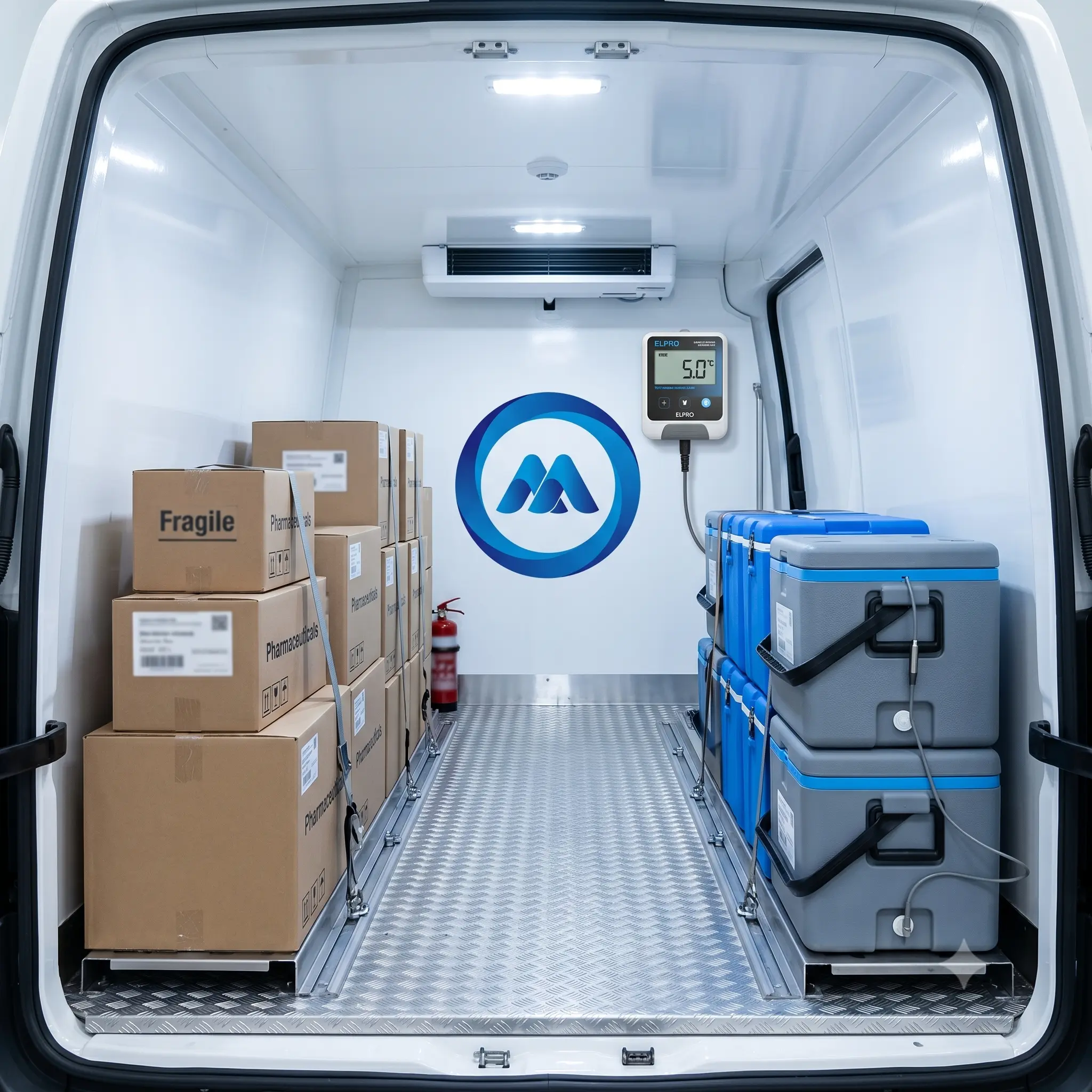
- Fast thermal recovery — the cargo area should return to its target range within roughly 5 minutes of a 60-second door-opening, so a loading-dock stop doesn’t become a sustained excursion
- Power redundancy — a secondary generator or plug-in capability so refrigeration keeps running at full capacity while the vehicle’s main engine is off during loading
- Seamless, non-porous interior surfaces that withstand clinical-grade sanitization without exposed bolts or sharp edges that could tear primary packaging
- Elevated shelving or pallet racking so cargo isn’t sitting directly on the floor absorbing road-surface heat
- Lockable bulkheads and tamper-evident seals for chain-of-custody on high-value biologics
Documentation is just as important as the hardware. Basic compliance can run on single-use data loggers that a receiving pharmacist downloads on delivery, but fleets serving hospital tenders increasingly use continuous IoT loggers that transmit temperature, humidity, and shock data live and trigger an alert if the reading drifts toward the regulatory limit before it’s breached. Logger placement matters as much as the logger itself: it must sit inside the cargo envelope among the actual product, not in the driver’s cabin or directly in front of the cooling unit’s discharge, both of which produce falsely stable readings that fail an audit the moment an inspector checks. Loggers used for serious pharma work should carry roughly ±0.5°C accuracy with an annual NIST- or NABL-traceable calibration certificate, typically logging at 5-minute intervals — some UAE hospital procurement specifications require 2-minute intervals for critical biologics.
Driver Qualification
Drivers carrying pharmaceutical cargo need documented training beyond a standard licence: cold chain principles, the biochemical reason temperature matters, the correct excursion response, and hands-on familiarity with the specific logger model in their vehicle. Standard rules forbid opening sealed pharmaceutical packaging, mixing medicinal cargo with food or personal items, and leaving the vehicle unattended with cargo doors open. DHA, DoH, and EDE audits frequently include impromptu driver interviews — a driver who can’t explain the excursion SOP from memory is treated as a compliance failure for the transport provider, not just a training gap.
Proving It Works: Vehicle Mapping and Lane Qualification
Owning the right equipment is only the first step; GDP expects documented proof that a specific vehicle holds temperature under worst-case conditions, governed by WHO Technical Report Series 961 Annex 9 principles extending into ground transport.
Temperature mapping tests a vehicle’s actual thermal distribution rather than assuming the thermostat reading is uniform throughout the cargo bay. A proper mapping study places sensors on a grid — horizontal and vertical — to catch hot spots and cold spots, runs for a minimum of 72 hours to capture a full operational cycle, and is conducted under both an empty-load and a 70-90% full-load test, since dense cargo changes airflow dynamics significantly. Critically, a vehicle mapped only in UAE winter conditions cannot be assumed safe for summer operation — a separate worst-case summer validation is needed given how much hotter a parked cargo bay runs in July and August.
Lane qualification goes a step further and validates the entire route, not just the vehicle: a test shipment with full logging equipment physically runs the actual corridor — for example Dubai to a remote site in Abu Dhabi’s Western Region — to build a “lane profile” accounting for loading-dock heat exposure, transit time, and realistic delay risk. As a safety margin, a lane generally shouldn’t be run if its expected transit time exceeds about 70% of the qualified hold time of whatever passive or active packaging is being used, leaving a buffer for traffic, customs delays, or a breakdown.
Who Needs This Level of Cold Chain Rigor
- Pharmacies, clinics, and hospitals on daily or scheduled replenishment routes — these need agile 1-ton to 3-ton vans with fast HVAC recovery, since a single delivery shift can involve dozens of door-openings
- Vaccine and immunization programmes, including seasonal campaigns — these demand the strictest protection against sub-zero excursions specifically, given how unforgiving freezing damage is to adjuvanted vaccines
- Clinical trial sites moving investigational products and patient specimens — often ultra-cold dry-ice shippers nested inside a standard 2-8°C vehicle, paired with continuous live tracking for chain-of-custody
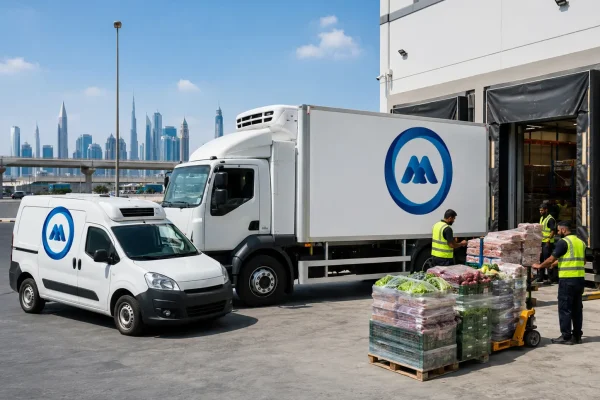
- Wholesale distributors and 3PLs running bulk inter-emirate freight — larger refrigerated and deep-freeze trucks moving palletized stock from import hubs to regional distribution centres
Outsourcing vs. Operating a Validated Fleet In-House
Building an in-house pharma fleet means real, recurring overhead beyond the vehicle itself: annual 72-hour thermal mapping runs, IQ/OQ/PQ revalidation documentation, NIST- or NABL-traceable calibration on every logger, and a continuous internal training programme to keep drivers current on GDP protocol — on top of the asset-downtime risk if a vehicle fails its calibration check mid-contract and a hospital delivery SLA is suddenly at risk. For a distributor running occasional or moderate pharma volume, this overhead frequently outweighs the alternative: contracting a chiller transport partner that supplies continuous temperature logging and documentation on a per-job basis without the distributor carrying the capital cost of fleet validation.
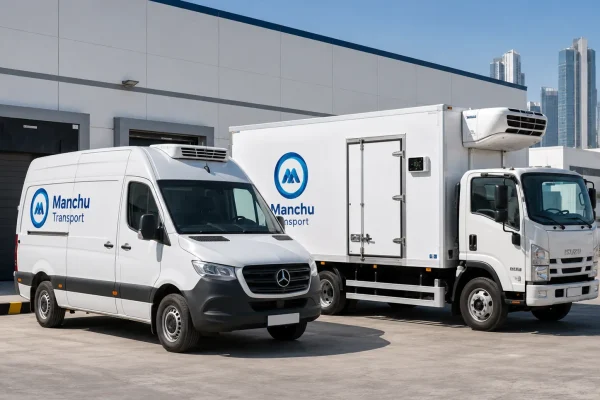
This is the same daily-rate logic that applies across food cold chain in the UAE, extended to a more demanding cargo category. A chiller van rental in Dubai from AED 350/day, or a larger chiller truck from AED 600/day for higher-volume distribution runs, can be specified with continuous temperature logging and documented handover records for pharma-grade jobs. Seasonal vaccine campaigns or short-term distribution contracts are also a natural fit for rental capacity rather than a vehicle purchase that sits idle once the campaign ends. For Abu Dhabi-based pharmaceutical distribution, the same approach applies via chiller van rental in Abu Dhabi, where DoH oversight and the Medicine Transportation Unit licence apply instead of DHA’s framework.
Manchu Transport can provide temperature logs and transit documentation on request to support a pharmaceutical client’s own GDP audit trail. Get a quote to discuss your specific cold chain documentation requirements before your next pharma distribution run.
Frequently Asked Questions
What temperature should pharmaceuticals be transported at in the UAE?
Most vaccines, insulin, and biologics require +2°C to +8°C throughout transport. Some stable pharmaceuticals only need controlled room temperature (+15°C to +25°C), while specialized biologics may require frozen (-20°C to -25°C) or ultra-cold (-60°C to -90°C) conditions.
What is GDP compliance for pharmaceutical transport?
Good Distribution Practice (GDP) is a WHO-originated standard, enforced in the UAE through the Emirates Drug Establishment federally and DHA/DoH at the emirate level, requiring medicines to maintain their required temperature throughout transport with continuous calibrated monitoring and a documented response to any deviation.
What happens if a vaccine accidentally freezes during transport?
Freezing can rupture the lipid structures or separate the antigen from the adjuvant in many vaccines. The damage is permanent even after the product is rewarmed — it looks completely normal but can confer little to no immunity, which is why minimum-temperature alarms are treated as seriously as maximum-temperature alarms.
Is a temperature excursion above 8°C always a compliance failure?
Not automatically — duration and the specific product’s stability data both matter, and a brief excursion may be acceptable if documented. But sustained heat exposure causes real, measurable potency loss in products like insulin within weeks, not months.
Do I need a dedicated validated fleet for pharmaceutical transport?
Not necessarily. Many UAE pharmacies, clinics, and distributors contract chiller transport providers that supply continuous temperature logging and documentation per job rather than carrying the capital cost of an in-house validated fleet, including annual mapping and calibration.
Need Reliable Refrigerated Transport?
Get a free quote for chiller van, truck, or trailer rental in Dubai and across the UAE.
Get a Free QuoteRecommended Services
Our Refrigerated Transport Services
Choose the vehicle that matches your route, payload, and temperature requirements.
 Dubai
Dubai
Chiller Truck Rental Dubai
3-Ton to 10-Ton refrigerated trucks for supermarket, pharma, and wholesale distribution.
View Service Last-Mile
Chiller Van Rental Dubai
1-Ton and 1.5-Ton chiller vans for last-mile cold chain, catering, and pharmacy routes.
View Service
Abu Dhabi
Chiller Truck Rental Abu Dhabi
ADAFSA and ASATEEL-compliant truck rentals for Mussafah, KIZAD, Khalifa City, and Al Ain.
View Service Cross-Border
Chiller Trailer Rental Dubai
20-Ton and 25-Ton reefer trailers for port clearances, warehouse transfers, and GCC routes.
View Service