Ask any procurement manager who has been turned away at a Dubai supermarket loading dock what “FoodWatch registered” actually means, and you will usually get a shrug or a half-answer. In 2026, that confusion has gotten expensive. Dubai Municipality has spent the past year retiring the last vestiges of paper-based food safety compliance and replacing it with DMChecked, a mobile-first inspection platform, and FoodDXB.AI, a predictive enforcement engine that reportedly draws on data from over 360,000 stakeholders in the food sector to flag non-compliant transport operators before an inspector ever shows up. For any business receiving chilled or frozen deliveries, and for the fleet operators serving them, the days of a driver waving a laminated permit at the gate and calling it compliance are over.
At Manchu Transport, every vehicle in our fleet is registered on the FoodWatch platform before it leaves our yard in Dubai Investment Park, because the procurement teams at the supermarkets, hotels and cloud kitchens we serve now check that registration before a single pallet comes off the truck. This guide walks through what FoodWatch vehicle registration actually is, how it differs from the physical DM Food Vehicle Permit, the step-by-step 2026 process, and — most importantly if you are sourcing a transport partner — exactly how to verify a supplier’s registration before you accept their next delivery.
What Is FoodWatch, and Why the 2026 Shift Matters
FoodWatch was launched in 2018 as Dubai Municipality’s digital food safety and traceability platform, built to connect every stakeholder in the food chain — importers, manufacturers, transporters, caterers and retailers — inside a single trusted network. Registration and ongoing subscription have been mandatory since inception for all food businesses operating in Dubai, including food transporters, historically carried at around AED 1,500 a year for a corporate account. The underlying goal has always been the same: eliminate fragmented, paper-based record-keeping and replace it with real-time, verifiable data.
The structural change that matters for 2026 is the retirement of the legacy “FoodWatch Connect” app in favour of DMChecked, unveiled at the Dubai International Food Safety Conference as the next generation of self-compliance and inspection technology. The FoodWatch web portal remains the foundational database for corporate registration, but the day-to-day compliance work — logging vehicle temperatures, running pre-dispatch hygiene checks, recording deliveries — has moved entirely to DMChecked. Inspectors no longer accept retrospective paper logs. If a transport company fails to record its daily chiller and freezer checks directly into DMChecked, or through an approved integrated API, it will automatically fail an unannounced municipal inspection.
Layered on top of DMChecked is FoodDXB.AI, an AI framework that has won recognition including the Seoul Smart City Prize for its work analysing years of inspection data, temperature logs and supplier histories to predict food safety risk before it materialises. In practice, this shifts enforcement from reactive spot checks to predictive, algorithmic targeting — a transport company with gaps in its DMChecked logs is now more likely to be flagged for a targeted inspection than in the paper-log era. Continuous, accurate digital registration is no longer a box-ticking exercise; it is what keeps a fleet off the municipality’s radar in the first place.
Two Different Hurdles: The DM Vehicle Permit and FoodWatch Registration
One of the most common points of confusion for new market entrants and procurement teams alike is treating “FoodWatch registration” as a single step. It is not. It is two distinct, sequential requirements, and both must be cleared before a vehicle can legally deliver to a registered establishment. We cover the physical permit process in detail in our Dubai Municipality food transport vehicle permit guide — this post focuses specifically on what happens after that permit is in hand, and on how the digital registration and supplier-verification side works.
| Regulatory Feature | DM Food Transport Vehicle Permit | FoodWatch Digital Vehicle Registration |
|---|---|---|
| Primary domain | Physical hardware: hygiene, insulation, mechanical refrigeration capability | Digital traceability, compliance data logging, supply chain visibility |
| Issuing authority | Authorised testing centres (Tasjeel, Aber, Shamil) acting on behalf of DM | Dubai Municipality Food Safety Department, via the FoodWatch portal |
| Tangible output | A physical inspection certificate and sticker applied to the vehicle | A digital record on the corporate profile plus a scannable QR code |
| Core requirement | Pass a physical inspection of door seals, compartment washability and chiller calibration | Accurately enter the valid permit details into the portal under a certified PIC |
| Renewal cycle | Annual physical re-inspection | Annual digital renewal and verification through the platform |
The distinction matters because a vehicle can pass its physical inspection and still not be legally cleared to deliver. Until the approved chassis number, licence plate and new DM Permit are linked to the company’s FoodWatch profile by a certified Person in Charge, the vehicle has no digital identity in the system — and no QR code for a receiving dock to scan. As our earlier piece on temperature-controlled transport and food safety in Dubai puts it: FoodWatch is Dubai Municipality’s digital registration system, and businesses cannot legally use a transport provider that is not FoodWatch-registered. That framing holds in 2026; what has changed is the platform doing the enforcing and how quickly gaps get caught.
The 2026 FoodWatch Vehicle Registration Process, Step by Step
For a fleet operator, getting a vehicle from “roadworthy” to “FoodWatch-registered and dispatch-ready” follows a fixed sequence across four phases.
Phase 1: Corporate Foundation and RTA Registration
The operating company needs a valid trade licence from the Department of Economy and Tourism or a recognised free zone authority, carrying a food-related activity code such as Food Transport, Catering or Foodstuff Trading. The specific vehicle then needs a standard RTA commercial registration — the mechanical test covering brakes, tyres, exhaust and chassis — resulting in a commercial Mulkiya registered under the company’s name. Note this is separate from the food-specific inspection; RTA registration confirms the vehicle is safe to drive, not that it is safe to carry chilled cargo.
Phase 2: Company FoodWatch Onboarding and Training
A new transport company must create a corporate profile on the FoodWatch portal and designate at least one Person in Charge (PIC) who holds a DM-approved food safety training certification. Under the Dubai Food Code, the PIC carries legal responsibility for the accuracy of the company’s FoodWatch records and its day-to-day DMChecked compliance. Every driver handling food also needs an Occupational Health Card from the Dubai Health Authority confirming they are medically fit to handle consumables.
Phase 3: The Physical DM Food Vehicle Inspection
With the corporate side sorted, the vehicle goes to an authorised testing centre — Aber Vehicle Testing, Tasjeel or Shamil — where the driver presents the Emirates ID, the RTA Mulkiya and a copy of the trade licence. Inspectors assess the cargo hold’s structural integrity, sanitation and thermal capability. The inspection fee is standardised at roughly AED 220 to AED 225. Processing speed after that depends on the testing centre’s technology: some push the approval straight to the FoodWatch backend the moment the vehicle passes, while manual applications through standard municipal channels can take up to five working days to reflect on the portal.
Phase 4: Digital Linkage and DMChecked Activation
Once the physical permit is synchronised with the municipality’s database, the PIC logs into the FoodWatch portal, adds the vehicle, and links the new DM Permit to the company’s fleet record. This is the step that finally produces the vehicle’s unique QR code. From there, the driver and PIC must also confirm the vehicle is active inside the DMChecked app itself, which is what allows the driver to log daily pre-trip hygiene checks and temperature validations before dispatch.
What Happens at the Loading Dock: The QR Code Verification Protocol
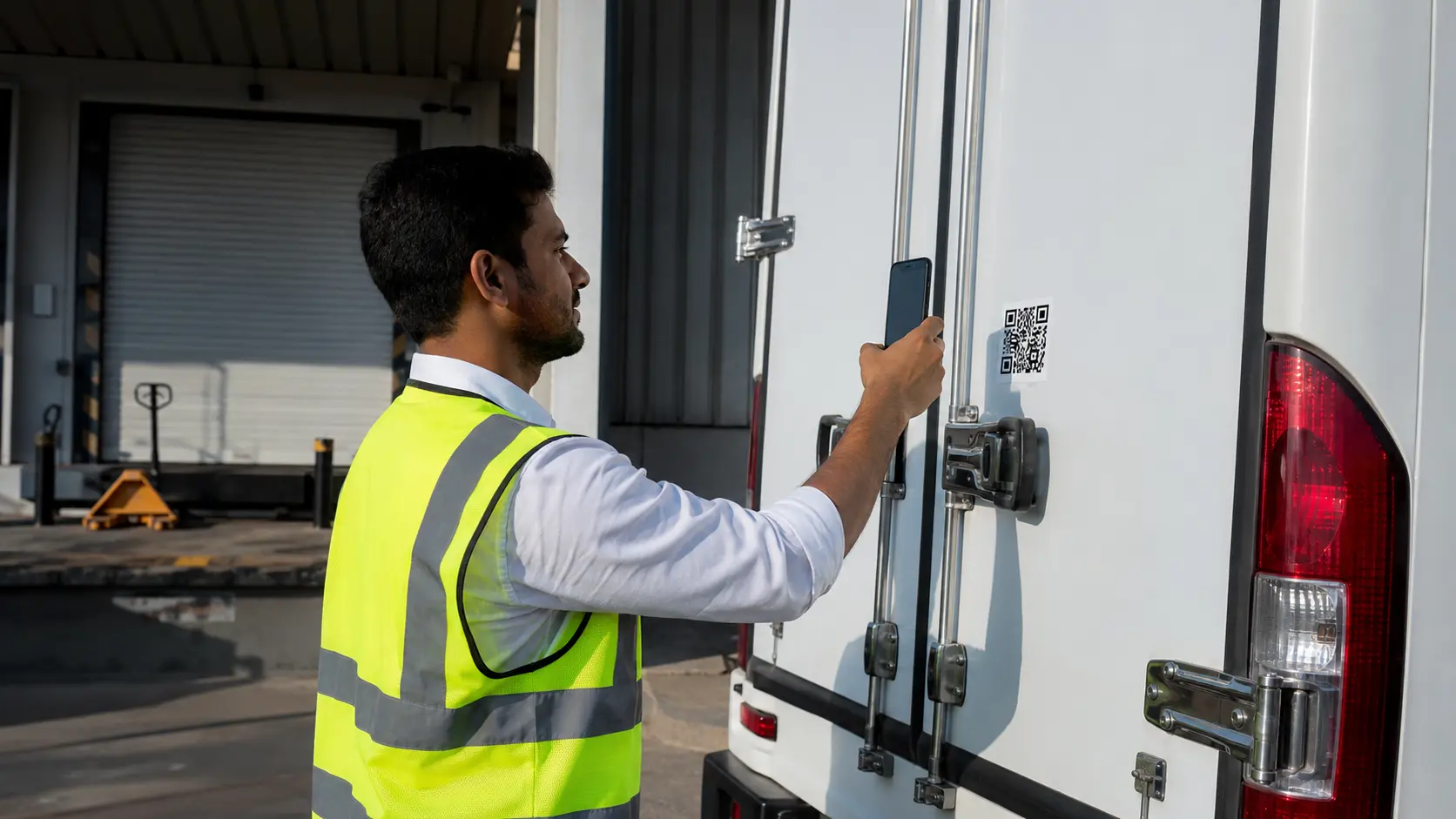
The FoodWatch system’s real enforcement power shows up daily at receiving docks, not in a municipal office. Every registered vehicle carries a unique, dynamic QR code. When a delivery arrives, the receiving establishment’s PIC or receiving clerk is expected to scan that code — through the DMChecked app or a connected scanner — before the load is accepted.
The scan pulls the vehicle’s permit validity, its approved temperature category (chiller versus freezer versus dry), and the transport company’s overall compliance status directly from the municipal backend. This is what stops a chiller-only vehicle from delivering deep-frozen stock, and what flags a driver whose Occupational Health Card has lapsed. If the scan turns up anything off — an expired permit, a category mismatch, a suspended corporate status — the receiving business is expected to reject the delivery outright. Accepting food from an unregistered or flagged vehicle shifts the compliance liability onto the receiving establishment, which is exactly the exposure a procurement team is trying to avoid when it audits suppliers in the first place.
Beyond the QR scan, the Dubai Food Code treats the transport leg as a Critical Control Point under HACCP, meaning the receiving PIC increasingly needs more than a quick temperature probe on arrival — they need evidence that the cargo hold held temperature for the whole trip, not just at the door. Transport operators whose vehicles carry IoT temperature sensors feeding into DMChecked can produce that transit history on request; operators still relying on a clipboard cannot, and in 2026 that gap is treated as a red flag rather than a formality.
The Cost of Skipping Registration
Dubai Municipality’s penalty structure for non-registration is designed to remove any cost-benefit case for cutting corners.
| Violation | Financial Penalty | Institutional Impact |
|---|---|---|
| Operating without a valid DM permit / FoodWatch registration | Fines up to AED 10,000 | Immediate stop on commercial activity for that vehicle |
| Failure to maintain accurate DMChecked digital records | AED 50,000 to AED 100,000 for serious, systemic failures | Municipal inspection grade downgraded; increased scrutiny |
| Temperature abuse leading to adulterated food | AED 10,000 up to AED 500,000 | Potential criminal liability for gross negligence |
The financial exposure is only half the risk. Because compliant receiving businesses are expected to reject unverified vehicles at the loading bay, a single failed QR scan can mean an entire load of fresh seafood or dairy is turned away and effectively written off. Persistent violations can see a transport company’s FoodWatch profile downgraded or suspended, which functions as an industry-wide blacklist — no restaurant, hotel or supermarket processing deliveries through the portal will be able to accept that company’s trucks at all.
Why Manchu Transport’s Fleet Is Pre-Registered — Across Dubai, Abu Dhabi and Al Ain
We have been renting chiller vans, trucks and trailers in Dubai Investment Park for over 14 years, and the single most common question we now get from new procurement contacts is not “what’s your rate,” it’s “can I see your FoodWatch registration.” Every vehicle in our Dubai fleet carries a current DM Card and an active FoodWatch registration with a live QR code, so a receiving PIC can verify us on the spot rather than take our word for it. For deliveries into Abu Dhabi and Al Ain, our fleet also holds the equivalent ADAFSA Food Watch Department (FWD) permit and ASATEEL GPS/OBU registration required by Abu Dhabi’s Integrated Transport Centre, and our drivers hold EFST food safety certification where that emirate requires it.
Practically, this means a procurement manager sourcing a rental for a one-off delivery, a seasonal spike, or a permanent route does not have to build compliance from scratch. Our current fleet rates:
| Vehicle | Daily Rate |
|---|---|
| 1-Ton chiller van | AED 350/day |
| 1.5-Ton chiller van | AED 400/day |
| 3-Ton chiller truck | AED 600/day |
| 7-Ton chiller truck | AED 700/day |
| 10-Ton chiller truck | AED 800/day |
| Chiller trailer | From AED 900/day |
Whether you need a chiller van rental in Dubai for daily HORECA replenishment, a chiller truck rental in Dubai for bulk distribution, or a chiller van rental in Abu Dhabi for a cross-emirate route, every vehicle we dispatch is already carrying the registration a receiving dock will scan for. See our full coverage across the areas we serve, from Dubai and Abu Dhabi to Al Ain.
A Quick Audit Checklist for Procurement Teams
If you are onboarding or re-vetting a transport supplier in 2026, verifying a trade licence alone is not enough. Before you sign, confirm:
- The vehicle’s FoodWatch QR code is live and returns a valid, non-expired DM permit when scanned.
- The temperature category on the registration (chiller, freezer or dry) matches what you are actually shipping.
- Every driver assigned to your account holds a current Occupational Health Card, and an EFST certificate for Abu Dhabi or Al Ain routes.
- The provider is actively logging pre-trip hygiene checks and temperatures in DMChecked, not relying on paper logs.
- The fleet has IoT temperature sensors that can produce a transit history on request, not just a temperature reading at the door.
- The company’s overall FoodWatch corporate status is active and in good standing, not flagged or under review.
If a prospective supplier cannot answer these confidently, that is the risk showing up before the fine does. For a broader look at how these requirements fit into your everyday receiving process, our FAQ page covers the most common questions we get from both procurement teams and drivers.
Frequently Asked Questions
What is the difference between the DM Food Vehicle Permit and FoodWatch registration?
The DM Food Vehicle Permit is the physical inspection: it confirms the cargo hold is hygienically built, properly insulated and mechanically capable of holding the right temperature range. FoodWatch registration is the digital step that comes after — linking that approved permit, the vehicle’s plate number and chassis details to the transport company’s FoodWatch profile, which is what generates the vehicle’s scannable QR code. A vehicle needs both before it can legally deliver.
How do I check if a supplier’s vehicle is actually FoodWatch registered before accepting a delivery?
Every registered vehicle carries a unique QR code. Your Person in Charge scans it using the DMChecked app or a connected device at the point of delivery, and the scan returns the permit’s validity, the vehicle’s approved temperature category, and the transport company’s current compliance status. That single scan is your verification — you should not accept a delivery from a vehicle that fails or cannot produce a valid scan.
Is “FoodWatch Connect” still valid for compliance in 2026?
No. FoodWatch Connect has been phased out in favour of the DMChecked platform. While a company’s historical data should have migrated across, they are required to be actively using DMChecked for daily inspection logging and compliance data in 2026. If a transport partner still references FoodWatch Connect as their active system, ask for confirmation they have moved to DMChecked.
How much does FoodWatch vehicle registration cost and how long does it take?
The physical DM inspection at an authorised centre such as Aber, Tasjeel or Shamil typically costs around AED 220 to AED 225 per vehicle. Registration on the FoodWatch platform itself does not carry an extra per-vehicle fee. Timing depends on the testing centre: some push approvals straight through to the FoodWatch backend instantly, while manual processing through standard municipal channels can take up to five working days to appear on the portal.
What happens if my business accepts a delivery from an unregistered vehicle?
Accepting a delivery from a vehicle that fails or lacks a valid FoodWatch registration shifts the compliance risk onto your establishment. It can expose your business to fines, a downgraded municipal inspection grade, and — if the delivery is later linked to a temperature or hygiene issue — much larger penalties. This is exactly why receiving docks are expected to scan and reject rather than take a driver’s word for it.
Does a vehicle carrying only dry, non-refrigerated goods still need to be registered?
Yes. Even vehicles that never run mechanical refrigeration still need to pass the physical DM inspection and carry a FoodWatch registration, because the cargo hold still has to meet hygiene, pest-control and cross-contamination standards. Registration is tied to whether the vehicle carries food at all, not just whether it needs to be cold.
If you are sourcing chilled or frozen transport in Dubai, Abu Dhabi or Al Ain and want a fleet that is already FoodWatch-registered, DM Card certified, and ADAFSA and ASATEEL compliant for cross-emirate routes, get in touch with our team or request a quote for your route and vehicle class. We handle the registration so your next delivery clears the dock without a second look.
Need Reliable Refrigerated Transport?
Get a free quote for chiller van, truck, or trailer rental in Dubai and across the UAE.
Get a Free QuoteRecommended Services
Our Refrigerated Transport Services
Choose the vehicle that matches your route, payload, and temperature requirements.
 Abu Dhabi
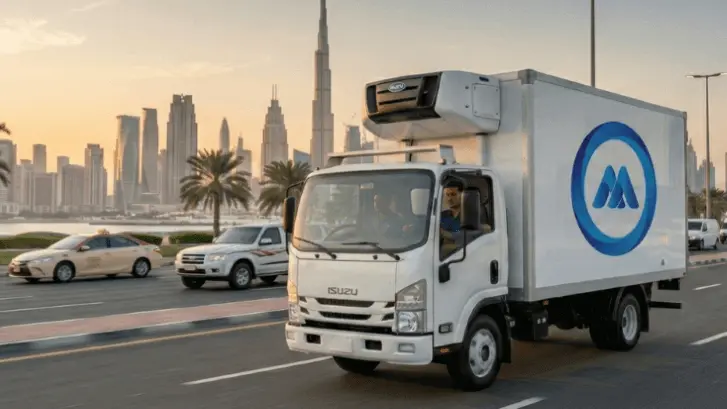
Chiller Truck Rental Abu Dhabi
ADAFSA and ASATEEL-compliant truck rentals for Mussafah, KIZAD, Khalifa City, and Al Ain.
View Service
Dubai
Chiller Truck Rental Dubai
3-Ton to 10-Ton refrigerated trucks for supermarket, pharma, and wholesale distribution.
View Service Last-Mile
Chiller Van Rental Dubai
1-Ton and 1.5-Ton chiller vans for last-mile cold chain, catering, and pharmacy routes.
View Service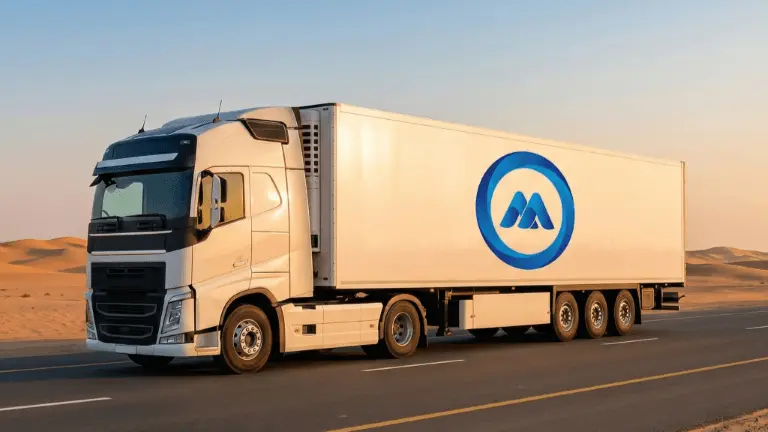 Cross-Border
Chiller Trailer Rental Dubai
20-Ton and 25-Ton reefer trailers for port clearances, warehouse transfers, and GCC routes.
View Service