Abu Dhabi’s cold chain economy is concentrated in two industrial powerhouses: KIZAD (now KEZAD) in Taweelah and the Mussafah/ICAD corridor south of the capital. Between them, they hold the emirate’s largest food processing plants, its pharmaceutical ultra-cold hubs, and the reefer container traffic flowing out of Khalifa Port. If your business stores or moves temperature-sensitive cargo in Abu Dhabi, you are almost certainly operating in one of these zones, or delivering into them. This guide maps the cold chain landscape across KIZAD, Mussafah and ICAD, explains the regulatory moat that separates Abu Dhabi from Dubai, and shows how to run compliant refrigerated transport without exposing your fleet to five-figure fines.
KIZAD and KEZAD: Abu Dhabi’s Logistics Gateway
KIZAD, the Khalifa Industrial Zone Abu Dhabi established in 2010, was absorbed in September 2022 into a much larger platform: KEZAD, the Khalifa Economic Zones Abu Dhabi, launched by AD Ports Group. KEZAD merged the original KIZAD footprint with the former ZonesCorp industrial zones to create 12 economic zones spread across Abu Dhabi City, Al Ain and Al Dhafra. The combined area covers roughly 550 square kilometres, of which around 100 square kilometres is designated free zone.
The scale is what makes KEZAD central to any conversation about KIZAD logistics companies and cold chain operators in the emirate. The platform hosts more than 1,750 tenants, supports over 450,000 worker beds, and has attracted upwards of 18 billion US dollars in foreign direct investment. Its location in Taweelah, integrated with the semi-automated deep-water Khalifa Port, sits around 64 kilometres from Abu Dhabi City and roughly 90 kilometres from Dubai. From KEZAD, a 90-minute drive reaches an estimated 75 percent of the UAE population and 89 percent of national GDP, positioning the zone as a gateway to a regional market of roughly 4.5 billion consumers across the Middle East and the subcontinent.
KEZAD’s Cold Chain Clusters
KEZAD is organised into specialised clusters, several of which are direct drivers of refrigerated transport demand:
- Food Processing and the Abu Dhabi Food Hub: a 3.3 square kilometre wholesale trade and logistics centre in KEZAD Area B, developed as a public-private partnership with Ghassan Aboud Group and France’s Rungis International Market. It handles fresh produce, dry goods, meat, poultry and seafood through custom thermal pavilions. Anchor tenants include NFPC, a top-five GCC food producer building an AED 1.5 billion mega-facility spanning 8 million square feet, and Brazil’s BRF (Sadia and Perdigão brands) with an AED 533 million facility of 1.74 million square feet.
- Life Sciences: a cluster built around ultra-cold storage and air transport for pharmaceuticals, backed by Mubadala Ventures and ADQ. During the pandemic, the HOPE Consortium distributed vaccines globally, and AD Ports built 19,000 square metres of ultra-cold storage capable of holding over 120 million doses. GMSC, a Mubadala Bio subsidiary, has expanded to a 4,766 square metre warehouse with 6,500 pallet positions and a 100 square metre strict cold-chain area.
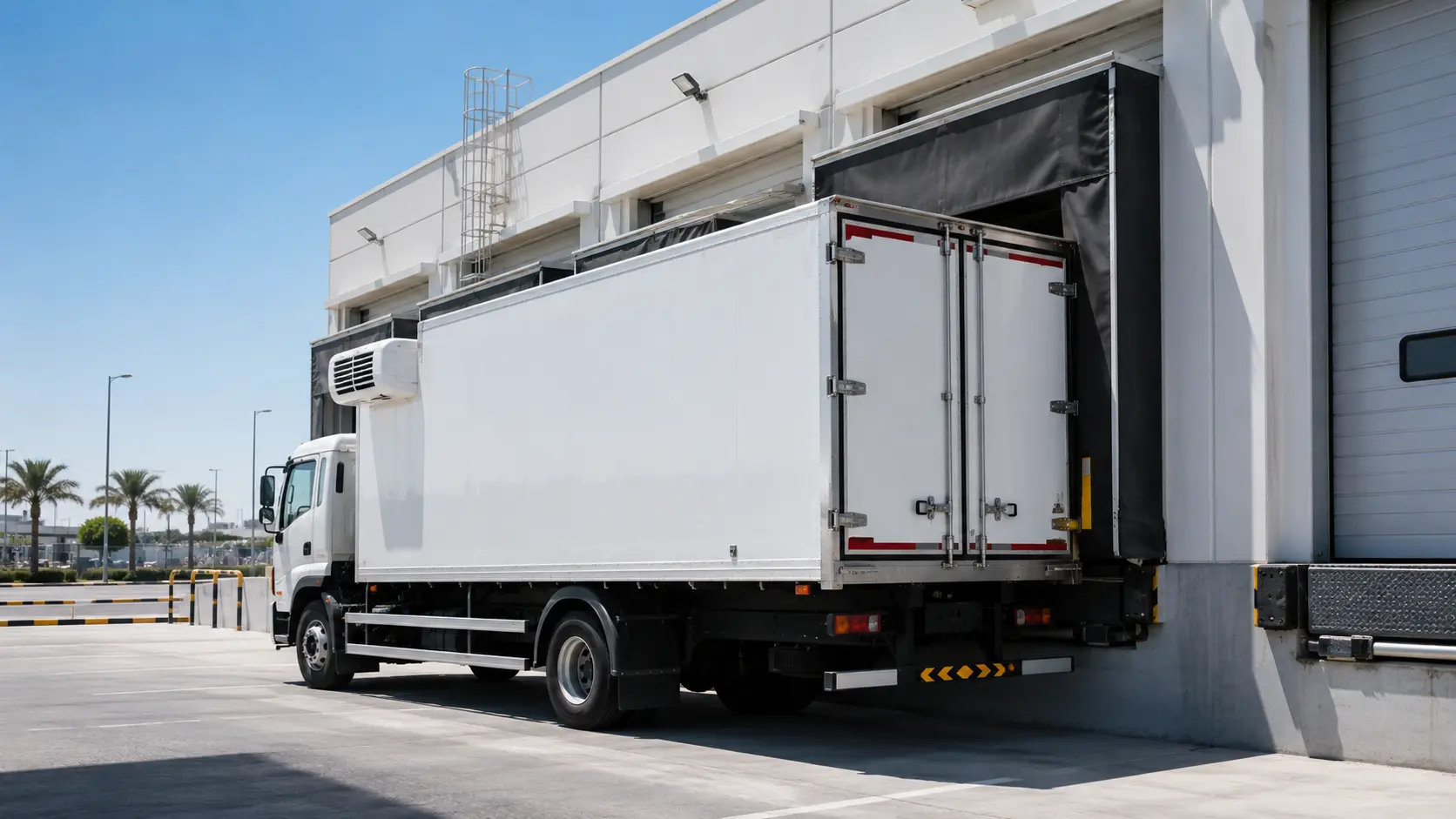
- KEZAD Logistics Park (KLP): a 2024 investment of AED 621 million added more than 250,000 square metres of warehousing by the end of 2025. KLP Phase 21 alone delivered 75,241 square metres of temperature-controlled cold and dry storage, featuring 1.3 metre raised loading docks, edge levellers and insulated roller shutter doors, all built for just-in-time replenishment.
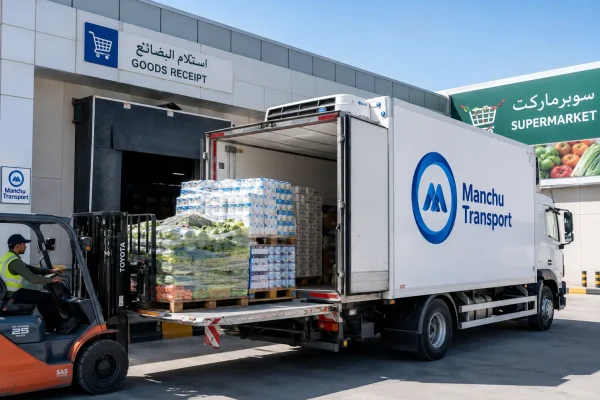
Every one of these facilities generates a constant flow of chilled and frozen cargo that has to move between warehouses, ports and end customers. That movement is where a dedicated chiller truck rental Abu Dhabi operator becomes part of the supply chain, bridging the gap between static cold storage and the customer’s dock.
Mussafah and ICAD: The Cold Storage Nexus
Where KEZAD is the coastal gateway, Mussafah and the Industrial City of Abu Dhabi (ICAD) are the operational engine room. Managed by the Abu Dhabi Department of Economic Development (ADDED), ICAD spans roughly 40 square kilometres along the Mussafah-Abu Dhabi corridor, integrated with Mussafah Port and the E311 and E30 highway routes. This is the densest concentration of cold storage and food processing capacity in the emirate, and it is where most Mussafah cold storage transport requirements originate.
ICAD is divided into functional zones, each with a different role in the cold chain:
| Zone | Size / Focus | Cold Chain Relevance |
|---|---|---|
| ICAD I | 14 sq km, heavy and medium industry (metal, fibreglass, construction) | Low direct cold chain; supports industrial catering and workforce food supply |
| ICAD II | Wood, chemicals, oil and gas support | Chemical and industrial cold storage; specialised handling |
| ICAD III | High-tech, food and beverage processing, textiles | The critical cold-chain nexus; major cold storage, with a new 13,810 sq ft facility handover due 2027 |
| ICAD IV & V | High-tech, automotive | Emerging temperature-controlled logistics and JIT parts storage |
ICAD III is the heart of the food cold chain. Its warehouses are purpose-built for temperature-controlled operations: pre-engineered steel buildings from suppliers such as Hibuild and Special Steels Factory LLC, insulated sandwich panel roofs, underground MEP utility corridors, and rooftop solar arrays designed to offset the heavy electrical load of continuous refrigeration. Commissioning one of these warehouses requires ADDC power connection, Tasheel occupancy certification, and Civil Defence sign-off against NFPA 13 fire standards, all under Abu Dhabi’s Estidama sustainability framework. Security in modern chambers extends to warehouse management systems, CCTV with ANPR gates, Hikvision analytics, and anti-condensation cameras built specifically for freezer environments.
Alongside ICAD, the older Mussafah M-zones (M-17, M-34, MW-4 and others) provide the 24/7 backbone: vehicle recovery, sanitisation, maintenance and rapid dispatch. From these zones, a refrigerated fleet can reach Yas Island, Saadiyat Island or the city centre in under 30 minutes, which is exactly the response window that hotels, cloud kitchens and event caterers demand. A well-positioned last-mile chiller van in ICAD can service these central destinations without the cold chain ever breaking.
The Regulatory Moat: Why Abu Dhabi Is Not Dubai
Here is the single most important operational fact for any company shipping cold cargo into Abu Dhabi from outside the emirate: an Abu Dhabi delivery is governed by ADAFSA, not Dubai Municipality, and the two systems are not reciprocal.
Food safety across Abu Dhabi, Al Ain and Al Dhafra falls under the Abu Dhabi Agriculture and Food Safety Authority (ADAFSA). Any vehicle transporting food into or within the emirate needs an ADAFSA Food Watch Department (FWD) Mobile Food Establishment Permit, a process we break down in full in our ADAFSA Mobile Food Establishment Permit guide. A Dubai Municipality DM Card does not carry over. Outside fleets arriving at Abu Dhabi cold storage docks without the ADAFSA permit are routinely rejected at the gate. The operational rules are equally specific:
- Temperature corridors: chilled cargo at +2°C to +8°C, frozen at -18°C to -25°C, and pharmaceutical GDP loads held to ±0.5°C. Interiors must be food-grade stainless steel with airtight seals and chemical sanitisation, following the ADOSH-SF Code of Practice 19.0 and HACCP-based SSOPs.
- Driver certification: every driver needs an Essential Food Safety Training (EFST) certificate issued through the Abu Dhabi Quality and Conformity Council. A Dubai-based driver without EFST is a compliance violation, even in a permitted vehicle.
- Summer resilience: the transport refrigeration unit must hold temperature in 50°C-plus ambient heat, which in practice means Thermo King or Carrier grade cooling, not consumer refrigeration.
ASATEEL and the AED 7,500 Cross-Border Trap
The regulatory moat gets deeper with ASATEEL, the fleet tracking platform run by Abu Dhabi’s Integrated Transport Centre (ITC). Every commercial vehicle operating in the emirate must be registered on ASATEEL: the operator links an ADDED trade licence, installs a certified On-Board Unit (OBU) from an approved vendor with a Certificate of Installation, and ties the vehicle’s Mulkiya and Traffic Code to the platform. Driver permits are issued against SEHA health certificates. Operator permits run one year, driver permits two.
The penalty for ignoring this is blunt: a non-Abu-Dhabi-plated commercial vehicle operating without ASATEEL registration faces an AED 7,500 fine per violation. A Dubai-plated chiller truck sent on a KIZAD or Mussafah run without ASATEEL is not a grey area, it is a repeatable, per-trip liability. There are only two clean ways around it: open an Abu Dhabi branch licence, transfer your plates and install ASATEEL yourself, or hand the delivery to a locally registered fleet doing drop-shipments with valid non-returnable delivery receipts.
For most Dubai-based food and pharma businesses, doing the first is expensive and slow. That is precisely why so many of them outsource the Abu Dhabi leg. Working with an operator like Manchu Transport, which is ASATEEL-registered and compliant with active OBUs and ADAFSA permits, removes the AED 7,500 exposure entirely. You get the cargo into KEZAD or Mussafah legally, without setting up an Abu Dhabi entity just to make deliveries.
Highways, Tolls and Access Rules Into the Zones
Getting a refrigerated truck into KEZAD and ICAD is not just about permits. Abu Dhabi’s road rules are stricter than Dubai’s, and they directly affect scheduling and cost.
Abu Dhabi enforces a zero-buffer speed policy, unlike Dubai’s 20 km/h grace margin, so speed limits are absolute. Across 2025 and 2026, several limits were cut: E11 dropped from 160 to 140, the E30 Mussafah-ICAD truck route fell from 120 to 100, and the E20 from 120 to 100. Variable Speed Limit boards can drop the limit to 80 in fog or sandstorms, and truck peak-hour bans apply on the E10, E11 and E30. Weight enforcement is tight too: the Ministry of Energy and Infrastructure set a 65-tonne maximum in 2024, weigh-station evasion draws an AED 5,000 fine, and overload penalties reach up to AED 15,000 per ton.
Tolling and gate access add further planning steps. The Darb toll system (Law 17 of 2017) uses licence-plate cameras across six gates at 4 AED per crossing, with the Al Qurm and Ghantoot gates billing 24/7. Access to KEZAD and Khalifa Port itself runs through the Advanced Trade and Logistics Platform (ATLP), which issues gate passes that must be applied for one to three days ahead, backed by the driver’s Emirates ID, vehicle registration and a No Objection Certificate from the host tenant. A fleet that already knows these workflows loads and dispatches on schedule; one that does not loses hours at the gate.
The Three Cold Chain Verticals in Abu Dhabi’s Industrial Zones
The demand inside KEZAD, Mussafah and ICAD splits into three distinct cargo profiles, each needing a different vehicle configuration.
| Vertical | Temperature | Typical Vehicle | Key Destinations |
|---|---|---|---|
| HORECA / FMCG replenishment | +2°C to +8°C chilled | 1 to 3 ton chiller vans, dual-evaporator, air curtains | Saadiyat resorts, Al Maryah (ADGM), Yas Island, Mussafah cloud kitchens |
| Pharma / Life Sciences | +2°C to +8°C, GDP ±0.5°C | GDP-grade vans and trucks with audited temp logging | Abu Dhabi Healthcare City, Al Ain Medical District, SEHA hospitals |
| Bulk seafood / frozen meat | -18°C to -25°C frozen | 7 to 10 ton freezer trucks, pallet airflow, 1,500 kg tail lifts | ICAD processing plants, Mussafah Central Fish Market, Khalifa Port reefers |
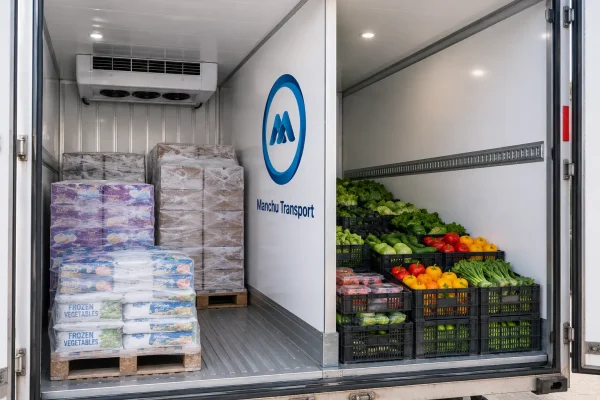
HORECA and FMCG is the highest-frequency work. Saadiyat’s luxury resorts, the financial district on Al Maryah, and Yas Island’s hospitality venues all need daily chilled replenishment through low-clearance docks, which favours compact vans with dual-evaporator systems and air curtains. The cloud kitchens clustered in Mussafah run around the clock and expect 24/7 replenishment with standby vehicles on call.
Pharmaceutical and life sciences cargo is lower volume but zero-tolerance. Loads move from KEZAD’s ultra-cold hubs to Abu Dhabi Healthcare City, the Al Ain Medical District and SEHA hospitals under both GDP and Department of Health standards, held to ±0.5°C. Here, the temperature log is not paperwork, it is an audited compliance document that can be demanded during an inspection.
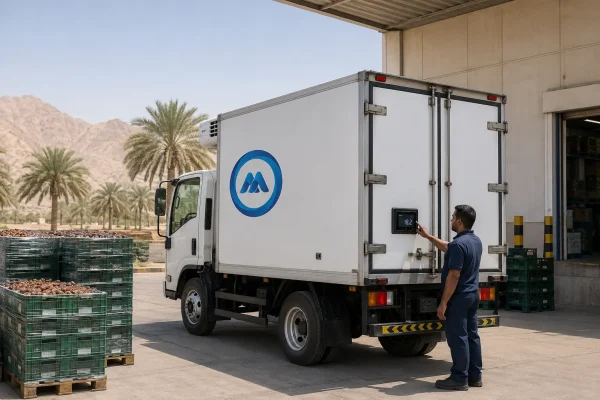
Bulk seafood and frozen meat is the heavy end. Reefer containers landing at Khalifa Port feed ICAD processing plants and the Mussafah Central Fish Market, requiring 7 to 10 ton freezer trucks running at -18°C to -25°C, pre-cooled before loading, with proper pallet airflow and 1,500 kg hydraulic tail lifts for palletised frozen goods. This is exactly the use case for a heavy freezer truck in Abu Dhabi operating between the port, the processing plants and the wholesale markets.
How Manchu Transport Serves KIZAD, Mussafah and ICAD
Manchu Transport, based at Dubai Investment Park 1, runs a refrigerated fleet across Dubai, Abu Dhabi and Al Ain that is built for exactly these industrial cold chain routes. Our vehicles are DM Card certified, ASATEEL-registered for legal Abu Dhabi operation, and staffed by EFST-certified drivers, which means we remove the AED 7,500 cross-border risk that stops Dubai-plated fleets at the Abu Dhabi border.
Our fleet covers the full temperature range these zones demand, with vans capable of holding +5°C down to -25°C:
| Vehicle | Daily Rate | Best Suited For |
|---|---|---|
| 1-Ton chiller van | AED 350/day | HORECA last-mile into Saadiyat, Yas Island, Al Maryah |
| 1.5-Ton chiller van | AED 400/day | Cloud kitchen and FMCG replenishment across Mussafah |
| 3-Ton chiller truck | AED 600/day | Mid-volume distribution across ICAD and KEZAD |
| 7-Ton chiller / freezer truck | AED 700/day | Bulk chilled and frozen runs from Khalifa Port |
| 10-Ton chiller / freezer truck | AED 800/day | Heavy seafood and frozen meat to ICAD III and Mussafah markets |
| Refrigerated trailer | AED 900/day | Large-scale project and long-haul cold storage transport |
Because KEZAD’s zones extend into Al Ain, we also support the inland market with chiller truck rental in Al Ain and chiller van rental in Al Ain, all under the same ADAFSA and ASATEEL compliance that applies across the wider Abu Dhabi emirate. For a full breakdown of every emirate and industrial zone we cover, see our areas we serve overview.
Whether you need a single chiller van rental Abu Dhabi for daily HORECA runs or a fleet of refrigerated trucks for Mussafah and KIZAD seafood distribution, we handle the permit, the tracking and the temperature so you do not have to build an Abu Dhabi operation from scratch.
Frequently Asked Questions
Do I need an ADAFSA permit to deliver food in Abu Dhabi?
Yes. Any vehicle transporting food into or within Abu Dhabi, Al Ain or Al Dhafra needs an ADAFSA Food Watch Department Mobile Food Establishment Permit. A Dubai Municipality DM Card is not reciprocal, and outside fleets without the ADAFSA permit are routinely rejected at KEZAD and Mussafah cold storage docks.
What is the ASATEEL fine for a Dubai-plated truck in Abu Dhabi?
A non-Abu-Dhabi-plated commercial vehicle operating without ASATEEL registration faces an AED 7,500 fine per violation. To avoid it, you either open an Abu Dhabi branch licence and install a certified OBU yourself, or outsource the delivery to a locally registered, ASATEEL-compliant operator like Manchu Transport.
Which cold storage zones does Manchu serve in Mussafah and KIZAD?
We serve the full KEZAD footprint in Taweelah including the Abu Dhabi Food Hub and KEZAD Logistics Park, the ICAD I to V zones, and the older Mussafah M-zones. From Mussafah we can reach Saadiyat, Yas Island and the Abu Dhabi city centre in under 30 minutes for HORECA and cloud kitchen replenishment.
What temperatures can your Abu Dhabi chiller trucks hold?
Our vans and trucks hold the full range required across the emirate: chilled cargo at +2°C to +8°C, frozen at -18°C to -25°C, with vehicles capable of running from +5°C down to -25°C. The transport refrigeration units are rated to maintain temperature in 50°C-plus summer ambient conditions.
Can you handle pharmaceutical cold chain into Abu Dhabi Healthcare City?
Yes. We support GDP-grade pharmaceutical transport held to tight temperature bands, moving from KEZAD’s ultra-cold hubs to destinations like Abu Dhabi Healthcare City, the Al Ain Medical District and SEHA hospitals, with audited temperature logs available for compliance inspections.
Do your drivers have the EFST certification required in Abu Dhabi?
Yes. Abu Dhabi requires every food transport driver to hold an Essential Food Safety Training certificate from the Abu Dhabi Quality and Conformity Council. Our Abu Dhabi and Al Ain drivers are EFST-certified, which is a mandatory requirement that a non-compliant Dubai fleet cannot meet.
Moving cold cargo through KIZAD, Mussafah or ICAD? Manchu Transport gives you an ASATEEL-registered, ADAFSA-compliant fleet that clears the Abu Dhabi border legally and keeps your cold chain intact from port to dock. Request a chiller truck rental Abu Dhabi quote or a chiller van in Abu Dhabi for last-mile work, and get a quote today for same-day dispatch into Abu Dhabi’s industrial heart.
Need Reliable Refrigerated Transport?
Get a free quote for chiller van, truck, or trailer rental in Dubai and across the UAE.
Get a Free QuoteRecommended Services
Our Refrigerated Transport Services
Choose the vehicle that matches your route, payload, and temperature requirements.
 Abu Dhabi
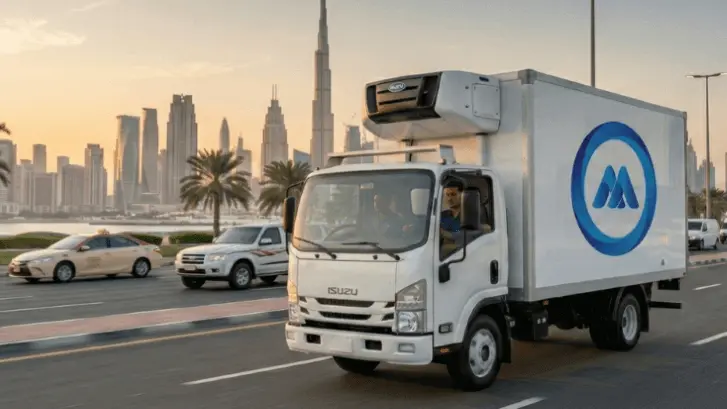
Chiller Truck Rental Abu Dhabi
ADAFSA and ASATEEL-compliant truck rentals for Mussafah, KIZAD, Khalifa City, and Al Ain.
View Service
Dubai
Chiller Truck Rental Dubai
3-Ton to 10-Ton refrigerated trucks for supermarket, pharma, and wholesale distribution.
View Service Last-Mile
Chiller Van Rental Dubai
1-Ton and 1.5-Ton chiller vans for last-mile cold chain, catering, and pharmacy routes.
View Service Cross-Border
Chiller Trailer Rental Dubai
20-Ton and 25-Ton reefer trailers for port clearances, warehouse transfers, and GCC routes.
View Service