Seafood is the most temperature-sensitive commodity in the UAE’s food supply chain. A consignment of fresh tuna that arrives at 6°C instead of 2°C does not just represent a quality problem — it is a public health risk. Histamine (Scombrotoxin) formation in tuna, mackerel, and related species accelerates exponentially above 4°C, and unlike most foodborne pathogens, histamine cannot be destroyed by cooking. A fish that looks, smells, and tests normal can still cause histamine fish poisoning in consumers if it spent too long in the wrong temperature band during transport.
This is why Dubai Municipality’s Food Safety Department, JAFZA customs authorities, and Abu Dhabi’s ADAFSA apply stricter scrutiny to seafood transport than to almost any other food category. The 2026 standards are unambiguous, the inspection triggers are well-defined, and the penalty schedule for violations has teeth.
This guide covers the complete regulatory framework for seafood cold chain transport in the UAE: temperature bands for each seafood category, what the Dubai Municipality DM Card inspection checks for fish and shellfish vehicles, the JAFZA import workflow, how HACCP plans apply to transport operations, the specific histamine risk that trips up operators of ambient-looking chilled cargo, vehicle engineering requirements, and the fine schedule operators need to factor into their compliance planning.
Temperature Bands: The Non-Negotiable Numbers
UAE food safety regulations, aligned with the Codex Alimentarius and Gulf Standardisation Organisation (GSO) standards, specify different temperature ranges for different seafood categories. These are not guidelines — they are legal requirements that can be verified by a DM or ADAFSA inspector with a calibrated probe at any point during transport.
| Seafood Category | Required Temperature Range | Notes |
|---|---|---|
| Fresh whole fish (iced) | -1°C to +2°C | Must be transported in slurry ice or flake ice; air chilling alone is insufficient |
| Fresh fish fillets and portions | 0°C to +4°C | Pre-packaged MAP portions — stricter than whole fish due to broken skin barrier |
| Live shellfish (oysters, clams, mussels) | 0°C to +4°C | Must remain alive until point of sale; temperature spikes kill shellfish faster than finfish |
| Cooked and chilled shellfish (prawns, crab) | 0°C to +4°C | Once cooked, treated as RTE (Ready-To-Eat); cross-contamination rules apply |
| Frozen fish and shellfish (general) | -18°C or below | No thaw cycles permitted during transport; core temperature must be -18°C throughout |
| High-fat fatty fish (salmon, herring, mackerel) | -24°C or below | High lipid content causes faster rancidity; stricter standard than general frozen |
| Sashimi-grade tuna and speciality fish | -60°C or below (super-frozen) | Required for parasitic destruction certification; handled in dedicated super-frozen containers |
| Smoked fish and cured products | 0°C to +5°C | Not ambient-stable in the UAE’s summer heat despite curing — must be refrigerated |
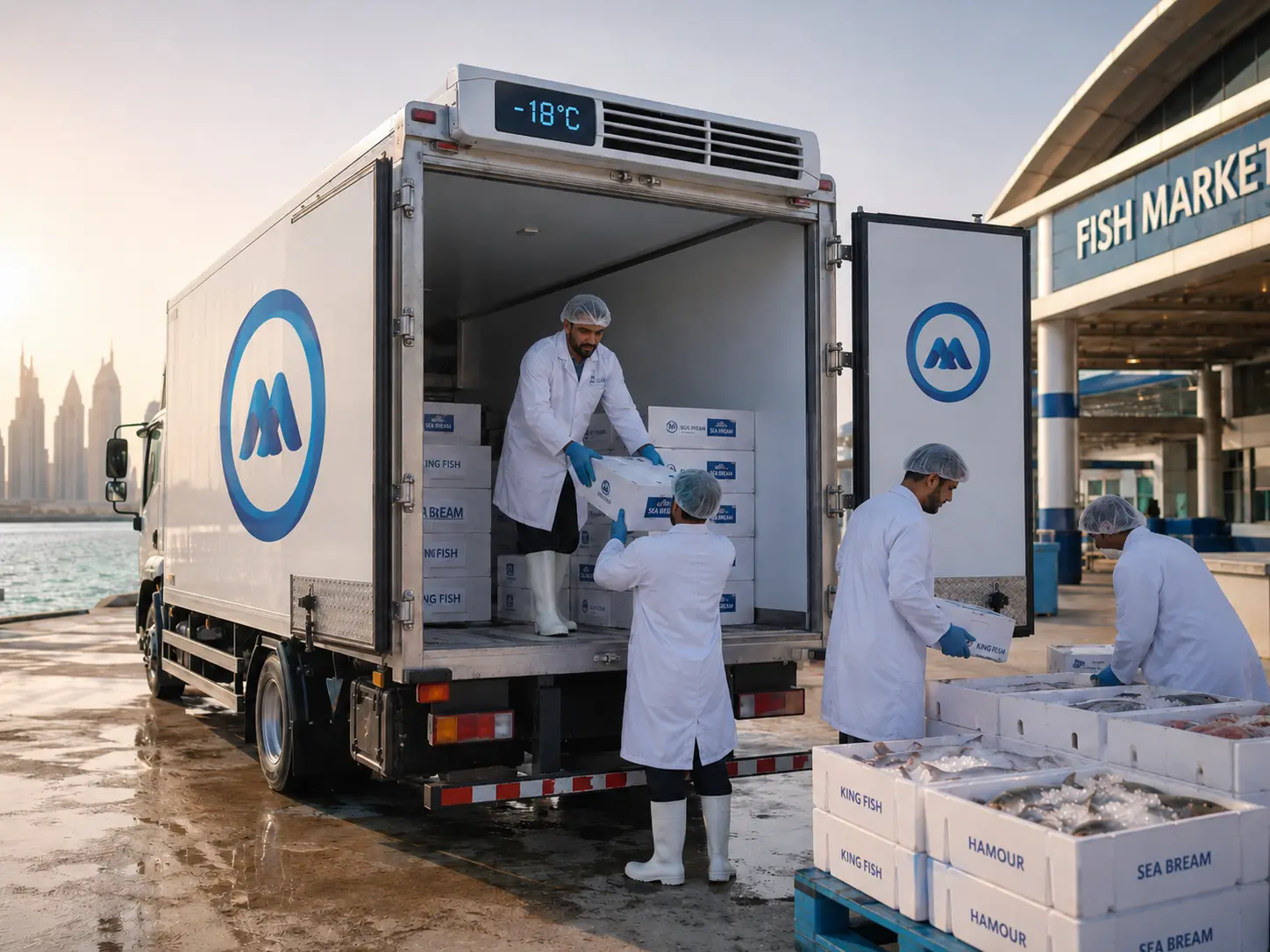
The tightest requirement — fresh whole fish at -1°C to +2°C — means vehicles servicing the fish market, hotel receiving docks, and restaurant distribution runs cannot simply set the refrigeration unit to a standard 4°C chiller setting and consider the job done. A unit running at +3°C is technically compliant for poultry but non-compliant for the fresh fish load in the same compartment.
For mixed-load operations (fresh fish and other chilled food in the same vehicle), the temperature of the most demanding commodity governs the entire compartment. Mixed loads of fresh fish and produce typically require dedicated single-commodity vehicles or multi-temperature trucks with physically separated, independently temperature-controlled compartments.
HACCP in Transport: What It Means for Seafood Operators
HACCP (Hazard Analysis and Critical Control Points) is a systematic approach to identifying and controlling food safety hazards at specific points in the production and distribution chain. Under Dubai Municipality requirements and ADAFSA regulations, any business involved in the commercial transport of seafood must operate under a documented HACCP plan.
Critical Control Points in Seafood Transport
For a seafood transport operation, the HACCP plan must identify and document control measures for at minimum the following CCPs:
CCP 1: Receiving (Loading Point)
Temperature verification at point of loading. Every consignment must be checked with a calibrated probe before it goes into the vehicle. If fish arrives at the loading dock above the permitted intake temperature, it must be rejected — not “cooled down in the truck” and delivered. The HACCP plan must specify the rejection criteria and the procedure for non-conforming consignments. Records must be retained for a minimum of 12 months.
CCP 2: Cold Chain Maintenance (During Transit)
Continuous temperature monitoring throughout the journey. DM requires IoT-connected temperature recorders that log at minimum every 30 minutes and transmit data to a cloud system accessible during inspections. For seafood transport, 2026 best practice is continuous logging (every 5 minutes) because temperature deviations in the narrow -1°C to +2°C band for fresh fish are detected more quickly. Any deviation above the upper limit triggers a corrective action that must be documented.
CCP 3: Delivery (Unloading Point)
Temperature verification at the point of delivery and confirmation of product condition. Drivers must record the delivery temperature and obtain a signed acceptance from the receiver. If a receiver accepts a consignment that the driver’s records show was out of temperature during transit, both parties share liability in a DM or ADAFSA investigation.
Scombrotoxin (Histamine): The Hidden CCP
Histamine fish poisoning — caused by Scombrotoxin — is one of the most common seafood-related illnesses in the UAE and globally. It affects tuna, mackerel, mahi-mahi, sardines, anchovies, and other species in the Scombridae and related families. The reason it is particularly dangerous for transport operators is that histamine formation is irreversible and undetectable by sight, smell, or taste.
When fish in this category is held above 4°C — even briefly — bacteria naturally present in the fish flesh begin producing histamine at an accelerating rate. The fish may continue to look and smell completely fresh. Standard temperature abuse (fish held at 8°C for two hours during a loading delay) can push histamine levels from safe to hazardous without any visible indication.
Cooking does not destroy histamine. A consumer who eats tuna that was temperature-abused during transport and then grilled at 180°C will still be exposed to the histamine that formed during the cold chain failure.
For operators transporting tuna, mackerel, or other Scombridae species, the HACCP plan must specifically address Scombrotoxin as a biological hazard with its own CCP. This typically means:
- Loading temperature verification with a specific rejection threshold of 2°C for Scombridae species
- Zero tolerance for temperature excursions during transit — no “brief deviation” allowances that might apply to other commodities
- Supplier documentation confirming the temperature history of the fish from point of harvest or processing
- Driver training that specifically covers Scombrotoxin risk and why fresh tuna cannot be “re-chilled if it warms up a bit”
DM food safety inspectors are increasingly testing for histamine levels in tuna and mackerel at market and restaurant receiving points. If elevated histamine is traced to a transport failure, the vehicle operator is liable under the food supply chain enforcement provisions — not just the seller or the importer.
Vehicle Engineering Requirements for Seafood Transport
Seafood imposes additional vehicle engineering requirements beyond the baseline Dubai Municipality DM Card standards for general food transport. Operators sourcing or modifying vehicles specifically for seafood distribution should be aware of these additional specifications.
Interior Surface Standards
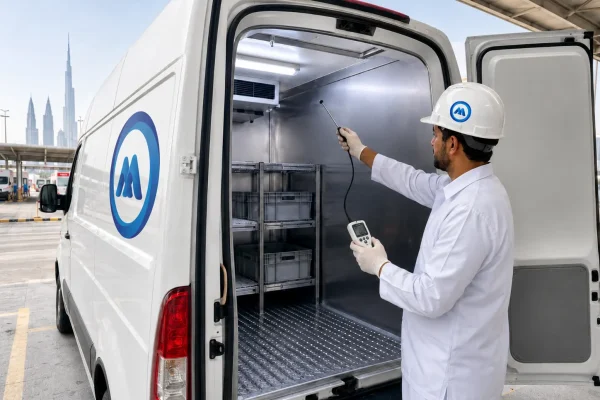
Fish generates blood, slime, and scale residue that creates corrosive and malodorous contamination in cargo compartments. The interior must be SS304 or SS316L stainless steel — not fibreglass or coated steel, which cannot withstand the repeated acid-wash sanitisation required for fish vehicles. The distinction matters for procurement: a general chiller van certified for produce or dairy transport may not pass a DM inspection for fresh fish without interior re-lining.
Drainage System
Fish transport generates significant liquid load — meltwater from ice, blood, and brine. The drainage system must include:
- A sloped floor with a gradient sufficient to prevent pooling (minimum 1% slope toward the drain)
- A rear drain of adequate bore to handle peak meltwater flow from a full ice load
- A closeable hygienic drain cap to prevent drainage back-flow during loading and unloading
- No direct connection between the drainage outlet and the vehicle’s mechanical underbody components — contamination of brake lines or electrical systems via drain overflow is a DM failure point
Strip Curtains and Cold Air Management
Fish loading and unloading at market, port, and wholesale dock environments is rarely rapid — crates are checked, weighed, and sorted. Every minute the rear doors are open, warm ambient air (frequently above 35°C in UAE summer) enters the cargo compartment. Strip curtains (PVC flap barriers) are mandatory on fish transport vehicles under DM 2026 standards for any vehicle operating in temperatures above 30°C ambient.
Ice Provision and Load Management
Fresh whole fish transported in ice requires that the ice-to-fish ratio be maintained throughout the journey. DM’s standard for iced fish transport is a minimum 1:1 ratio by weight (one kilogram of ice per kilogram of fish) at the point of loading, with sufficient additional ice to account for melting during the maximum expected transit time. Operators cannot compensate for inadequate ice by running the refrigeration unit colder — ice contact is a regulatory requirement, not just a method of temperature control.
JAFZA Import Workflow: Fish Entering Dubai via Jebel Ali
The majority of the UAE’s imported fresh and frozen seafood enters via Jebel Ali Port (JAFZA), the region’s primary maritime gateway. Operators collecting seafood consignments from JAFZA warehouses or arranging onward distribution from port-adjacent cold stores need to understand the customs and DM inspection workflow at this entry point.
DM Health Certificate and Permit of Entry
All imported seafood consignments require a DM Health Certificate issued or endorsed by the country of origin’s food authority and verified by Dubai Municipality upon import. The health certificate must specify species, temperature conditions during sea or air freight, country of origin and processing facility, and any preservatives or additives used. JAFZA customs will not release the consignment without this certificate being verified in the Dubai Customs/DM integrated system.
Cold Store Hold Procedures
High-risk consignments — new suppliers, species with elevated Scombrotoxin risk, consignments with temperature deviations flagged by shipping data — are placed on DM hold in JAFZA’s temperature-controlled inspection facilities. DM inspectors conduct physical checks including temperature probing of multiple packages, organoleptic assessment (appearance, odour), and may take samples for laboratory histamine testing (results typically in 24–48 hours). Consignments on hold cannot be moved or distributed until DM issues a release notice.
Cold Chain from JAFZA to Final Destination
Once released, consignments must move directly from the JAFZA cold store to the end destination or an intermediate licensed cold store. There is no provision for “road staging” — leaving consignments in a parked non-refrigerated vehicle while the driver completes other deliveries. DM’s traceability requirements mean that the temperature log from the JAFZA pickup to delivery must be continuous and show no unexplained gaps.
For operators collecting seafood consignments from JAFZA on behalf of Dubai restaurants, hotels, or wholesale markets, our chiller trucks in Dubai are configured for fish transport with appropriate drainage, steel interiors, and continuous IoT temperature logging. Our chiller vans are suited to last-mile distribution runs from JAFZA and Ras Al Khor fish market to restaurant and hotel receiving docks.
DM Inspection Triggers for Seafood Vehicles
Dubai Municipality’s Food Safety Department conducts both scheduled (permit renewal) and unannounced inspections of food transport vehicles. Seafood vehicles face a higher frequency of unannounced checks than general chiller vehicles because of the elevated public health risk. Understanding what triggers an unannounced inspection allows operators to maintain consistent compliance rather than point-in-time readiness.
Common Inspection Triggers
- Complaint from a receiver — a hotel chef, supermarket manager, or restaurant owner who reports a temperature or quality issue with a delivery. DM takes consumer and business complaints about food transport seriously and typically visits the operator within 72 hours.
- FoodWatch temperature alert — if the vehicle’s IoT temperature monitoring system shows a deviation above the permitted range, FoodWatch generates an automatic alert that can trigger an inspection scheduling.
- Spot checks at Ras Al Khor Fish Market and JAFZA — DM inspectors operate regular spot-check programmes at the city’s main fish handling points. Vehicles loading or unloading at these facilities may be checked without prior notice.
- Failed permit renewal inspection from previous year — vehicles that failed any element of their last DM inspection are flagged for enhanced monitoring during the subsequent permit year.
- Cold chain data anomalies — gaps in temperature logging records during FoodWatch review can prompt a follow-up inspection to determine whether the gap represents a technical fault or deliberate tampering.
DM Penalty Schedule for Seafood Transport Violations
Dubai Municipality’s penalty schedule for food transport violations distinguishes between operational violations (process failures that could be corrected) and technical breaches (engineering or systemic failures that indicate a persistent non-compliance). Seafood violations tend to attract the higher end of both bands because of the direct public health implications.
| Violation Type | Fine Range (AED) | Additional Consequences |
|---|---|---|
| Temperature deviation — fresh fish above +4°C at inspection | 5,000 – 10,000 | Consignment may be seized and destroyed at operator’s cost |
| Temperature deviation — frozen fish above -15°C (partial thaw) | 5,000 – 10,000 | Consignment destroyed; vehicle suspended pending re-inspection |
| Missing or falsified temperature records | 10,000 – 25,000 | DM Card suspended; may be referred to prosecutor |
| Transporting seafood without a valid DM Card | 5,000 per vehicle | Vehicle grounded until permit issued; cargo may be seized |
| Mixed load — raw fish with RTE food without physical separation | 5,000 – 10,000 | Both consignments subject to seizure; cross-contamination investigation triggered |
| Interior hygiene failure — blood residue, scale contamination, mould | 5,000 – 15,000 | Vehicle suspended; remediation and re-inspection required before resuming fish transport |
| No drainage system or blocked drain | 5,000 | Vehicle suspended from fish transport until remediated |
| Technical breach — no IoT temperature monitoring installed | 10,000 – 100,000 | Serious category; DM Card cancelled; operator may face trading licence review |
| HACCP plan absent or not implemented | 10,000 – 50,000 | Business closure notice possible for repeat offenders |
| Repeat violation within 12 months | Double the base fine | Enhanced monitoring programme; DM may require operational audit |
The distinction between operational violations (AED 5,000–10,000 range) and technical breaches (AED 10,000–100,000 range) is not academic. An operational violation is a failure during a specific transaction — a delivery that arrived too warm, a record-keeping gap. A technical breach is a systemic failure — no IoT monitoring installed at all, no HACCP plan in place. DM treats technical breaches as evidence that the operator was never compliant, not just non-compliant on a given day, and the penalties and consequences reflect that.
UAE Summer Seafood Transport: The August Challenge
Summer in the UAE — June through September, with August typically the peak — imposes exceptional demands on seafood cold chain operations. Ambient temperatures above 45°C mean that any break in the cold chain, however brief, has faster and more severe consequences than in winter months.
Loading Dock Management
At ambient temperatures of 40°C+, opening the rear doors of a chiller vehicle for five minutes allows enough warm air ingress to raise the cargo compartment temperature by 2–3°C. For fresh fish in the -1°C to +2°C band, this represents a potential compliance breach before a single crate has been loaded. Summer seafood protocol requires:
- Refrigeration unit pre-cooling: start the unit minimum 60 minutes before loading, not 15 minutes as is common with general produce transport
- Strip curtains in use at all times during loading and unloading, not just during transit
- Night dispatch preference: where logistics allow, early-morning (before 6 AM) or late-evening (after 9 PM) delivery runs avoid the peak temperature window
- Covered loading docks: deliveries to facilities without covered refrigerated docks should be questioned — a luxury hotel that insists on a fully loaded delivery at a sun-exposed dock at noon presents a compliance risk to the transport operator, not just the receiver
Refrigeration Unit Maintenance
Refrigeration units working in continuous ambient heat operate at maximum compressor load. Summer is when units that were serviceable in winter begin to fail. A unit that can maintain -18°C in December ambient (20°C) may not maintain -18°C in August ambient (46°C). Annual refrigeration servicing is a DM Card requirement — but for seafood operations, quarterly checks during the summer period are best practice. A unit failure in August with a full frozen tuna load is a significant financial and compliance event.
Using a Third-Party Chiller Provider for Seafood Distribution
Many seafood importers, distributors, and processors in the UAE do not operate their own transport fleet. The compliance overhead — DM Card per vehicle, IoT monitoring, HACCP documentation, driver OHC cards, annual inspections — combined with the engineering demands specific to fish transport (stainless interiors, enhanced drainage, dedicated vehicles to prevent cross-contamination) makes a case for outsourced transport that is hard to argue against at most scales of operation.
When selecting a third-party chiller provider for seafood distribution, the questions to ask are:
- Is the vehicle’s DM Card endorsed for seafood (fish and shellfish) specifically, or only for general food transport?
- What is the interior lining material — stainless steel or fibreglass?
- Does the vehicle have an adequate drainage system for iced fish loads?
- Is IoT temperature monitoring installed and transmitting continuously — and can you request temperature logs from previous journeys?
- Does the driver hold a current OHC card, and has the driver received Scombrotoxin-specific training?
- Does the company carry liability insurance that covers food spoilage claims?
Manchu Transport’s chiller trucks and chiller vans in Dubai are equipped with IoT temperature monitoring and are inspected to DM standards annually. For specific seafood transport requirements including stainless interiors or enhanced drainage configurations, contact us for a quote and we will confirm vehicle suitability for your commodity before committing.
Summary: Seafood Cold Chain Compliance at a Glance
| Item | Requirement |
|---|---|
| Fresh whole fish temperature | -1°C to +2°C (in ice) |
| Fresh fillets / live shellfish / cooked shellfish | 0°C to +4°C |
| Frozen fish and shellfish | -18°C or below (no thaw cycles) |
| Fatty fish (salmon, mackerel, herring) | -24°C or below |
| Sashimi-grade / super-frozen tuna | -60°C or below |
| Scombrotoxin risk species | Tuna, mackerel, mahi-mahi, sardines — zero-tolerance temperature excursions |
| Vehicle interior material | SS304 or SS316L stainless steel for fish transport |
| Temperature monitoring | IoT-connected continuous logging; FoodWatch integrated |
| HACCP plan | Mandatory; must include Scombrotoxin CCP for applicable species |
| DM permit | DM Card required; endorsed for seafood transport category |
| Driver certification | OHC card (Dubai) + Scombrotoxin awareness training |
| DM operational fine range | AED 5,000 – 10,000 per violation |
| DM technical breach fine range | AED 10,000 – 100,000 per violation |
Seafood cold chain in the UAE operates at finer margins than most food categories — the temperature windows are narrower, the hazards are less visible, and the regulatory consequences of failure are more immediate. Operators who understand the HACCP framework, apply it to the specific risks of their commodity, and invest in the right vehicle engineering and monitoring infrastructure are the ones who build long-term relationships with the hotels, restaurants, and retailers that set the quality bar for the sector.
If you are setting up or expanding a seafood distribution operation in Dubai or the wider UAE, the Manchu Transport team can advise on vehicle selection, compliance documentation requirements, and the cold chain setup that fits your route profile and commodity mix.
Need Reliable Refrigerated Transport?
Get a free quote for chiller van, truck, or trailer rental in Dubai and across the UAE.
Get a Free QuoteRecommended Services
Our Refrigerated Transport Services
Choose the vehicle that matches your route, payload, and temperature requirements.
 Last-Mile
Chiller Van Rental Dubai
1-Ton and 1.5-Ton chiller vans for last-mile cold chain, catering, and pharmacy routes.
View Service Dubai
Dubai
Chiller Truck Rental Dubai
3-Ton to 10-Ton refrigerated trucks for supermarket, pharma, and wholesale distribution.
View Service
Abu Dhabi
Chiller Truck Rental Abu Dhabi
ADAFSA and ASATEEL-compliant truck rentals for Mussafah, KIZAD, Khalifa City, and Al Ain.
View Service Cross-Border
Chiller Trailer Rental Dubai
20-Ton and 25-Ton reefer trailers for port clearances, warehouse transfers, and GCC routes.
View Service