Every year between May and September, the UAE transforms into one of the most demanding operating environments on the planet for cold chain logistics. Average highs climb past 42°C in August, humidity along the coast pushes toward 90%, and the pavement beneath your fleet absorbs enough heat to reach 74°C. For anyone moving food, dairy, pharmaceuticals, or any temperature-sensitive goods, this is not a seasonal inconvenience. It is a months-long stress test that exposes every weakness in a cold chain operation.
This guide covers what actually goes wrong in UAE summer heat, the legal temperature standards you are legally required to maintain, and the protocols that experienced operators use to protect cargo when the thermometer refuses to come down.
Why UAE Summer Is Unlike Any Other Market
Cold chain operators from Europe or South Asia who set up in the UAE often underestimate the summer for the first season. The published air temperature of 42°C is already severe, but the number that actually matters for refrigerated transport is the temperature your equipment is working against, and that figure is considerably higher.
Asphalt pavement absorbs and radiates solar energy throughout the day. Research confirms that road surface temperatures run 25 to 26°C above the ambient air temperature during peak hours. On a 48°C afternoon in Dubai or Sharjah, the asphalt beneath a parked delivery van is sitting at roughly 74°C. The undercarriage, chassis, and lower side panels of your refrigerated unit are absorbing radiant heat at that level continuously.
Coastal cities add a compounding problem. Humidity reaching 90% in Abu Dhabi and Dubai during the humid season creates condensation on door seals, packaging, and any surface exposed during loading. Moisture accelerates the deterioration of cardboard packaging, encourages mold growth on produce, and increases the rate at which warm air infiltrates the cargo hold every time a door opens.
Perhaps the most underappreciated factor is what engineers call thermal soak. During July and August, overnight lows in the UAE rarely drop below 30°C. This means refrigeration units never get a cool period to recover. In temperate climates, overnight temperatures allow equipment to reset. In a UAE summer, the compressor runs continuously from the moment it is switched on, accumulating heat stress across every shift without relief.
Standard refrigeration units used in refrigerated transport are rated to operate in ambient temperatures up to 43 to 45°C. The UAE regularly and routinely exceeds that design ceiling. When a unit is forced to operate above its rated ambient, its Coefficient of Performance drops sharply. A unit working above design temperature may only achieve a 4 to 5°C cooling effect despite running at full capacity. A van that should hold dairy at 3°C can find itself struggling to maintain 8°C on a long urban delivery run.
The Legal Temperature Zones You Must Maintain
Dubai Municipality and ADAFSA (Abu Dhabi Agriculture and Food Safety Authority) specify mandatory temperature ranges for every category of food and pharmaceutical product in transport. These are not guidelines. Non-compliance results in rejected consignments, fines, and the suspension of permits including the DM Card required for food transport vehicles in Dubai.
| Product Category | Required Transport Temperature |
|---|---|
| Frozen products | -18°C or lower |
| Raw meat and seafood (chilled) | 0°C to +2°C |
| Dairy products | +1°C to +5°C |
| Fruits and vegetables | 0°C to +5°C |
| Pharmaceuticals | +2°C to +8°C |
| Dry food products | +10°C to +21°C |
The margin for error on chilled raw meat and seafood is two degrees. On a day when your equipment is underperforming due to extreme ambient heat, that margin disappears fast. The economics are equally severe. GCC food waste runs to 150 kg per capita annually, roughly 14% above the global average, with retail food waste 38% higher than the global norm. The combined economic loss from spoilage across the region reaches an estimated $4 to $7 billion annually. A single failed delivery run in July is not just a product write-off. It is a compliance incident, a client relationship risk, and a direct contribution to that statistic.
What Actually Fails in 50°C Heat
Understanding the specific failure modes of refrigerated vehicles in extreme heat helps operators and fleet managers make better decisions about maintenance, routing, and vendor selection. The problems are predictable, and most are preventable.
Condenser Coil Fouling
The UAE environment is sandy. Fine dust and sand particles accumulate on condenser coils continuously, particularly in industrial areas like DIP, JAFZA, and Mussafah. Dust on a condenser coil acts as an insulating layer, reducing the coil’s ability to shed heat into the ambient air. The result is compressor overheating. In summer, with ambient temperatures already at the upper limit of rated operation, a fouled condenser can push a compressor into thermal shutdown within hours. Weekly condenser coil cleaning is not a best practice in UAE summer. It is a non-negotiable operational requirement.
Door Seal Degradation
Rubber door seals on refrigerated vehicles deteriorate under sustained UV exposure. The UAE’s summer sun is intense enough to crack and harden seals within a single season if they are not maintained. Compromised seals allow warm, humid ambient air to infiltrate the cargo hold continuously. Each infiltration event adds thermal load and moisture. Over a full delivery shift, the cumulative effect on cargo temperature is significant, and the increased humidity inside the hold accelerates packaging degradation.
Insulation Performance at Extreme Temperatures
Insulation thickness directly determines how long a cargo hold stays within temperature range when the refrigeration unit is temporarily off, such as during loading, unloading, or an engine-off stop. The difference between insulation grades becomes stark at UAE summer ambient temperatures.
| Insulation Thickness | Temperature Rise Rate at 45°C Ambient | Time to Danger Zone (dairy) |
|---|---|---|
| 50mm | 4.5°C per hour | 30 to 45 minutes |
| 75mm (standard) | 2.2°C per hour | 1.5 to 2 hours |
| 100mm (heavy duty) | 1.1°C per hour | 3 to 4 hours |
A van with 50mm insulation carrying dairy at 3°C can breach the 5°C legal limit in under 45 minutes at peak summer ambient. For urban multi-drop delivery routes with frequent door openings, this is an extremely tight window. Operators running chiller van rental fleets in Dubai should verify insulation thickness before committing to a summer contract.
Fuel and Power Consumption
Refrigeration units working above their design ambient consume 20 to 30% more fuel than in temperate conditions. For operators running their own fleet, this is a direct operating cost increase across the entire summer season. For rental customers, it is a factor in understanding why fuel-inclusive pricing varies seasonally and why some operators limit summer operations during peak hours.
Pre-Cooling: The Protocol That Saves Cargo
Pre-cooling is the single highest-impact operational practice for summer cold chain management, and it is the one most commonly skipped when operations are running behind schedule. Skipping it in UAE summer is not a minor shortcut. It is the leading cause of avoidable in-transit spoilage.
The correct pre-cooling protocol has three components that must happen in sequence.
Pre-chill the vehicle before loading. The cargo hold must reach its target temperature before a single item is loaded. Loading warm cargo into a cold hold is expected, but loading any cargo into a warm hold means the refrigeration unit must cool both the cargo and the internal surfaces of the vehicle simultaneously. In 45°C ambient, this can take 90 minutes or more, during which cargo temperature rises.
Verify cargo internal temperature with probes before acceptance. Surface temperature readings are misleading. A pallet of poultry can feel cold to the touch while the internal temperature is already above 4°C. Insert probe thermometers into the core of products before loading. Refuse cargo that does not meet temperature requirements at origin. Accepting out-of-spec cargo means you are responsible for delivering out-of-spec product.
Use pre-chilled loading docks where possible. Ideally, loading areas should be maintained at around 10°C. Every minute a cargo hold door is open during loading in 45°C ambient introduces a significant warm air mass. Loading dock refrigeration is standard practice at large FMCG distributors and cold stores in the UAE. If your loading facility does not have a conditioned dock, minimize door-open time and load in the coolest part of the day.
Proper pallet spacing inside the vehicle matters as much as pre-cooling. Blocked air vents create hot spots. Cargo stacked against the evaporator coil restricts airflow. Pallets should be spaced to allow 360-degree airflow, with the space in front of the evaporator kept clear. Operators who ignore pallet arrangement will see temperature variance of 3 to 5°C between spots in the same hold.
Operational Best Practices for Summer Deliveries
Beyond equipment and pre-cooling, the decisions made around routing, scheduling, and ancillary equipment have a measurable impact on summer cold chain performance.
Night and Early Morning Routing
Scheduling long-distance hauls and high-density urban delivery routes during overnight hours, when ambient temperatures drop to 30 to 32°C, significantly reduces the thermal load on refrigeration units. This is not always possible for every delivery, but for routes where timing is flexible, shifting departure to 10 PM or 2 AM makes a meaningful difference. Fuel consumption drops, equipment runs within rated parameters, and the risk of temperature excursions during multi-stop urban routes decreases substantially.
The Midday Work Ban
From June 15 to September 15 each year, outdoor work in the UAE is prohibited between 12:30 PM and 3:00 PM under MoHRE regulation. This applies directly to loading and unloading activities at non-refrigerated docks. Route planning and delivery scheduling must account for this window. Deliveries that require outdoor loading or unloading need to be completed before 12:30 PM or scheduled after 3:00 PM. Violations carry fines, and the regulation is actively enforced.
Strip Curtains on Van Doors
PVC strip curtains fitted inside cargo hold doors reduce warm air infiltration by up to 40% during door-open periods. For delivery routes with frequent stops, this is one of the most cost-effective modifications available. The curtains allow handlers to pass through the door opening while significantly slowing the exchange of air between the refrigerated hold and the ambient environment.
Genset Backup Units
For longer hauls or routes where the vehicle may need to remain stationary with the engine off, a diesel genset backup unit provides up to four hours of continuous refrigeration independent of the main engine. This is particularly relevant for port and airport pickups, where waiting times are unpredictable, and for multi-emirate routes where rest stops are unavoidable.
IoT Temperature Monitoring
Real-time temperature monitoring with automated alerts is now standard on any serious cold chain operation in the UAE. Sensors placed at multiple points inside the cargo hold log temperature continuously and trigger alerts when readings approach the limit of the legal range. This allows dispatch to intervene before a temperature excursion becomes a compliance incident. For pharmaceutical deliveries in particular, full temperature logging with timestamped records is required documentation for ADAFSA compliance.
Choosing a Summer-Ready Fleet
Not all refrigerated vehicles are built for UAE summer operation. The difference between a fleet that performs reliably across June, July, and August and one that generates constant maintenance calls and cargo claims comes down to a set of specific equipment and compliance characteristics.
Look for vehicles fitted with high-ambient rated refrigeration units. Manufacturers such as Thermo King (UT XTREME series) and Carrier (PrimeLINE series) produce units specifically engineered for operation up to 55°C ambient. These are the units that maintain performance when standard equipment is struggling. Ask your rental provider specifically which refrigeration unit model is fitted, and verify the rated ambient operating temperature before committing to a summer contract.
Insulation of 75mm minimum is the practical standard for UAE summer operation. For pharmaceutical cargo or any load with a legal temperature range narrower than 5°C, 100mm insulation provides the safety margin that 75mm cannot guarantee across a full urban delivery shift.
Regulatory compliance documentation matters as much as the hardware. In Dubai, chiller transport vehicles must carry a valid DM Card (Dubai Municipality food transport certification). In Abu Dhabi, ADAFSA FWD certification is required for food transport, and ASATEEL GPS/OBU registration is mandatory for all commercial vehicles. A fleet that carries these certifications is a fleet whose maintenance and temperature standards are audited by the relevant authorities, which is a meaningful quality signal.
At Ghabt Al Manchu Transport L.L.C, our entire fleet carries DM Card certification, ADAFSA FWD certification, and ASATEEL registration. Our chiller vans and chiller trucks operate across all seven UAE emirates year-round, including through the full summer season. We have been running refrigerated transport in the UAE since 2011, and our maintenance schedules, pre-cooling protocols, and operational practices are designed specifically for the conditions described in this guide.
Fleet options start at AED 350 per day for a 1-ton van, AED 400 per day for a 1.5-ton van, AED 600 per day for a 3-ton truck, AED 700 per day for a 7-ton truck, and AED 800 per day for a 10-ton truck. Daily and monthly rates are available depending on your volume and duration requirements.
If you are sourcing refrigerated transport for the summer season, whether for a single urgent shipment or an ongoing distribution contract, the right time to confirm your fleet is now. Summer capacity fills quickly among operators who maintain the equipment and certifications described above. Contact us at +971 54 7171 345 or get a tailored quote for your route and cargo requirements below.
Need Reliable Refrigerated Transport?
Get a free quote for chiller van, truck, or trailer rental in Dubai and across the UAE.
Get a Free QuoteRecommended Services
Our Refrigerated Transport Services
Choose the vehicle that matches your route, payload, and temperature requirements.
 Dubai
Dubai
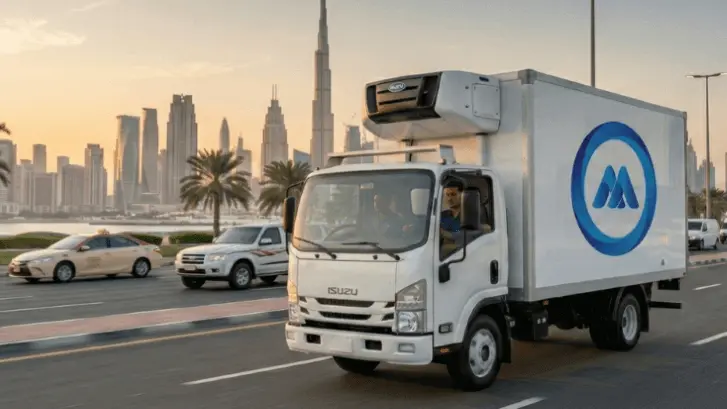
Chiller Truck Rental Dubai
3-Ton to 10-Ton refrigerated trucks for supermarket, pharma, and wholesale distribution.
View Service
Abu Dhabi
Chiller Truck Rental Abu Dhabi
ADAFSA and ASATEEL-compliant truck rentals for Mussafah, KIZAD, Khalifa City, and Al Ain.
View Service Last-Mile
Chiller Van Rental Dubai
1-Ton and 1.5-Ton chiller vans for last-mile cold chain, catering, and pharmacy routes.
View Service Cross-Border
Chiller Trailer Rental Dubai
20-Ton and 25-Ton reefer trailers for port clearances, warehouse transfers, and GCC routes.
View Service