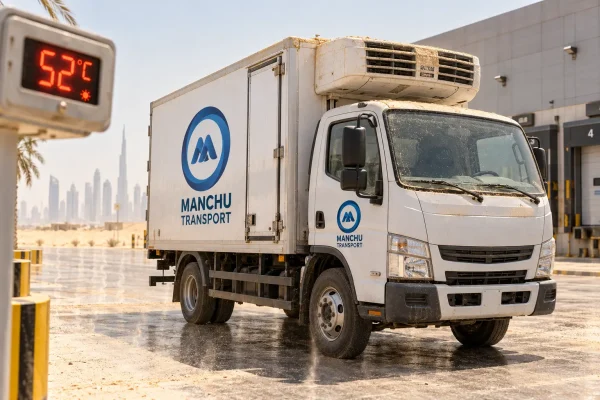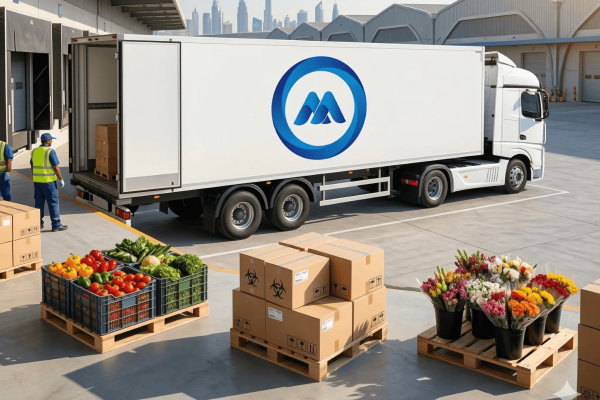
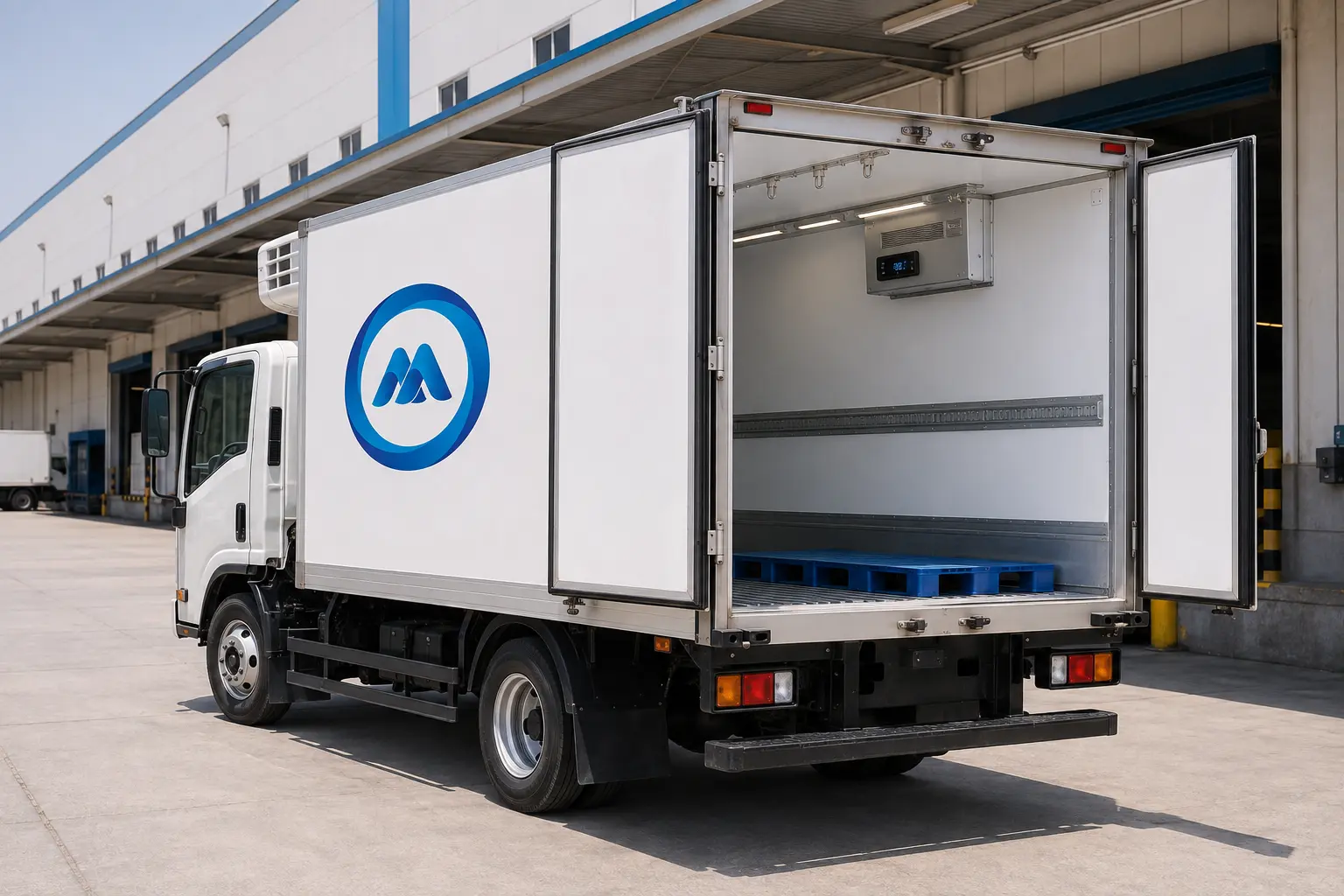
A 3-ton chiller truck is a medium-duty refrigerated vehicle commonly selected for supermarket replenishment, catering, food distribution, meat transport, and other loads that have outgrown a van. Its main advantage is balance: more cargo space and easier pallet handling than a chiller van, without automatically moving to the access and operating demands of a 7-ton or 10-ton truck.
The most important warning is that “3-ton” should not be treated as a guaranteed 3,000 kg legal cargo payload. Rental-market labels, chassis categories, gross vehicle weight, and usable payload are not always the same thing. Insulated bodies, refrigeration equipment, tail lifts, partitions, fuel, occupants, and accessories all consume part of the permitted weight.
This guide explains how buyers should evaluate 3 ton chiller truck rental UAE options, including payload, dimensions, pallets, chiller and freezer configurations, compliance, and Manchu Transport’s published starting price of AED 600/day.
What Does “3-Ton Chiller Truck” Actually Mean?
In commercial conversation, “3-ton” is often a convenient class name. It may describe a payload expectation, a familiar chassis segment, or simply the size category used by a provider. It is not enough information for a lawful loading plan.
Three figures matter:
- Gross vehicle weight: the maximum permitted weight of the loaded vehicle under the applicable registration and manufacturer limits.
- Tare or unladen weight: the vehicle’s empty operating weight as defined in the relevant document.
- Available payload: the remaining allowance after accounting for the vehicle, refrigerated body, cooling equipment, accessories, occupants, fuel, and other carried equipment.
The only safe approach is to review the assigned vehicle’s registration, specification, and actual configuration. A generic online payload range cannot authorize a specific load.
Why Refrigeration Equipment Changes Payload
A refrigerated truck carries more permanent equipment than a basic dry box truck. The insulated body, subframe, evaporator, condenser, compressor system, doors, floor, partitions, rails, and monitoring equipment all add weight. Optional equipment changes the calculation further.
| Equipment | Operational Benefit | Payload Effect |
|---|---|---|
| Thicker insulated body | Supports lower-temperature or demanding routes when correctly specified | Adds tare weight |
| Hydraulic tail lift | Helps load pallets and heavy trolleys where no dock is available | Reduces available payload |
| Meat-hook rails and roof reinforcement | Supports hygienic hanging-meat transport | Adds structural weight and changes load distribution |
| Internal partition | Separates cargo or supports a designed multi-zone system | Adds weight and reduces usable volume |
| Electric standby system | May allow refrigeration while parked with compatible power | Adds equipment and requires site compatibility |
Ask the provider to confirm the payload of the truck exactly as supplied. If a tail lift or meat-hook system is added after a generic specification was issued, the usable allowance may change.
Cargo-Box Dimensions and Pallet Planning
There is no universal internal dimension for every 3-ton refrigerated truck. Chassis wheelbase, body builder, insulation thickness, evaporator placement, wheel-arch design, rear-door frame, and optional side doors all affect usable space.
A buyer should request these measurements:
- usable internal length, width, and height
- rear and side-door opening dimensions
- space occupied by the evaporator and any bulkhead
- floor rating and permitted point loads
- distance required around cargo for airflow
- tail-lift platform dimensions and rated capacity, if fitted
Some 3-ton bodies may be planned around approximately four to six pallets, but that is only an initial estimate. Euro pallets and larger industrial pallets use different floor space, and refrigeration equipment or airflow gaps may reduce the theoretical count. Confirm the exact pallet layout with dimensions before dispatch.
Chiller vs Freezer Configuration
A chiller and a freezer truck may look identical from outside, yet differ significantly in insulation, refrigeration capacity, sealing, defrost strategy, and tested operating range.
- Chiller configuration: commonly selected for cargo whose specified transport range remains above freezing.
- Freezer configuration: selected for cargo that must remain frozen and requires a unit demonstrated to hold the required sub-zero set point.
Do not judge capability only by the controller. Ask what range the complete vehicle—not merely the refrigeration model—can maintain under the planned ambient temperature, loading pattern, and stop frequency.
Best Uses for a 3-Ton Refrigerated Truck
Supermarket and Food-Service Replenishment
The 3-ton class suits medium-volume routes that are too large for a van but still require several accessible delivery points. It can carry a planned mix of cartons or pallets while remaining more maneuverable than larger rigid trucks.
Dairy, Meat, Poultry, and Seafood
These products need cargo-specific temperature, hygiene, packaging, and segregation controls. Meat-hook bodies can support hanging product when properly designed, cleaned, loaded, and kept within weight and structural limits.
Catering and Events
A 3-ton truck can move ingredients, prepared items, insulated containers, and trolleys for hotels and events. A tail lift may help with heavy rolling equipment, subject to its capacity and the receiving-site surface.
Pharmaceutical and Healthcare Logistics
A food-grade refrigerated body is not automatically a qualified pharmaceutical vehicle. Medicines must follow their labelled storage condition and the shipper’s approved distribution process. The official UAE good storage and distribution guidance emphasizes documented procedures, suitable vehicles and equipment, monitoring, and traceability.
Flowers
Flowers are sensitive to more than temperature. Variety, humidity, airflow, ethylene exposure, packaging, and delivery time can all matter. Confirm the florist’s specification instead of applying a universal range.
Single-Temperature vs Multi-Temperature Trucks
A true multi-temperature truck uses an engineered system to maintain different conditions in separate compartments. This may include insulated partitions, multiple evaporators, appropriate controls, and a validated loading plan. A loose divider alone does not prove independent temperature control.
Multi-zone equipment can help businesses deliver chilled and frozen product on one route, but it reduces usable space and adds operational complexity. Compare that approach with separate vehicles using our multi-temperature refrigerated truck guide.
When Is a 3-Ton Truck Better Than a Van?
Move from a van to a 3-ton truck when one or more of these conditions applies:
- the verified load exceeds the van’s lawful capacity
- pallet or forklift handling is required
- the cargo needs more usable floor area or box height
- multiple van trips can be safely consolidated
- the route and receiving sites can accommodate a truck
A van can still be better for light, fragmented, high-stop routes. Bigger is not automatically more economical when access and door-opening frequency are poor.
When Should You Choose a 7-Ton or 10-Ton Truck?
Move up when the verified cargo weight, pallet plan, or box volume exceeds the assigned 3-ton truck; when the route is a consolidated warehouse transfer; or when repeated smaller trips cost more than one correctly planned large movement.
Manchu Transport’s published starting daily rates are AED 600 for a 3-ton chiller truck, AED 700 for a 7-ton truck, and AED 800 for a 10-ton truck. Review our 3-ton vs 7-ton vs 10-ton comparison before upsizing.
Dubai Food-Transport Considerations
Dubai Municipality publishes official food-establishment resources, including its Food Code and guidance for food transportation and delivery vehicles. The exact approval and operational requirements depend on the food activity and vehicle. Confirm the current process with Dubai Municipality rather than relying on an old checklist or assuming every registration platform applies identically to every business.
For the commercial service itself, see our chiller truck rental Dubai page. Route restrictions can change by vehicle classification, road, and time, so dispatchers should check current RTA notices before travel.
Abu Dhabi Food and Freight Considerations
Food operations in Abu Dhabi should verify the applicable ADAFSA requirements. Commercial freight operators should also check the Abu Dhabi Mobility freight framework.
The official ASATEEL service explains that companies can obtain freight activity, vehicle, and driver permits through the platform. Registered companies install approved tracking devices, and a functioning device is required for a vehicle permit. This is more precise than claiming that every vehicle entering Abu Dhabi automatically has identical registration obligations; the operator should check the regulation, activity, registration status, and any exemption.
For local fleet options, visit our chiller truck rental Abu Dhabi page.
With-Driver vs Self-Drive
The correct driving-licence category depends on the registered vehicle class and the applicable UAE licensing rules. Do not rely on a generic statement that every “3-ton” truck requires the same category. Verify the assigned vehicle and the driver’s licence before handover.
A self-drive contract may give the renter responsibility for the driver, daily inspection, fuel, tolls, fines, route compliance, loading, and cargo handling, depending on the agreement. A with-driver service may reduce some administrative work, but responsibilities for cargo preparation, declarations, loading, and acceptance should still be written clearly into the contract.
3-Ton Chiller Truck Rental Price
Ghabt Al Manchu Transport L.L.C publishes a starting rate of AED 600/day for a 3-ton chiller truck. The final quotation may depend on rental duration, route, operating hours, temperature configuration, driver requirement, cargo type, specialized equipment, and other contract terms.
Do not compare quotations by headline price alone. Check whether the same vehicle class, refrigeration capability, driver arrangement, operating schedule, fuel policy, mileage, support, and compliance documents are included. Our UAE chiller truck pricing guide explains the main comparison points.
Rental Quotation Checklist
- Assigned vehicle registration and verified usable payload
- Internal box and door-opening dimensions
- Required temperature and confirmed chiller/freezer capability
- Temperature-monitoring method and record availability
- Pallet count, dimensions, weight, and loading arrangement
- Tail lift, meat hooks, partition, side door, or standby-power requirement
- Dubai or Abu Dhabi approvals relevant to the operation
- Driver arrangement and licence verification
- Fuel, toll, mileage, overtime, cleaning, and damage responsibilities
- Breakdown response and cargo-protection procedure
Frequently Asked Questions
Does a 3-ton chiller truck carry exactly 3,000 kg?
Not necessarily. “3-ton” is often a market class. Confirm the assigned truck’s registered limits and available payload after accounting for its refrigerated body, equipment, occupants, fuel, and accessories.
How many pallets fit in a 3-ton chiller truck?
Approximately four to six pallets may fit in some bodies, but pallet type, internal dimensions, evaporator placement, wheel arches, airflow, and safe restraint determine the actual number.
Can a 3-ton truck carry frozen food?
Yes, when that specific truck is configured and verified as a freezer vehicle capable of maintaining the cargo’s required condition. A normal chiller setting is not sufficient evidence.
Can a 3-ton truck carry chilled and frozen products together?
Only with a properly designed multi-temperature system or another validated arrangement that maintains each product’s specification and prevents contamination.
Does a tail lift reduce payload?
Yes. A tail lift adds permanent weight, so the available cargo payload must be calculated for the vehicle with the lift installed.
What should I provide when asking for a quote?
Provide the cargo type, required temperature, weight, dimensions or pallet plan, pickup and delivery locations, number of stops, rental dates, operating hours, and required accessories.
Book the Correct 3-Ton Configuration
To request a 3-ton chiller or freezer truck, contact Ghabt Al Manchu Transport L.L.C with the exact cargo and route details. Call +971 54 7171 345, email manchutransport@gmail.com, use WhatsApp, or get a refrigerated truck quote.
Vehicle specifications, legal limits, permits, product requirements, and road restrictions can change. Verify the assigned vehicle and current official requirements before loading or dispatch.
Need Reliable Refrigerated Transport?
Get a free quote for chiller van, truck, or trailer rental in Dubai and across the UAE.
Get a Free QuoteRecommended Services
Our Refrigerated Transport Services
Choose the vehicle that matches your route, payload, and temperature requirements.
 Dubai
Dubai
Chiller Truck Rental Dubai
3-Ton to 10-Ton refrigerated trucks for supermarket, pharma, and wholesale distribution.
View Service
Abu Dhabi
Chiller Truck Rental Abu Dhabi
ADAFSA and ASATEEL-compliant truck rentals for Mussafah, KIZAD, Khalifa City, and Al Ain.
View Service Last-Mile
Chiller Van Rental Dubai
1-Ton and 1.5-Ton chiller vans for last-mile cold chain, catering, and pharmacy routes.
View Service Cross-Border
Chiller Trailer Rental Dubai
20-Ton and 25-Ton reefer trailers for port clearances, warehouse transfers, and GCC routes.
View Service