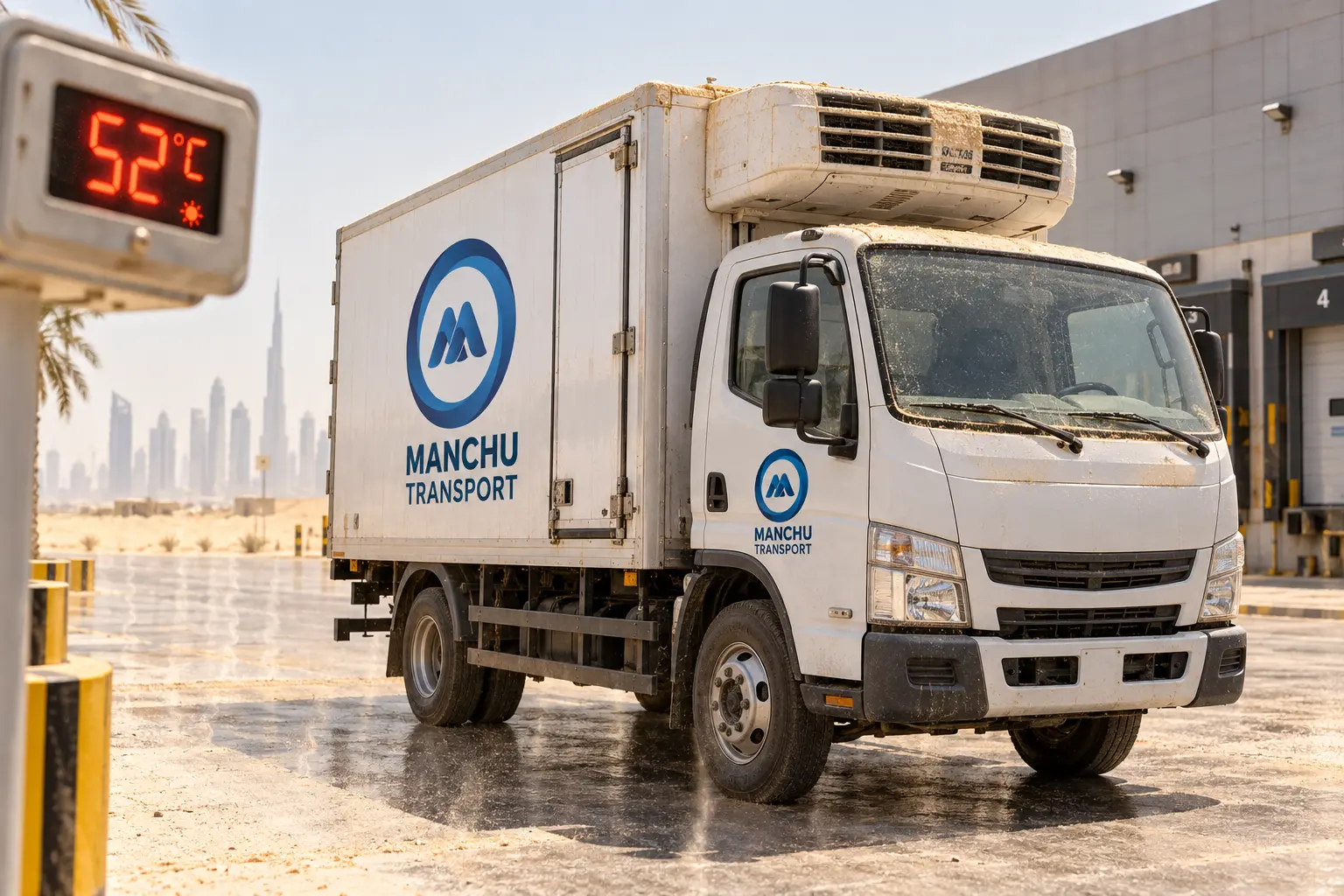
Operating a temperature-controlled transport fleet in the United Arab Emirates requires mitigating some of the most hostile thermodynamic conditions on the planet. During peak summer, ambient air temperatures routinely surpass 50°C. But the air temperature alone tells only half the story.
The conductive heat radiating from asphalt, combined with intense solar radiation impacting the truck’s roof and walls, generates a localized microclimate that can push surface temperatures to 65°C–70°C. This heat sink effect forces refrigeration units and thermal insulation materials to withstand environmental loads far beyond their baseline design parameters. Consequently, standard chiller trucks engineered for temperate European or East Asian climates face catastrophic failure rates when deployed in the GCC.
The Compressor Burnout Crisis
The primary point of mechanical breakdown in extreme heat is the refrigeration compressor. In a temperate environment, a compressor operates on a balanced duty cycle: it cycles on to achieve the target temperature, then cycles off to rest once the thermostat is satisfied.
In the UAE summer, the massive continuous heat load penetrating the vehicle body prevents the thermostat from ever being fully satisfied. The compressor is forced to run continuously near maximum capacity. This relentless operation leads to:
- Rapid component wear and fatigue
- Thermal degradation of lubricating oils
- Reduced bearing lifespan
- Eventual catastrophic compressor burnout
Fleet operators frequently face compressor burnouts, incurring repair or replacement costs ranging from AED 4,000 to AED 9,000—entirely separate from the massive financial liabilities of spoiled cargo and disrupted client relationships.
The Sand-Clogging Cascade
This mechanical strain is aggressively compounded by the UAE’s unique atmospheric conditions. The coastal humidity mixed with fine, airborne desert sand creates a highly abrasive particulate matter that rapidly clogs the condenser coils of the refrigeration unit.
The condenser is responsible for expelling heat absorbed from the cargo space into the outside atmosphere. When airflow becomes obstructed by sand and debris, heat exchange efficiency plummets by 20%–30%. A clogged condenser forces the already strained compressor to work exponentially harder against the extreme ambient heat, creating a rapid failure cascade:
- Sand accumulation on condenser coils → Airflow restriction
- Reduced heat rejection → Elevated discharge pressure
- Compressor working harder → Oil degradation and component stress
- Thermal cycling stress → Seal failure and refrigerant leakage
- Total compressor failure → Vehicle grounded, cargo at risk
High-performance systems from manufacturers like Carrier Transicold and Thermo King (T-Series flagship units) are engineered to withstand higher ambient thresholds, but even these premium assets degrade rapidly without severe preventative maintenance schedules.
The K-Value Crisis: Thermal Insulation Failure
To offset strain on the refrigeration unit, the thermal resistance of the truck body itself must be flawless. The insulating capability of a refrigerated structure is defined by its thermal conductivity coefficient (K-value), which measures the amount of heat (in watts) transferred through the body panels.
In the UAE, adequate thermal resistance requires the use of high-density rigid Polyurethane (PU) foam, which offers superior insulation performance compared to standard materials. For cold chain applications operating in 50°C heat, PU foam must be injected at high density—typically 42 kg/m³ to 50 kg/m³—to achieve thermal conductivity as low as 0.020 to 0.022 W/m·K.
However, insulation is not a static asset; it degrades over time. When outer fiberglass or metal paneling is punctured, or when continuous road vibration causes microscopic cells of polyurethane foam to rupture, atmospheric air and moisture penetrate the insulation matrix. This moisture displacement destroys the foam’s thermal resistance, drastically raising the K-value and causing thermal bridging—allowing outside heat to bypass the insulation entirely.
Research indicates that heat loss due to inadequate or degraded insulation accounts for over 30% of the refrigeration unit’s total energy expenditure during a standard transport cycle. This inefficiency is mathematically catastrophic in the UAE summer.
Performance Comparison: Standard vs UAE-Optimized
| Transport Parameter | Standard Climate | Extreme Climate (UAE) | Performance Gap |
|---|---|---|---|
| Compressor Duty Cycle | Intermittent / Balanced | Near-Continuous / Max Load | 3-5x higher stress |
| Condenser Cleaning Interval | Biannually | Every 2-4 weeks | 12x more frequent |
| PU Foam Density Required | 30-35 kg/m³ | 42-50 kg/m³ | +40% density needed |
| Pre-Cooling Time | 10-15 minutes | 30-60 minutes minimum | 4x longer |
| Target K-Value | < 0.40 W/m²·K | < 0.022 W/m·K | 18x better required |
Regulatory Enforcement: Zero Tolerance
The regulatory environment surrounding temperature-controlled operations in the UAE has evolved into a zero-tolerance apparatus, strictly enforcing temperature compliance to ensure public food safety.
Dubai Municipality Enforcement
In Dubai, enforcement is driven by the Dubai Municipality and its digital food safety platform, FoodWatch. Trading or transporting food in Dubai requires:
- Commercial trade license from the Department of Economy and Tourism (DET)
- Specific Dubai Municipality food establishment and vehicle permit
- Rigorous physical testing by certified centers (e.g., Aber Vehicle Testing)
- Technical safety standards verification by the Roads and Transport Authority (RTA)
- Thermal calibration standards audit by the municipality
Inspections routinely reveal violations: vehicles operating without proper RTA modifications, lacking active DM permits, or actively transporting perishables without operational refrigeration. The municipality monitors these systems through calibrated digital temperature loggers integrated with FoodWatch.
Financial penalties for temperature violations:
- Baseline fines: AED 10,000
- Serious violations: AED 50,000–AED 100,000
- Violations compromising FoodWatch records: AED 100,000+
- Health endangerment cases: Immediate business closure
Abu Dhabi ADAFSA Enforcement
Abu Dhabi’s parallel enforcement structure is spearheaded by the Abu Dhabi Agriculture and Food Safety Authority (ADAFSA) under Law No. 2 of 2010. ADAFSA has implemented pioneering regulatory frameworks to unify registration requirements and import permits across the emirate.
Vehicles engaged in commercial freight in Abu Dhabi must secure specific operational approvals from the Integrated Transport Centre (ITC) to ensure complete alignment with both transport and food safety regulations.
Survival Through Predictive Maintenance
To survive the intersection of extreme weather and unrelenting regulatory enforcement, fleet managers must transition from reactive repair models to aggressive, predictive maintenance protocols.
Mandatory Maintenance Schedule for UAE Summer
- Condenser cleaning: Every 2 weeks during peak summer (May–September)
- Oil analysis and filter replacement: Every 250 operating hours
- Refrigerant system pressure check: Weekly during peak season
- Thermal insulation inspection: Monthly for punctures, dampness, or foam degradation
- Door seal verification: Weekly to ensure tight closure
- Pre-cooling validation: Before every dispatch (minimum 30–60 minutes)
- Night-time vehicle parking: In shaded environments to reset thermal load
- Driver training: Quarterly on thermal management and pre-cooling protocols
In the UAE, the margin for error is non-existent. Operational survival is exclusively dictated by strict thermodynamic discipline and proactive compliance.
Frequently Asked Questions
Why does my chiller truck lose temperature quickly in summer?
Extreme ambient heat (50°C+) creates a thermal load your compressor cannot overcome during peak hours. Combined with sand-clogged condenser coils and degraded insulation, the system is constantly fighting a losing battle. Solution: aggressive pre-cooling, condenser maintenance, and thermal insulation inspection.
How often should I clean the condenser coils?
Every 2–4 weeks during UAE summer. Sand and debris accumulation reduces heat exchange efficiency by 20–30%, forcing your compressor to work exponentially harder. Neglecting this single maintenance item is the primary cause of summer compressor burnouts.
What is the correct pre-cooling time in the UAE?
Minimum 30–60 minutes before any cargo is loaded. Loading chilled or frozen goods into a heat-soaked cargo box creates immediate thermal shock, causing temperature excursions that damage cargo and trigger regulatory alarms.
Can a standard chiller truck handle 50°C heat?
Not reliably. Standard trucks designed for temperate climates fail catastrophically in extreme UAE heat. You need high-density PU foam insulation (42–50 kg/m³), premium-grade compressors, and a rigorous maintenance regimen to survive.
What is a K-value, and why does it matter?
K-value measures thermal conductivity—how much heat penetrates through the truck’s insulated walls. In the UAE, you need a K-value below 0.022 W/m·K. Degraded insulation drastically raises this value, forcing your refrigeration system to work 3–5x harder and burning out compressors.
Ensure Thermodynamic Reliability
Operating cold chain logistics in the UAE demands uncompromising adherence to thermal discipline and proactive maintenance. Partner with experienced providers who invest in high-capacity refrigeration systems, premium insulation, and rigorous preventative maintenance protocols.
For reliable chiller trucks engineered for extreme UAE summer conditions, contact Manchu Transport at +971 54 7171 345, email manchutransport@gmail.com, or WhatsApp.
Thermal performance, maintenance requirements, and regulatory standards can vary. Verify equipment specifications and local compliance requirements with your logistics partner and the relevant authorities before each transport operation.
Need Reliable Refrigerated Transport?
Get a free quote for chiller van, truck, or trailer rental in Dubai and across the UAE.
Get a Free QuoteRecommended Services
Our Refrigerated Transport Services
Choose the vehicle that matches your route, payload, and temperature requirements.
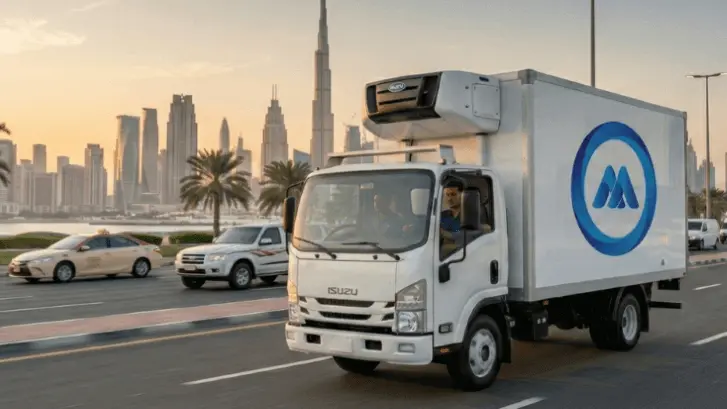 Abu Dhabi
Chiller Truck Rental Abu Dhabi
ADAFSA and ASATEEL-compliant truck rentals for Mussafah, KIZAD, Khalifa City, and Al Ain.
View Service
Dubai
Chiller Truck Rental Dubai
3-Ton to 10-Ton refrigerated trucks for supermarket, pharma, and wholesale distribution.
View Service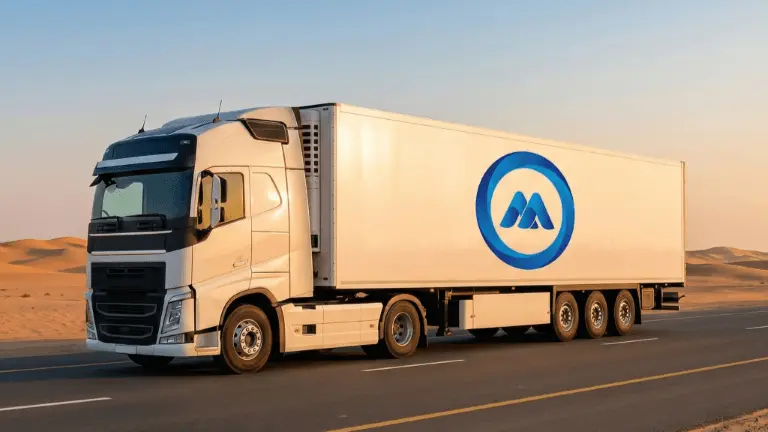 Cross-Border
Chiller Trailer Rental Dubai
20-Ton and 25-Ton reefer trailers for port clearances, warehouse transfers, and GCC routes.
View Service Last-Mile
Chiller Van Rental Dubai
1-Ton and 1.5-Ton chiller vans for last-mile cold chain, catering, and pharmacy routes.
View Service