The UAE’s cut flower market is worth more than AED 200 million a year, and the Dubai Flower Centre alone handles between 150,000 and 300,000 metric tonnes of floral cargo annually. None of that volume is forgiving of a broken cold chain. A refrigeration failure that merely shortens the shelf life of fresh produce will cause immediate, irreversible damage to cut flowers — often within two to four hours of exposure to ambient heat that regularly exceeds 45°C to 50°C in a UAE summer. Flowers do not have the buffer that food has. They are living, respiring tissue with no root system left to replace lost water, and the last-mile delivery van is consistently the weakest link in an otherwise highly engineered supply chain.
Why Flowers Fail Faster Than Food in UAE Heat
Temperature directly controls a flower’s metabolic rate. For every 5.5°C drop in temperature, a flower’s respiration rate roughly halves, conserving the limited sugar reserves it has left after being cut. Run that in reverse and the UAE’s summer becomes genuinely destructive: a rose held at 30°C ages approximately 26 times faster than the same rose held at an optimal 1°C. Heat stress also triggers the release of ethylene gas — an aging hormone that is contagious within a confined cargo space. A single heat-stressed bloom releasing ethylene will accelerate aging in every other flower stacked around it, turning one bad bucket into a ruined shipment.
The floral logistics industry quantifies this cumulative damage using degree-hours — average temperature multiplied by hours of exposure. As a rule of thumb, every 500 degree-hours a shipment accumulates costs roughly one full day of vase life. A van left on a 45°C Dubai loading dock for even 20 minutes can rack up destructive degree-hours far faster than the same exposure in a temperate climate, which is why rapid pre-cooling and an unbroken cold chain are non-negotiable rather than best practice. Abrupt temperature swings also cause thermal shock: the stem reacts by bleeding sap to seal its cut end, or drawing in an air embolism that blocks the xylem and prevents the flower from rehydrating at all — permanent damage that no amount of post-delivery water can reverse.
The Hidden Variable Most Operators Miss: Vapor Pressure Deficit
Temperature alone does not explain why flowers wilt so fast in the UAE. The more precise driver is Vapor Pressure Deficit — the gap between how much moisture the surrounding air could hold at saturation and how much it actually holds. Hot, dry air has a very high deficit, and it acts like an evaporative vacuum, pulling moisture out of petals and leaves far faster than a severed stem can draw water up to replace it. This is also why aggressively air-conditioned vehicles or showrooms can dry out flowers almost as fast as the open desert air outside — cold is not the same as humid. It is also why a bridal bouquet held against the body for an hour wilts faster than the same bouquet sitting in a bucket: localized body heat raises the vapor pressure deficit right at the flower’s surface.
Temperature and Humidity Requirements by Flower Type
Treating every flower the same is the single most common and most damaging mistake in floral transport. Temperate species need near-freezing conditions to suspend their metabolism; tropical species suffer chilling injury — translucent, water-soaked patches and blackened tips — if held below about 10°C.
| Flower Type | Optimal Temperature | Relative Humidity | Typical Vase Life (Cold Chain Maintained) | Handling Notes |
|---|---|---|---|---|
| Roses | 1°C to 4°C | 90–95% | 7–14 days | Highly sensitive to ethylene and thermal shock; strict pre-cooling required |
| Tulips | 0°C to 2°C | 95% | 5–8 days | Bloom rapidly and irreversibly if ambient exceeds 4°C in transit |
| Lilies | 2°C to 4°C | 90–95% | 10–14 days | Bruise easily; transport upright to avoid pollen shedding |
| Carnations | 0°C to 2°C | 90–95% | 14–21 days | Tolerant of low temperatures but highly sensitive to ethylene |
| Hydrangeas | 2°C to 4°C | 90–95% | 6–8 days | Extremely sensitive to vapor pressure deficit; desiccates fast in dry airflow |
| Orchids (tropical) | 10°C to 15°C | 80–85% | 14–21 days | Chilling injury and irreversible browning below 10°C |
A general 2°C to 8°C chiller setting works as a rough baseline for mixed retail deliveries, but any wholesaler or event company regularly moving tropical and temperate stems together needs a vehicle that can hold two zones at once, not one compromise temperature that mildly damages both.
Why a Standard Food Chiller Van Wilts Flowers
Refrigeration units built for food transport are designed to actively pull moisture out of the cargo air — turbulent, high-velocity circulation that keeps packaging dry and limits surface microbial growth. Applied to cut flowers, that same airflow acts as a mechanical desiccant, stripping moisture from petals and accelerating exactly the wilting it should be preventing. A floral-spec chiller does the opposite: it preserves humidity in the 80% to 95% range and uses gentle, dispersed (laminar) airflow that cools the cargo without blasting cold air directly onto petals or creating bruising micro-currents and thermal hot pockets.
Given the thermal load of a UAE summer, the vehicle’s insulation matters as much as the refrigeration unit. Serious floral fleets specify around 80mm of high-density polyurethane core insulation, giving roughly R-30 thermal resistance against ambient heat penetration through the body panels. Wholesalers and event companies that regularly move both tropical and temperate flowers together use partition vehicles with adjustable bulkheads, compression thermal-break seals, and dual evaporators — letting one vehicle run a 70/30 split, for example 2°C on one side for roses and 12°C on the other for orchids, without temperature bleeding between zones.
The 20-Minute Rule: Loading and Door-Opening Risk
Industry guidance is consistent: flowers should not sit outside refrigeration for more than about 20 minutes at any stage of the journey. In UAE summer heat that window is effectively shorter. This makes the loading dock and the multi-stop delivery route the highest-risk points in the entire chain — not the refrigerated drive in between.
- Pre-cool the cargo bay for 30 to 45 minutes before the first bucket is loaded. Loading warm flowers into a vehicle that has not reached target temperature triggers thermal shock the refrigeration unit may never fully recover from.
- Load in the early morning wherever possible, ahead of peak ambient heat and direct sun load.
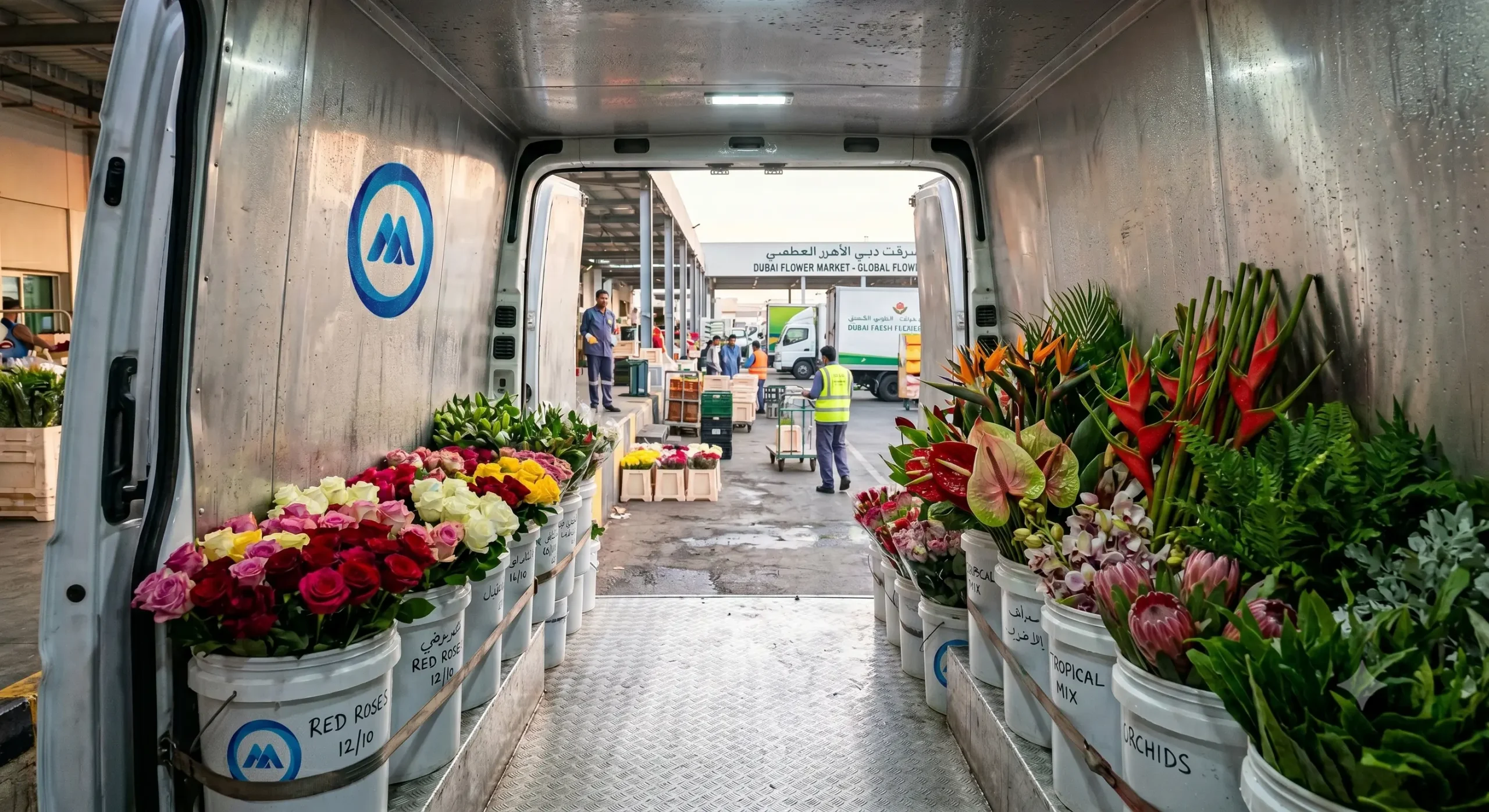
- Leave space between buckets. Tightly packed flowers generate their own “organic heat” through respiration — a dense load can incubate itself from the inside even while the refrigeration unit runs correctly.
- Minimize door-open time per stop on multi-drop routes; stage buckets in delivery order so each stop takes seconds, not minutes.
Inside the UAE’s Floral Supply Network
The UAE imports heavily from Kenya for premium roses, Colombia for hydrangeas, and the Netherlands for tulips and rarer varieties, feeding both domestic demand and a significant re-export trade across the region. The hub for all of it is the Dubai Flower Centre at Dubai International Airport, a roughly $50 million, 34,000-square-metre bonded facility built specifically to eliminate cold chain gaps. Pallets move from the aircraft directly into +2°C to +4°C climate-controlled zones via high-speed roller beds, typically clearing the airside-to-cold-storage transfer in under 90 minutes — a deliberate design choice to minimize degree-hour accumulation before the flowers ever reach a delivery van.
From there, flowers move into the domestic wholesale network concentrated around Ras Al Khor and Al Aweer, adjacent to Dubai’s central Fruit and Vegetable Market, where most wholesale importers operate cold storage and supply retail florists, event planners, and hotels. The Al Warsan district near International City is Dubai Municipality’s designated trading zone for nurseries, wholesale botanical supplies, and landscaping materials. Both zones depend entirely on chilled road transport to move stock the final stretch — the same vans and trucks covered in this guide.
Valentine’s Day and Peak Season: Why UAE Florists Cannot Own Enough Capacity
| Occasion | Demand Spike | Notes |
|---|---|---|
| Valentine’s Day (Feb 14) | +400% to +500% | Dominated by red roses; local cargo handlers have processed over 227,000 kg in 5 days, peaking at 60,000 kg in a single day. Wholesale stem prices can spike over 120%. |
| Mother’s Day (Mar 21 & May 10) | +200% to +300% | The UAE observes both Arab Mother’s Day (March 21) and International Mother’s Day (May 10), creating two separate spring demand peaks rather than one. |
| Wedding Season (Nov–Apr) | Sustained +150% | Cooler outdoor weather drives demand for premium blooms and large structural installations, with near-zero tolerance for delivery delay or visible damage. |
A florist who buys a van sized for a +500% Valentine’s Day spike has an expensive asset sitting idle the other 360 days of the year. A florist who doesn’t simply cannot move the volume when it matters most. The standard fix across the UAE market is renting extra chiller van capacity specifically for these peak windows: a daily-rate chiller van rental in Dubai from AED 350/day for two or three peak weeks costs a fraction of owning a second vehicle that depreciates for the rest of the year.
Multi-Stop Event and Wedding Delivery Risk
Event florists and wedding planners carry a different risk profile from retail flower shops. Large structural installations — flower walls, arches, and oversized centerpieces — often require a 3-ton to 10-ton refrigerated truck with a hydraulic tail lift rather than a van, simply to move the weight and bulk safely. Standing arrangements still fitting in a van benefit from a high-roof chiller van configuration so the top of the display isn’t crushed against the cargo ceiling. For multi-venue routes, sequencing the most time- and temperature-sensitive deliveries first — weddings ahead of more forgiving retail drops — keeps the highest-value cargo in cold storage for the shortest possible time.
Regulatory Compliance: MOCCAE, Phytosanitary Permits, and the DM Card
Importing cut flowers commercially requires a Phytosanitary Import Permit from the Ministry of Climate Change and Environment before placing an order with an overseas farm, plus an original Phytosanitary Certificate from the exporting country confirming the shipment is free of quarantine pests. Dubai Municipality and Dubai Customs verify these documents against the physical shipment on arrival; any mismatch results in rejection or destruction at the importer’s expense.
Once cleared, moving flowers domestically brings a second layer of compliance that matters just as much operationally: every commercial vehicle transporting perishables in Dubai needs a valid Dubai Municipality Card (DM Card). This is not paperwork that only matters in an audit — it is an active gatekeeper. Security at a luxury hotel, hospital, or major event venue will check a delivery van’s DM Card at the gate, and a vehicle without current certification can be refused entry regardless of how well the flowers inside have been kept. For deliveries crossing into Abu Dhabi, ADAFSA-compliant chiller van rental in Abu Dhabi with active ASATEEL GPS registration applies the same principle across the emirate border, and Al Ain’s growing local floriculture and agriculture sector is increasingly served by chiller van rental in Al Ain for farm-to-retailer routes.
Matching Vehicles to Customer Segments
| Segment | Core Requirement | Typical Pain Point |
|---|---|---|
| Retail florists | Nimble 1-ton to 1.5-ton chiller vans for high-frequency multi-stop city deliveries | Scaling last-mile capacity during Valentine’s Day and Mother’s Day without breaking the cold chain |
| Event & wedding planners | 3-ton to 10-ton trucks with tail lifts for flower walls, arches, and bulk centerpieces | Preventing thermal shock when loading at exposed outdoor or beach venues |
| Hotel F&B departments | Strict, repeatable delivery scheduling with full regulatory compliance | Receiving-bay audits — vehicles without a valid DM Card are turned away regardless of cargo condition |
Pre-Delivery Checklist for Florists and Event Planners
- Pre-cool the cargo bay to target temperature 30–45 minutes before the first bucket is loaded.
- Separate tropical flowers from temperate flowers, or use a partitioned multi-temperature vehicle if both travel together.
- Confirm the rental provider’s humidity setting is configured for floral cargo, not left at a standard food-chiller default.
- Leave airflow space between buckets — dense loads generate their own heat through respiration.
- Stage deliveries in route order before loading so door-open time per stop stays under a minute.
- For peak weeks (Valentine’s Day, both Mother’s Days, wedding season), book rental capacity at least 2 weeks ahead — fleet availability tightens fast across the UAE market.
Manchu Transport supplies chiller vans and trucks for florists, event planners, and floral wholesalers across Dubai, Abu Dhabi, and Al Ain, with daily, weekly, and monthly contracts available to match both everyday routes and seasonal surges. Get a quote for your next delivery run or peak-season capacity.
Frequently Asked Questions
What temperature should a flower delivery van be set to?
Most temperate cut flowers (roses, carnations, chrysanthemums) need 2°C to 4°C with 85–95% humidity. Bulb flowers like tulips need it as low as 0°C to 2°C. Tropical flowers such as orchids need a much warmer 10°C to 15°C, since they suffer chilling injury below about 10°C.
Why can’t I just use a regular food chiller van for flower delivery?
Food refrigeration units are built to actively dehumidify the cargo air, which keeps packaged food dry but strips moisture from flower petals and accelerates wilting. Flowers need a vehicle configured to preserve high humidity (80–95%) with gentle airflow instead.
Can the same chiller van carry both tropical and non-tropical flowers?
Only safely with a multi-temperature partition vehicle. A single-temperature van set cold enough for roses will damage chilling-sensitive tropical flowers like orchids.
How much does flower delivery van rental cost in Dubai?
Daily chiller van rental for floral delivery starts from AED 350/day for a standard 1-ton van and AED 400/day for a high-roof 1.5-ton van suited to standing arrangements and wedding arches. Larger structural installations may need a tail-lift truck instead.
Do I need a refrigerated van for a single wedding or event?
Yes, if arrangements will be outside cold storage for more than about 20 minutes, which is almost guaranteed once travel time and venue setup are included, especially in UAE summer heat.
Need Reliable Refrigerated Transport?
Get a free quote for chiller van, truck, or trailer rental in Dubai and across the UAE.
Get a Free QuoteRecommended Services
Our Refrigerated Transport Services
Choose the vehicle that matches your route, payload, and temperature requirements.
 Last-Mile
Chiller Van Rental Dubai
1-Ton and 1.5-Ton chiller vans for last-mile cold chain, catering, and pharmacy routes.
View Service Abu Dhabi
Chiller Truck Rental Abu Dhabi
ADAFSA and ASATEEL-compliant truck rentals for Mussafah, KIZAD, Khalifa City, and Al Ain.
View Service
Dubai
Chiller Truck Rental Dubai
3-Ton to 10-Ton refrigerated trucks for supermarket, pharma, and wholesale distribution.
View Service Cross-Border
Chiller Trailer Rental Dubai
20-Ton and 25-Ton reefer trailers for port clearances, warehouse transfers, and GCC routes.
View Service