
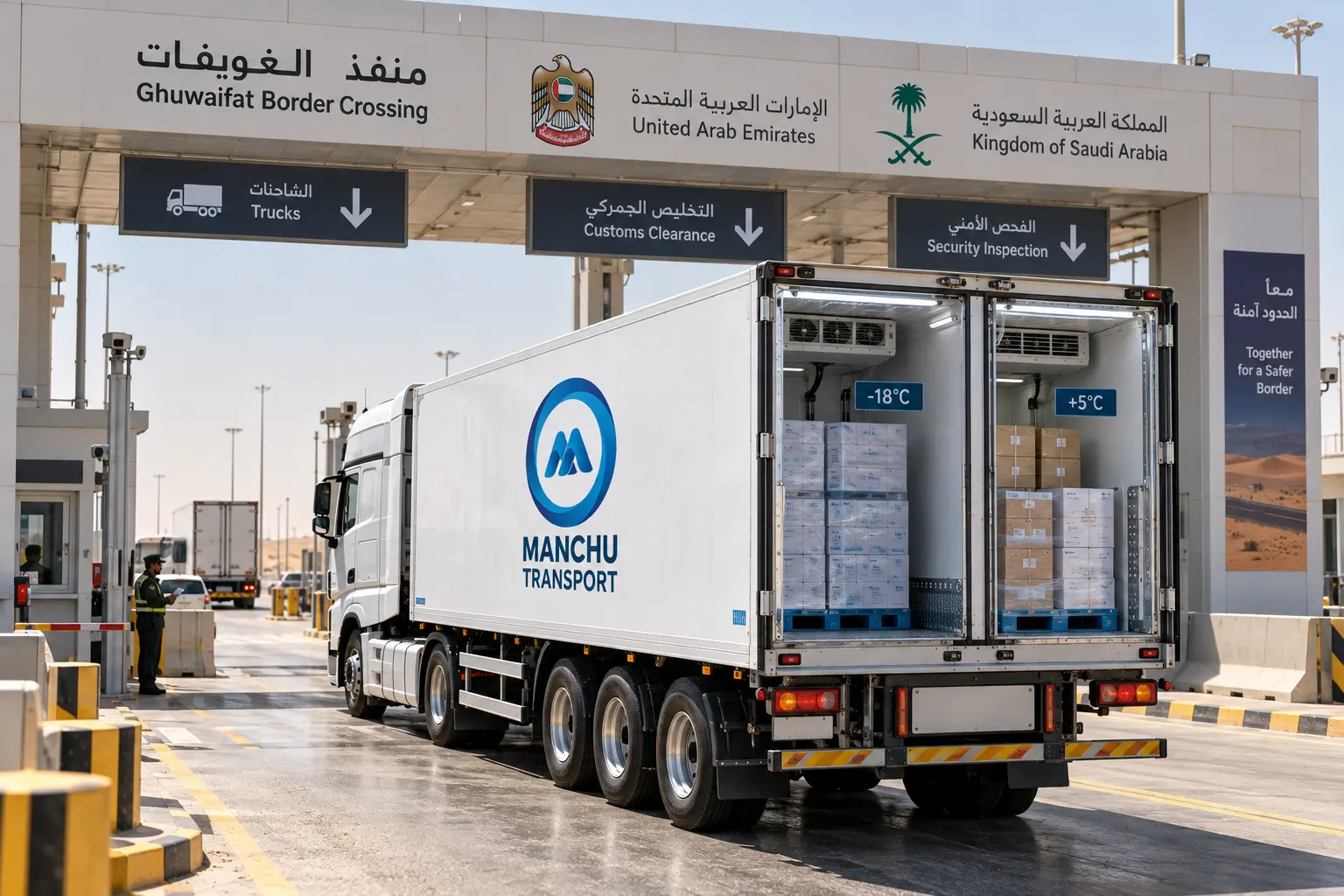
The Gulf Cooperation Council (GCC) functions as a deeply intertwined economic bloc, representing a rapidly expanding hub for regional trade and supply chain modernization. However, beneath the surface of this economic unity lies a highly complex cross-border logistics network defined by geographical bottlenecks, varying customs protocols, and rigorous import regulations.
As GCC nations—particularly the Kingdom of Saudi Arabia (KSA) and the UAE—aggressively pursue national visions centered on food security and pharmaceutical self-sufficiency, the demand for precise, uninterrupted cold chain logistics has surged dramatically. Executing these international movements involves navigating severe operational stressors, the most formidable of which is the transit corridor connecting the UAE to Saudi Arabia via the Al Ghuwaifat-Batha border crossing.
The Ghuwaifat-Batha Border Bottleneck
The Ghuwaifat-Batha border has historically functioned as a severe logistical choke point. Heavy commercial traffic, complex physical inspection requirements, and chronic shortages of available flatbed and reefer trailers frequently create embedded delays, leaving transport vehicles idling in queues stretching for miles across the desert.
The operational physics of a stationary refrigerated truck in this environment are brutal. When a vehicle idles on sun-baked asphalt in temperatures exceeding 50°C, the refrigeration unit is entirely deprived of the dynamic aerodynamic airflow generated during highway transit. This stagnation places immense thermal strain on the compressor and condenser, forcing the system to consume massive amounts of diesel simply to fight penetrating radiant heat.
Every additional hour spent awaiting customs clearance exponentially amplifies:
- Risk of temperature excursions
- Cargo contamination and pathogenic growth
- Systemic refrigeration unit failure
- Compressor burnout and replacement costs (AED 4,000–AED 9,000)
- Total cargo loss and financial liability
Saudi Food and Drug Authority (SFDA) Enforcement
Border delays are intrinsically tied to the strict, layered import controls enforced by the Saudi Food and Drug Authority (SFDA). The SFDA does not rely on a single point of approval; rather, it utilizes a comprehensive, multi-tiered security apparatus encompassing:
- Pre-shipment documentation reviews
- Exhaustive border inspections
- Targeted laboratory testing at clearance units located directly within ports of entry
- Halal certification verification (mandatory since November 2020)
- Traceability and origin documentation validation
Exporters moving goods from the UAE into Saudi Arabia must ensure flawless alignment of commercial invoices, certificates of origin, and highly specific food labeling requirements.
Halal Certification Mandate
Since November 2020, Saudi Arabia has mandated uncompromising Halal certification protocols for all imported meat and poultry shipments, governed under regulations SFDA.FD/GSO 2055-1 and SFDA.FD/GSO 993. Discrepancies in these certifications, or any failure to strictly adhere to SFDA’s transportation and storage codes, lead to devastating outcomes.
If a shipment is deemed non-compliant, the SFDA strictly mandates:
- Immediate rejection of the entire shipment
- Forced re-exportation back to the UAE
- Total destruction of the goods
The financial liabilities associated with a rejected shipment of high-value pharmaceuticals or perishable foods are immense, placing overwhelming pressure on exporters to ensure perfection in both documentation and thermal consistency.
Commodity-Specific Temperature Requirements for GCC Export
The precision required for thermal consistency varies wildly depending on the specific export commodity. Different products demand fundamentally different atmospheric conditions to prevent irreversible biochemical degradation.
Seafood and Meat
These commodities represent the highest risk of rapid pathogenic proliferation. Raw fish and fresh seafood must be strictly maintained in a chilled environment below 4°C. If temperature breaches this threshold, dangerous bacterial growth accelerates instantly, rendering cargo toxic. Deep-frozen goods (shrimp, frozen meats, frozen poultry) require high-performance compressors capable of sustaining uninterrupted internal temperatures of -18°C or lower throughout the entire border transit.
Dairy Products
Dairy exports (milk, specialty cheeses, yogurts) require a delicate, stable thermal band ranging from +2°C to +8°C. Fluctuations outside this range induce enzymatic breakdown, texture separation, and bacterial souring—rendering the entire shipment unsaleable.
Floriculture (Cut Flowers)
Flower logistics are uniquely demanding. To slow cellular respiration and suppress ethylene gas production (which accelerates senescence and petal drop), fresh cut flowers must be meticulously held between 1°C and 3°C. Beyond temperature control, the floral cold chain requires:
- Sophisticated environmental management
- Continuous airflow ventilation
- High relative humidity to prevent rapid water loss
- Strict “degree-hour” tracking (a mere 10 minutes of ambient heat exposure can permanently destroy shelf life)
| Commodity | Required Temperature | Critical Risk | Border Delay Impact |
|---|---|---|---|
| Fresh Seafood | Below 4°C | Bacterial proliferation (3–5 hours to toxicity) | 2+ hour delay = cargo loss |
| Frozen Meat | -18°C or lower | Partial melting, refreezing, quality loss | 4+ hour delay = degradation |
| Dairy | +2°C to +8°C | Enzymatic breakdown, souring | 3+ hour delay = fermentation |
| Cut Flowers | 1°C to 3°C | Ethylene damage, petal drop | 30 min ambient = shelf-life loss |
The Strategic Shift: Multi-Zone Trailers vs Single-Temperature Trucks
To manage these highly divergent cargo requirements across unpredictable cross-border routes, logistics operators are fundamentally rethinking their asset strategies.
Historical Market: Single-Temperature Rigid Trucks
The regional market has been historically dominated by single-temperature rigid chiller trucks, accounting for approximately 72.35% of the Saudi Arabian refrigerated trailer market share in recent years. However, the operational inflexibility of a single-temperature rigid truck presents a massive logistical bottleneck.
If an exporter needs to service a client demanding both frozen seafood (-18°C) and fresh dairy (+4°C), relying on rigid trucks necessitates deploying two entirely separate vehicles. This approach:
- Doubles fuel expenditures
- Doubles required SFDA customs paperwork
- Doubles statistical risk of experiencing a border delay
- Doubles administrative overhead
- Reduces per-unit profitability dramatically
The Future: Advanced Multi-Zone Chiller Trailers
Consequently, the GCC logistics sector is experiencing a rapid strategic shift away from rigid trucks toward advanced, multi-zone, multi-temperature articulated chiller trailers. These sophisticated trailer systems represent the vanguard of cold chain modernization.
Multi-zone trailers utilize:
- Movable, heavily insulated bulkheads
- Sophisticated, multi-point air-blown evaporators
- Independent climate zone controls
- Digital temperature monitoring per compartment
- High-capacity refrigeration (Carrier or Thermo King T-Series systems)
This architectural innovation allows a logistics provider to load deeply frozen meats in the front compartment (nearest the primary cooling unit, regulated to -18°C), strictly regulated chilled flowers in a central compartment (+1°C to +3°C), and temperature-agnostic dry goods in the rear compartment (+15°C to +25°C)—all within a single transport manifest.
Asset Comparison: Operational & Financial Impact
| Metric | Single-Temperature Rigid Truck | Multi-Zone Chiller Trailer | Strategic Advantage |
|---|---|---|---|
| Operational Flexibility | Low (Restricted to one cargo type) | High (Frozen + Chilled + Dry simultaneously) | Trailer = 100% asset utilization |
| Border Crossing Efficiency | Poor (Requires multiple trucks for mixed loads) | Excellent (Consolidated paperwork and fuel) | Trailer = Single SFDA clearance |
| Fuel Cost per Unit | High (Two vehicles = 2x diesel) | Low (One trailer = consolidated consumption) | Trailer = 40–50% fuel savings |
| Gross Vehicle Weight Utilization | Moderate (Limited by single-temp constraint) | Excellent (Payload consolidation) | Trailer = +25% gross weight efficiency |
| Carbon Emissions (per ton cargo) | High (Multiple vehicles) | Low (Consolidated transport) | Trailer = 35–45% lower emissions |
| Border Delay Risk | High (2 vehicles = 2x inspection risk) | Low (Single vehicle clearance) | Trailer = 50% risk reduction |
| Market Trend | Losing Market Share | Rapid Expansion (20%+ annual growth) | Trailer = Future standard |
Consolidation Benefits: The Economic Case
This level of consolidation provides transformational advantages:
- Maximizes gross vehicle weight utilization: Multi-zone trailers achieve 90–95% cargo space utilization vs 70–75% for dual single-temperature trucks
- Drastically reduces carbon emissions: Per-ton emissions drop 35–45% by eliminating the need for dual-vehicle deployments
- Massively streamlines customs clearance: Unifying multiple commodity streams under a single transport manifest and SFDA documentation package reduces processing time by 2–4 hours at the Ghuwaifat-Batha border
- Reduces per-unit logistics costs: Fuel, tolls, driver hours, and administrative overhead are halved on a per-ton basis
- Provides unprecedented operational flexibility: Respond dynamically to customer demands across the GCC market without massive asset redeployment
The 2026 Reality: Market Trajectory and Strategic Imperatives
As the GCC continues to invest heavily in supply chain modernization, expanding logistics hubs, and upgrading road infrastructure, the reliance on high-capacity, multi-temperature trailer systems will become the baseline standard for cross-border profitability.
For logistics firms operating in the 2026 landscape, the transition from rigid trucks to advanced, telematics-enabled multi-zone trailers is not merely an operational upgrade. It is a critical strategic necessity to survive:
- The uncompromising regulatory demands of the SFDA
- The thermal realities of the Arabian peninsula (50°C+ ambient)
- Intense competitive pricing pressure in GCC markets
- Customer demand for consolidated, efficient cross-border logistics
Companies that continue to rely exclusively on single-temperature rigid trucks will find themselves increasingly marginalized, unable to compete against logistics providers wielding sophisticated, thermally flexible trailer infrastructure.
Frequently Asked Questions
Why do border delays at Ghuwaifat-Batha destroy refrigerated cargo?
When a refrigerated vehicle idles in 50°C+ heat without highway airflow, the compressor cannot overcome the thermal load. Every hour spent queuing forces temperatures toward excursion thresholds. For seafood and flowers, delays exceeding 2–4 hours result in total cargo loss.
What is the key advantage of multi-zone trailers over dual rigid trucks?
A single multi-zone trailer consolidates frozen, chilled, and dry cargo under one vehicle, one SFDA customs declaration, and one driver—eliminating the operational complexity and cost of dual-truck deployments. This reduces border processing time, fuel costs, and risk exposure by 40–50%.
Do SFDA regulations allow consolidated mixed-commodity shipments?
Yes, when the consolidated shipment is documented accurately on a single commercial invoice and SFDA import permit. Each commodity must remain in its designated temperature zone and be properly segregated to prevent cross-contamination.
What is the market share trend for multi-zone trailers in the GCC?
Multi-zone trailer adoption is expanding at 20%+ annually. Single-temperature rigid trucks are losing market share as exporters recognize the profitability advantage of consolidated, multi-temperature logistics.
Are multi-zone trailers more expensive than single-temperature trucks?
Initial capital cost is higher (approximately 15–20% premium). However, the operational savings in fuel, tolls, driver hours, and border processing time achieve payback within 18–24 months of continuous GCC cross-border operations.
Optimize Your GCC Export Strategy
The economic and regulatory case for multi-zone trailers is compelling. As the GCC continues to integrate its logistics networks, exporters leveraging advanced, multi-temperature trailer systems will dominate cross-border profitability while those relying on legacy single-temperature rigid trucks will face margin compression and competitive obsolescence.
For GCC cross-border cold chain logistics, contact Manchu Transport at +971 54 7171 345, email manchutransport@gmail.com, or WhatsApp. We operate 20–25 ton multi-zone reefer trailers for GCC export.
SFDA regulations, border procedures, customs requirements, and market infrastructure can change. Verify current compliance requirements with the Saudi Food and Drug Authority (SFDA) and Integrated Transport Centre (ITC) before each GCC cross-border shipment.
Need Reliable Refrigerated Transport?
Get a free quote for chiller van, truck, or trailer rental in Dubai and across the UAE.
Get a Free QuoteRecommended Services
Our Refrigerated Transport Services
Choose the vehicle that matches your route, payload, and temperature requirements.
 Cross-Border
Chiller Trailer Rental Dubai
20-Ton and 25-Ton reefer trailers for port clearances, warehouse transfers, and GCC routes.
View Service Dubai
Dubai
Chiller Truck Rental Dubai
3-Ton to 10-Ton refrigerated trucks for supermarket, pharma, and wholesale distribution.
View Service Last-Mile
Chiller Van Rental Dubai
1-Ton and 1.5-Ton chiller vans for last-mile cold chain, catering, and pharmacy routes.
View Service
Abu Dhabi
Chiller Truck Rental Abu Dhabi
ADAFSA and ASATEEL-compliant truck rentals for Mussafah, KIZAD, Khalifa City, and Al Ain.
View Service